
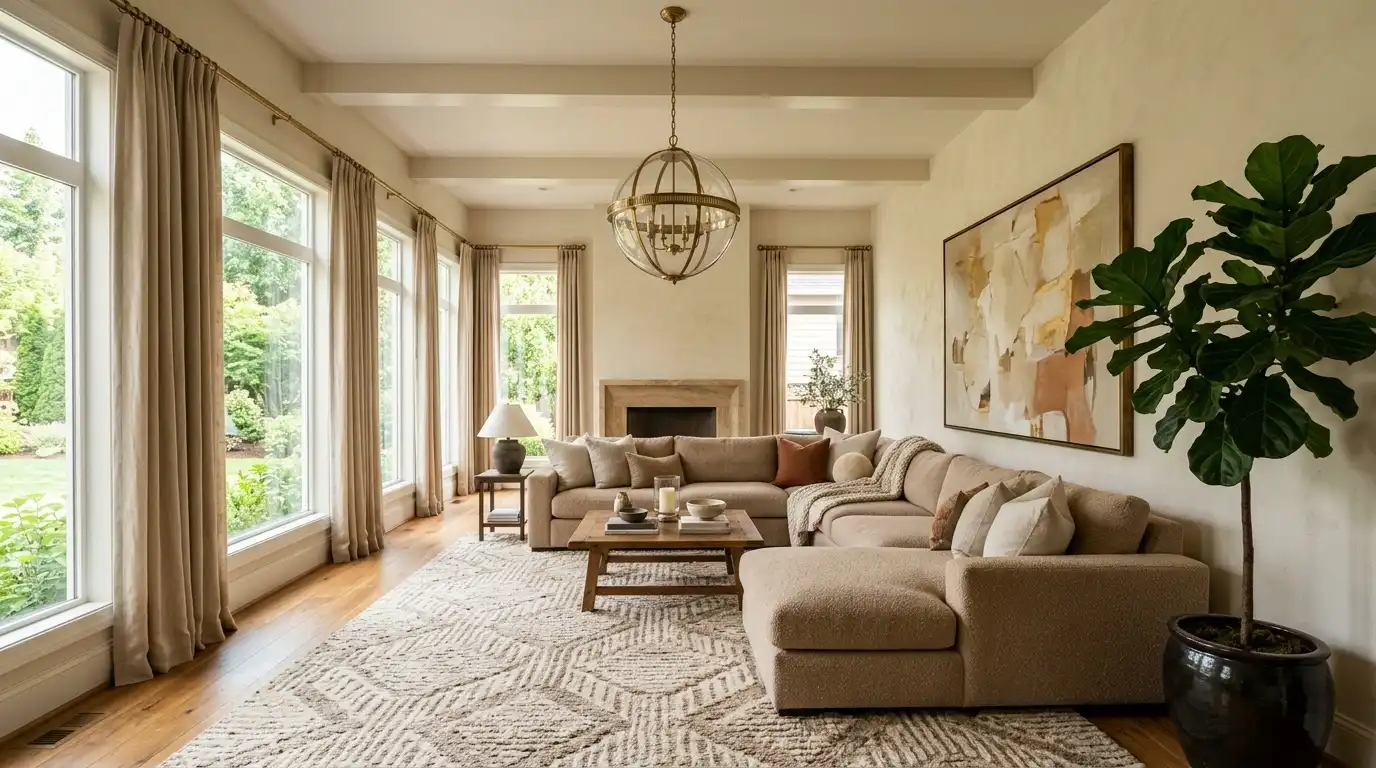
The short answer: To decorate a room with high ceilings, acknowledge the height but anchor the room at eye level. Use substantial furniture, hang lighting lower and in layers, add tall curtains and vertical accents, and soften hard surfaces with rugs and textiles so the room feels warm instead of hollow.
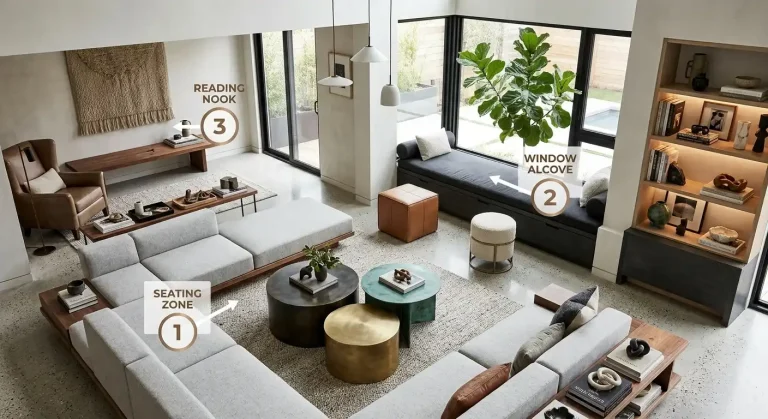
High ceilings add drama, but they can also leave a room feeling cold, echoey, or strangely empty. The height itself is rarely the problem. The problem is that furniture, art, and lighting are often sized for an 8-foot room. The steps below fix that in order. If you’re still planning the whole space, our living room decor ideas guide is a good companion read.
Start Here: What’s Your Problem?
| If your room feels… | Start with |
| Empty or too big | Step 1 (furniture), Step 2 (statement fixture), Step 9 (vertical accents) |
| Cold or cavernous | Step 3 (color), Step 5 (ceiling treatments), Step 8 (rugs and textiles) |
| Echoey | Step 6 (curtains), Step 8 (rugs and sound) |
| Dim at eye level | Step 4 (layered lighting) |
| Fine, but the walls are blank | Step 7 (walls and art) |
What Counts as a High Ceiling?
The standard ceiling height in most homes is about 8 feet (2.4 m). Ceilings of 9 feet are commonly described as high, and 10 feet or more is where scale problems become obvious. Vaulted, cathedral, and double-height spaces go further. The advice below works from 9 feet up and scales for taller rooms.
Why High Ceilings Are Hard to Decorate
Three things usually go wrong:
- Scale gap: Standard furniture looks small under a tall ceiling.
- Visual drift: With nothing to anchor the eye, attention floats up to a blank surface.
- Hard acoustics: More air volume and fewer soft surfaces means more echo.
Each step below targets at least one of these.
Step 1: Choose Furniture With Real Presence
A few substantial pieces work better than many small ones.
- Pick deeper sofas, high-back chairs, and tall bookcases or cabinets.
- Choose a coffee table with visual weight, not a thin, light one. Our guide to styling your coffee table like a pro shows how to balance it.
- Add height near the seating area with a tall plant, floor lamp, or console.
- Keep walkways clear so larger pieces don’t crowd the room.
Small room, high ceiling? You don’t need oversized furniture. Add height instead with tall shelving, a large leaner mirror, or a tall plant, and keep the seating proportionate to the floor space. For space-saving ideas, see living room storage ideas for small apartments.
Already own furniture? You can make existing pieces work with a few larger anchors. Here’s how to mix and match old and new furniture.
Step 2: Hang a Statement Fixture at the Right Size and Height
A large chandelier or pendant is the single most effective fix for a room that feels empty above.
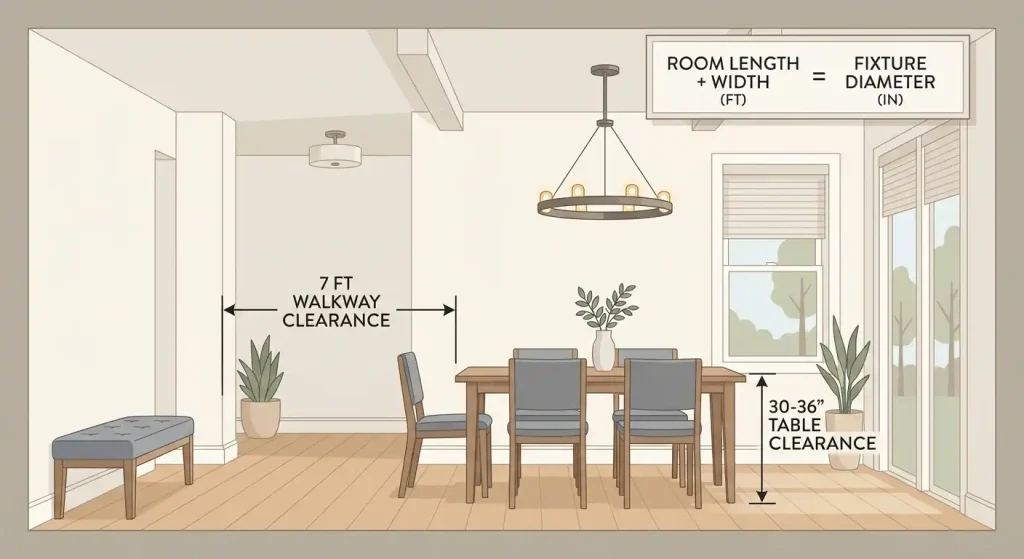
- Size: A common guideline is fixture diameter in inches ≈ room length + width in feet. A 12 x 16 ft room suggests a fixture about 28 inches wide. In a high-ceiling room, going a little larger usually looks better than going smaller.
- Over a dining table: Hang the bottom of the fixture about 30 to 36 inches above the table.
- In open spaces: Keep the bottom at least 7 feet above the floor where people walk.
- Drop length: A common rule adds about 3 inches of chain or stem for each foot of ceiling above 8 feet. Adjust by eye, since the goal is a fixture that relates to the furniture, not the ceiling.
Renters: A plug-in swag pendant with a ceiling hook gives you a statement fixture without wiring.
Step 3: Use Color to Set the Mood
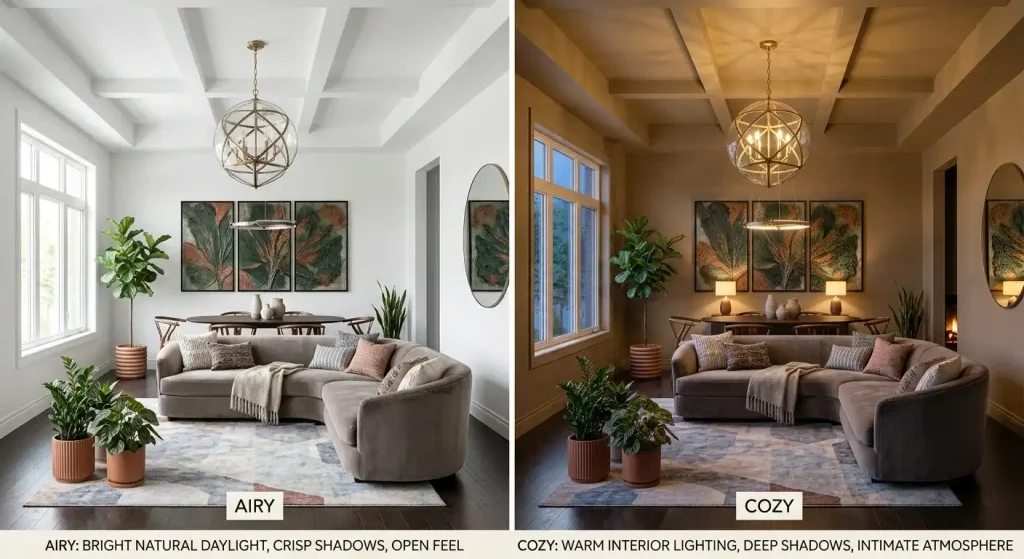
Decide your direction first:
| Goal | Best for | How |
| Embrace the height | Bright rooms with plenty of light | Light ceiling and walls, tall drapery, vertical elements |
| Make it cozier | Cold or cavernous rooms | Warmer or deeper wall color, darker ceiling tone, layered textiles |
Some practical guidance:
- Do high ceilings make a room look bigger? Yes, they make it feel more open and airy. That can also make it feel cold if the room has no warmth.
- Darker ceiling colors visually lower the ceiling. A soft, warm, or slightly darker ceiling tone brings the room in without closing it off. Color drenching (the same color on walls, trim, and ceiling) makes a tall room feel enveloping and rich.
- Two-tone walls (darker below, lighter above) ground the room. Place the dividing line, such as a chair rail, paint line, or paneling top, at roughly one-third to one-half of the wall height. Going higher makes the dark section overwhelming.
- Low natural light? Choose mid-tones or warm neutrals instead of very deep colors.
Not sure how to bring in color without overwhelming the room? See how to add seasonal color to a neutral home.
Step 4: Layer the Lighting
One overhead light leaves a tall room dim at eye level. Use three layers:
- Statement fixture (Step 2).
- Table and floor lamps to keep light at seating height.
- Wall sconces or picture lights to add warmth to tall walls.
Use warm-white bulbs (around 2700K) in living spaces.
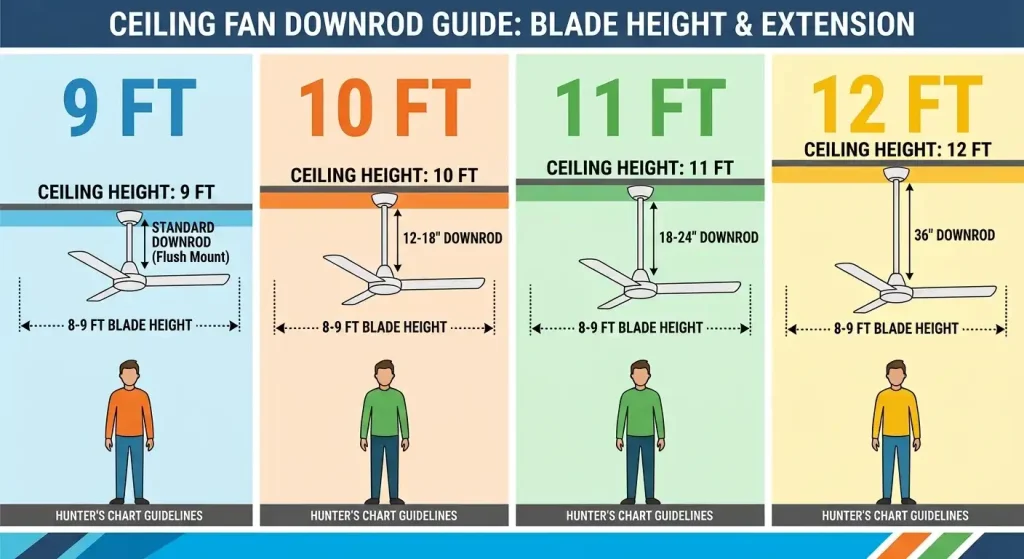
Ceiling fans: If you need a fan, the downrod length matters. A general guide from Hunter Fan suggests a standard downrod for 9 feet, 12 to 18 inches for 10 feet, 18 to 24 inches for 11 feet, and 36 inches for 12 feet. The aim is to place the blades roughly 8 to 9 feet above the floor. Check the fan’s manufacturer specifications before ordering.
Renters: Plug-in sconces and floor lamps give you layers without any wiring.
Step 5: Treat the Ceiling Itself
Most guides skip this, but the ceiling is the biggest surface in the room.
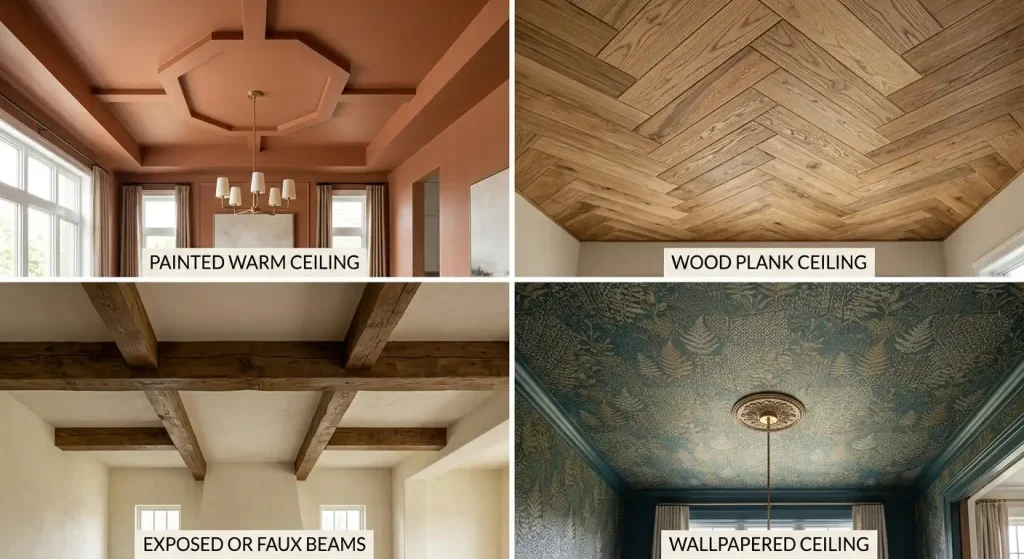
- Paint: A warm white, soft greige, or deeper tone changes the whole feel. Matte finishes hide imperfections.
- Wood or plank ceilings: Add warmth and texture.
- Exposed or faux beams: Break up the expanse and add a focal point.
- Wallpaper on the ceiling: Works well in bedrooms, entryways, and dining rooms. For pattern inspiration, browse these living room wallpaper ideas.
- Molding or coffers: Add architectural interest.
Renters: Removable wallpaper and lightweight faux beams can work if your lease allows. Otherwise, use the ceiling’s visual weight in other ways, like lower lighting and rugs.
Step 6: Hang Curtains High and Use Full Panels
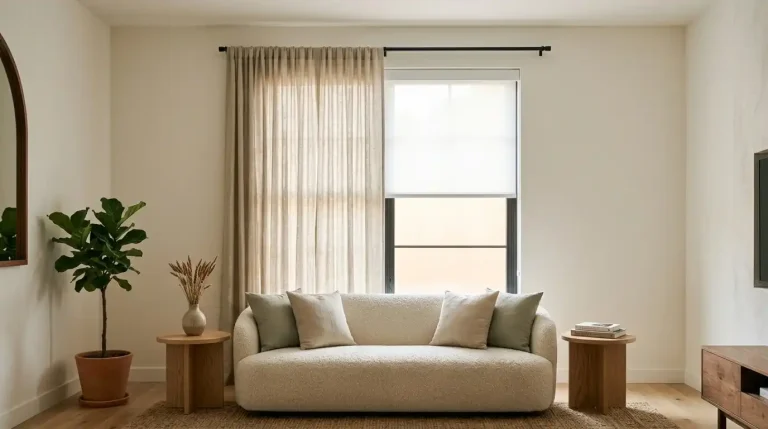
Mount the rod close to the ceiling or crown molding, not at the window frame. This lengthens the window and creates a taller, more intentional look.
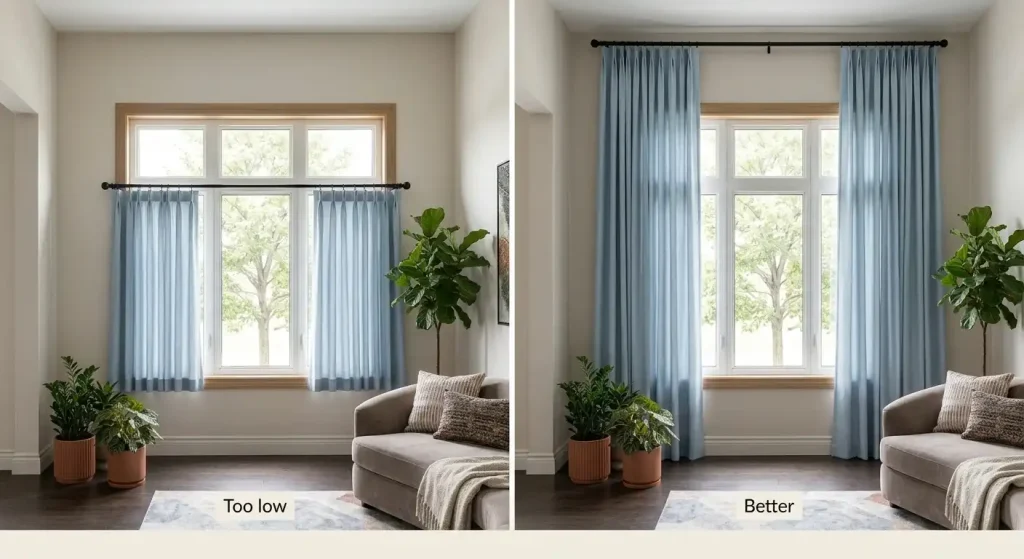
- Use floor-length panels, and make them full, at 2 to 2.5 times the width of the window.
- Length reality check: Standard store panels are often 84 or 96 inches. For high ceilings you’ll usually need 108 to 120 inches or more, and taller rooms may require custom curtains or adding a fabric extension at the top.
- Heavier, lined fabric improves the look and absorbs sound.
- Tall windows: For clerestory or arched windows, use shades or leave the upper portion uncovered and treat only the lower section for privacy.
Step 7: Decorate Tall Walls and Hang Art Correctly
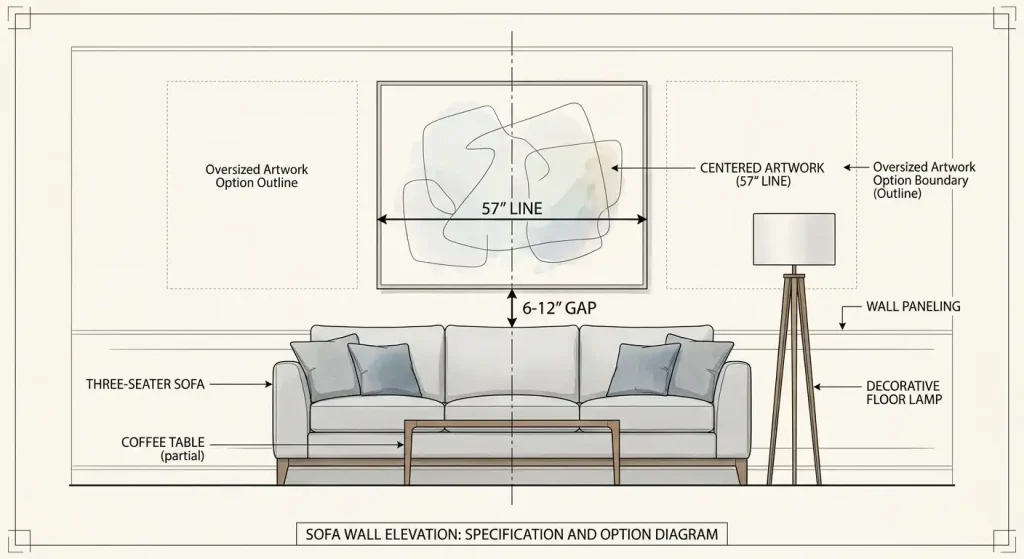
The classic gallery guideline is to center art at about 57 inches from the floor. In a high-ceiling room, that keeps art at human scale, but it can leave a large blank area above.
Use this approach:
- Anchor the art to furniture, not the ceiling. Above a sofa or console, leave about 6 to 12 inches between the furniture and the bottom of the frame.
- Size it up. Art should be roughly two-thirds to three-quarters of the furniture’s width.
- Fill the space above with one oversized piece, a vertical gallery arrangement, tall shelving, or architectural detail. Large-scale metal wall art is a strong option for tall walls.
- Large mirrors work well leaned against a wall or hung in a tall vertical format. They reflect light and add height.
- Fireplaces: Style the mantel with a tall mirror or oversized art, and add vertical elements on either side.
- Secure heavy mirrors and art into studs or use proper anchors.
Want built-in storage that draws the eye up? Try these DIY floating shelves.
Step 8: Ground the Room With Rugs and Soft Surfaces
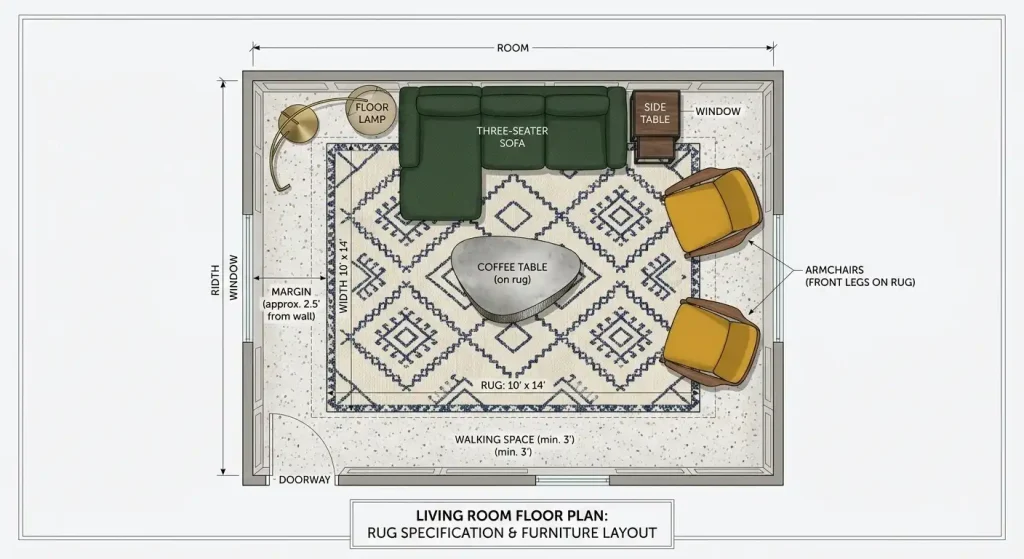
A large rug defines the seating area and reduces the floating feel. In a living room, an 8 x 10 or 9 x 12 rug is a common starting point, with at least the front legs of all seating on it.
Hard surfaces reflect sound, which makes tall rooms echo. Soft materials absorb it:
- Large rugs (thicker rugs and pads absorb more)
- Heavy, lined curtains
- Upholstered furniture
- Bookshelves filled with books
- Wall textiles, tapestries, or acoustic panels
Acoustic products are rated by NRC (Noise Reduction Coefficient), generally from 0 to 1, where higher means more sound absorption. Use it when comparing acoustic panels.
Step 9: Add Vertical Interest
Draw the eye up in a controlled way with elements that belong there:
- Tall plants (fiddle-leaf fig, olive tree, or a quality faux version)
- Floor-to-ceiling shelving or built-ins
- Picture molding or board-and-batten
- Pendant clusters or a woven light fixture
- A tall statement piece, such as a large ladder, screen, or leaning mirror
Leave some breathing room. You don’t need to fill every inch. For an awkward empty spot, see how to decorate an empty living room corner on a budget.
By Ceiling Type
- Vaulted or cathedral: Use a long-stem pendant or a large chandelier, and add a fan with a longer downrod. Tall drapery and a large rug help ground the room.
- Beamed: Let the beams be the feature. Keep the walls simpler and use warm lighting.
- Coffered: Paint the recesses a deeper color to add depth, and choose a statement fixture that suits the pattern.
- Tray: Highlight the recess with cove lighting or a slightly different paint color.
By Room
- Living room: Focus on furniture scale, a large rug, and layered lighting. Browse more living room decor ideas.
- Bedroom: Use a tall headboard, sconces, and a deeper wall or ceiling tone for a cozy feel. No headboard? See how to style a bed without a headboard, or explore bedroom decor ideas for every style.
- Kitchen: Tall cabinets or open shelving, plus pendants over the island. Try styling open shelving in a kitchen.
- Entryway or staircase: Use a long-drop chandelier and tall art or a gallery wall.
- Open-plan or loft: Zone areas with rugs, furniture groupings, and different lighting.
Budget and Renter Options
- Plug-in sconces and floor lamps
- Leaner mirrors and tall plants
- Removable wallpaper and peel-and-stick accents
- Larger rugs and heavier curtains
- Thrifted tall bookcases
For more low-cost projects, see our DIY home decor ideas.
Practical Considerations
- Heating and cooling: Warm air rises. In winter, run a ceiling fan clockwise on low speed to push warm air back down into the room.
- Cleaning and maintenance: Tall windows and fixtures are harder to reach. Choose easy-to-clean materials and consider an extendable duster or safe ladder.
- Safety: Use proper anchors for anything heavy on tall walls.
Common Mistakes to Avoid
- Buying small furniture that gets lost in the room
- Hanging art too high so it floats away from furniture
- Mounting curtains at the window frame
- Relying on one central light
- Skipping soft surfaces, which leaves the room echoey
- Choosing a chandelier that’s too small
Frequently Asked Questions
Do high ceilings make a room look bigger?
Yes. They make a room feel more open and airy, though the room may feel cold or empty without warm lighting, rugs, and furniture that fits the scale.
Should you paint a high ceiling dark?
You can. A darker ceiling visually lowers the height and makes the room feel cozier, especially in large or bright rooms. In a room with little natural light, choose a warm mid-tone instead.
How do you make high ceilings feel cozier?
Use warm wall or ceiling colors, layered lighting, a large rug, heavy curtains, and a statement fixture hung lower.
How high should you hang curtains with high ceilings?
Mount the rod close to the ceiling or crown molding and use floor-length panels, typically 108 to 120 inches or longer.
What size chandelier for a high ceiling?
A common rule is fixture diameter in inches ≈ room length + width in feet. For a high ceiling, go slightly larger, and hang it about 30 to 36 inches above a table or at least 7 feet from the floor in a walkway.
How do you decorate tall walls?
Use one oversized artwork, a vertical gallery arrangement, tall shelving, or architectural detail. Anchor art to furniture and secure heavy pieces properly.
How do you reduce echo in a high-ceiling room?
Add rugs, heavy curtains, upholstered furniture, filled bookshelves, and wall textiles or acoustic panels.
What is the best ceiling fan for high ceilings?
Choose a fan with a downrod long enough to place the blades 8 to 9 feet above the floor, such as a 12 to 18 inch downrod for a 10-foot ceiling.
Key Takeaways
- Acknowledge the height, but anchor the room at eye level.
- Use substantial furniture and a properly sized statement fixture.
- Layer lighting, and use a longer downrod for fans.
- Hang curtains near the ceiling and art in relation to furniture.
- Use rugs, drapery, and soft materials to control echo.
- Choose your direction, airy or cozy, before choosing colors.
Related Next Steps
- Living Room Decor Ideas: Put these principles to work across the whole room.
- How to Style Your Coffee Table Like a Pro: Finish the seating area once your furniture is in place.
- Living Room Wallpaper Ideas: Add pattern and warmth to tall walls or the ceiling.
- Metal Wall Art for a Modern Living Room: Fill tall walls with oversized statement pieces.
- Bedroom Decor Ideas for Every Style: Apply the same ideas to a high-ceiling bedroom.
Sources and References
- Apartment Therapy: Use the 57″ Rule To Hang Pictures at the Perfect Height: art centered at 57 inches
- Chairish: How High to Hang Artwork, a Designer’s Guide: 6 to 12 inch gap above furniture
- Ballard Designs: Chandelier Buying Guide: room-size formula, 30 to 36 inches above a table, 7 feet minimum clearance

Join the Conversation
What Do You Think?