
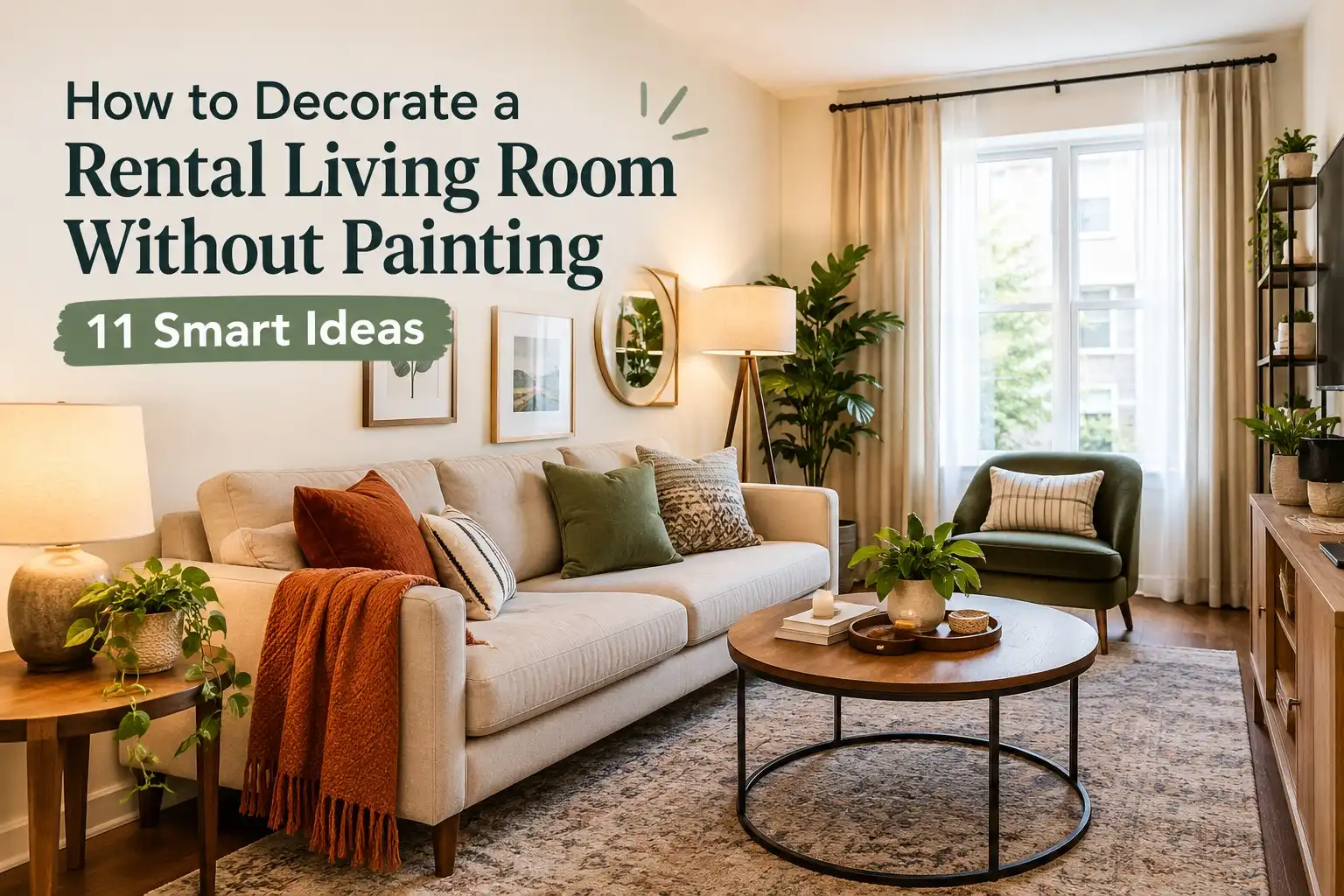
You do not need to paint your rental living room to make it feel finished.
When the walls are stuck in landlord white, beige, or another color you would never choose yourself, the better approach is to shift visual attention away from the wall color and build character through layers: rugs, curtains, lighting, art, mirrors, plants, furniture, and removable accents.
The important part is not simply finding things labeled “renter-friendly.” Your lease and the actual wall surface matter. Adhesive products can have surface and weight restrictions, and even removable wallpaper may not be suitable for textured or low-sheen walls.
So the goal is simple:
Make the room look intentionally designed while keeping every change as reversible as your rental requires.
Quick Answer
You do not need paint to change how a rental living room feels. The fastest wins usually come from a large area rug to anchor the space, layered lighting instead of one overhead fixture, textiles such as curtains and pillows for color, and renter-safe wall solutions such as leaning art or compatible removable hanging systems.
Furniture layout and a clear focal point can do more visual work than wall color. Start with the largest elements first, then add smaller accessories once the room’s foundation feels right.
The rest of this guide shows how to apply those changes while keeping your lease, wall surface, and deposit in mind.
The renter-friendly decorating rule that changes everything
Before buying decor, think about the room in terms of visual weight.
If you cannot change the walls, you do not have to fight them. Instead, give the eye other things to notice.
A useful order is:
Floor → windows → seating → lighting → wall decor → accessories
This works because large elements such as a rug, curtains, sofa, and lighting can change how the whole room feels without permanently changing its structure.
It also prevents a common rental-decorating mistake: buying ten small accessories because the walls still look empty.
One large rug and properly scaled curtains can do more visually than a collection of tiny decorations scattered around the room.
1. Start with a large rug, not small accessories
A rental living room can feel unfinished even when the furniture is perfectly good. One reason is that the seating area has no visual boundary.
A large area rug solves that without touching the walls.
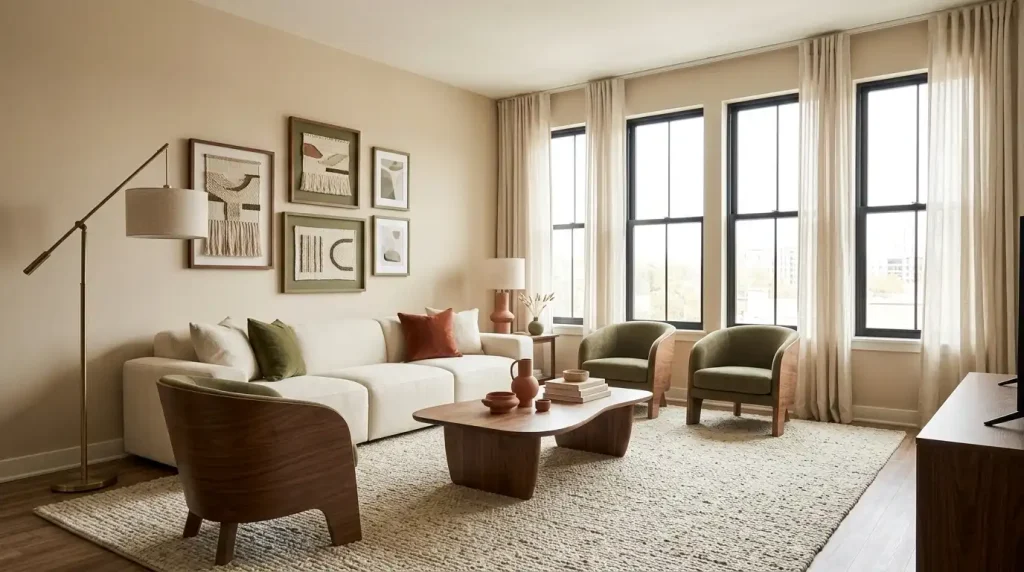
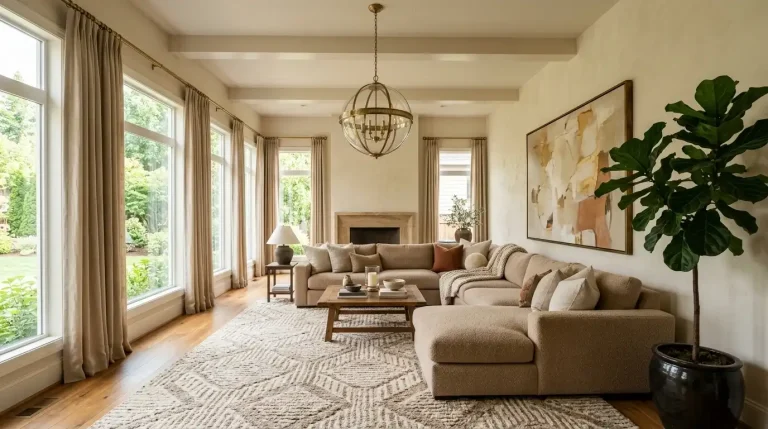
For most living rooms, look for a rug large enough to connect the main seating pieces rather than placing a tiny rug in the middle of the room. Ideally, the front legs of the sofa and chairs sit on the rug so the furniture reads as one conversation area.
If you have a small living room, you do not necessarily need an enormous rug. The important thing is that the rug relates to the furniture rather than floating independently in the center.
What the rug should add
Choose a rug that contributes at least one thing your rental currently lacks:
- Warmth if the room feels cold
- Pattern if the walls and furniture are plain
- Texture if the room feels flat
- Contrast if everything is the same neutral tone
- Color if you want personality without changing the walls
This is one of the safest rental updates because the rug comes with you when you move.
Instead of treating the rug as another decorative accessory, use it as the visual foundation of the room. Once its colors and texture are established, you can repeat small elements of that palette elsewhere.
For more ways to build a cohesive living room foundation, see our Living Room Decor Ideas.
2. Make the windows part of the design
Bare rental windows can make an otherwise comfortable living room feel temporary.
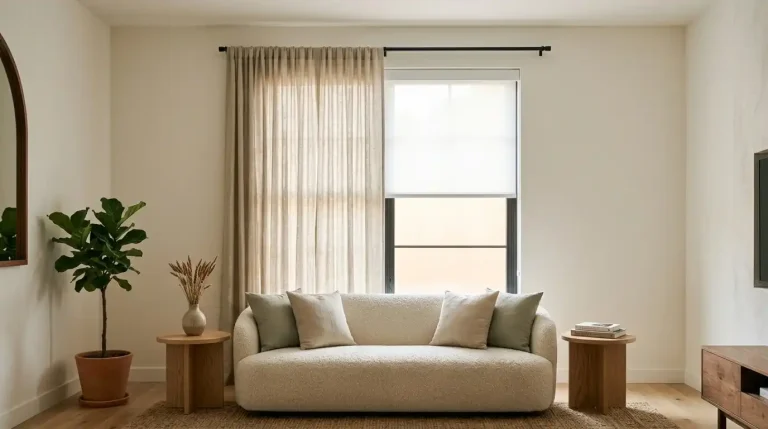
Curtains are useful because they add both softness and vertical emphasis without changing the wall itself.
If your rental allows a tension rod or another no-drill solution, use it where appropriate. If the lease permits standard hardware, follow those rules rather than assuming every rental must remain completely hole-free.
For the strongest visual effect, curtains generally look more intentional when they extend beyond the window rather than ending exactly at its edges.
Choose:
- Linen-look fabric for relaxed rooms
- Heavier curtains for a cozier atmosphere
- Light-filtering panels for bright rooms
- A simple solid color if you already have patterned furniture
- A subtle pattern if the rest of the room is quiet
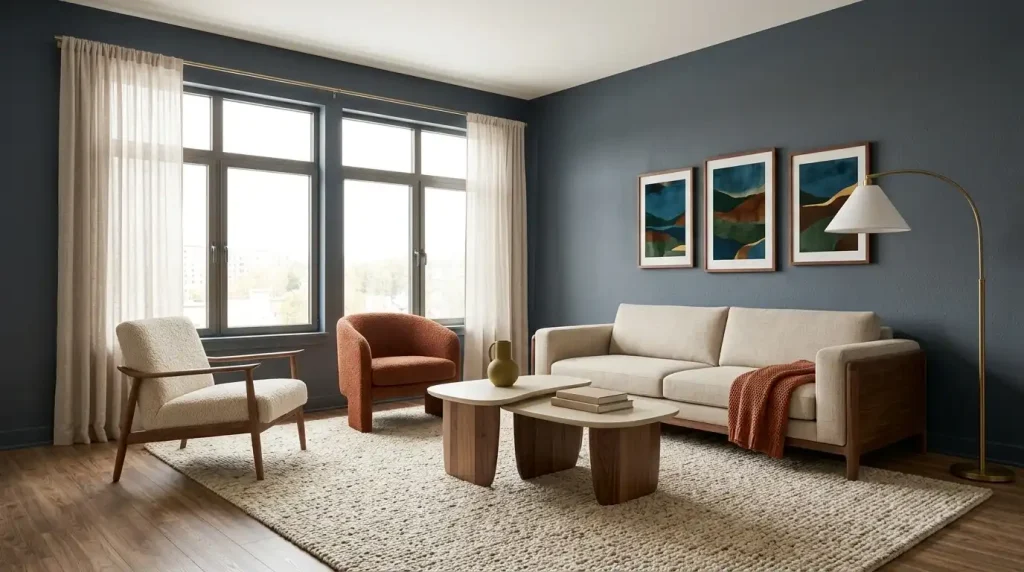
The curtain color can also become your substitute for a wall-color change.
For example:
Warm beige walls + terracotta curtains + cream rug + dark wood accents
creates a different atmosphere from:
Warm beige walls + sage curtains + natural fiber rug + pale wood
The wall stays exactly the same.
If you are deciding between window treatments, see Living Room Curtains vs. Blinds for more guidance.
3. Use lighting to change the mood instead of the wall color
If your rental has one harsh ceiling fixture, changing the lighting may have a greater effect than adding more wall decor.
Build at least two or three lighting levels where the room allows:
- General light: existing ceiling fixture
- Task light: table or floor lamp near seating
- Ambient light: another low-level lamp or suitable decorative light
Warm-toned bulbs can create a softer evening atmosphere, while brighter neutral light can be useful when you need the room for reading, working, or cleaning.
The important point is to avoid making every light serve the same purpose.
A floor lamp beside a sofa gives the seating area visual height. A table lamp adds a smaller pool of light. Together, they create depth that a single overhead fixture cannot provide.
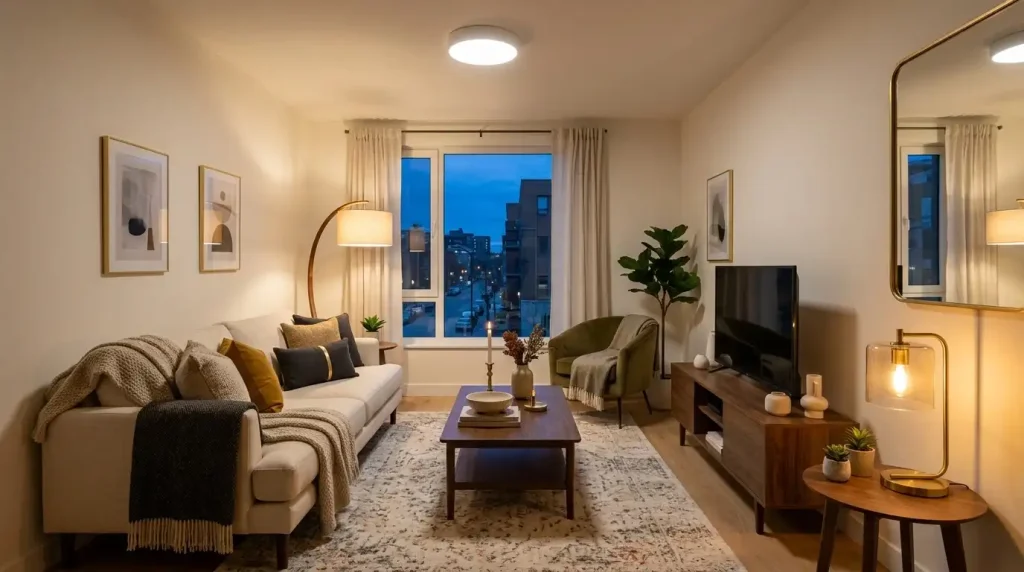
A renter-friendly lighting trick
If you cannot install new hardwired fixtures, look for plug-in lighting solutions that fit your lease and electrical setup.
Hide or organize visible cords rather than letting them become the new focal point. If the television is creating visual clutter, see How to Hide TV Wires and Cables in a Living Room.
4. Turn plain walls into a gallery without automatically drilling into them
You can add personality to rental walls, but “damage-free” does not mean “works on every wall.”
Before using adhesive strips, check:
- Your lease
- The wall surface
- The product’s instructions
- The weight of the item
- The removal instructions
The important question is not simply:
“Are Command strips renter-friendly?”
Ask instead:
“Is this particular wall, item, weight, and hanging method compatible with the product?”
That is a much safer way to approach rental decorating.
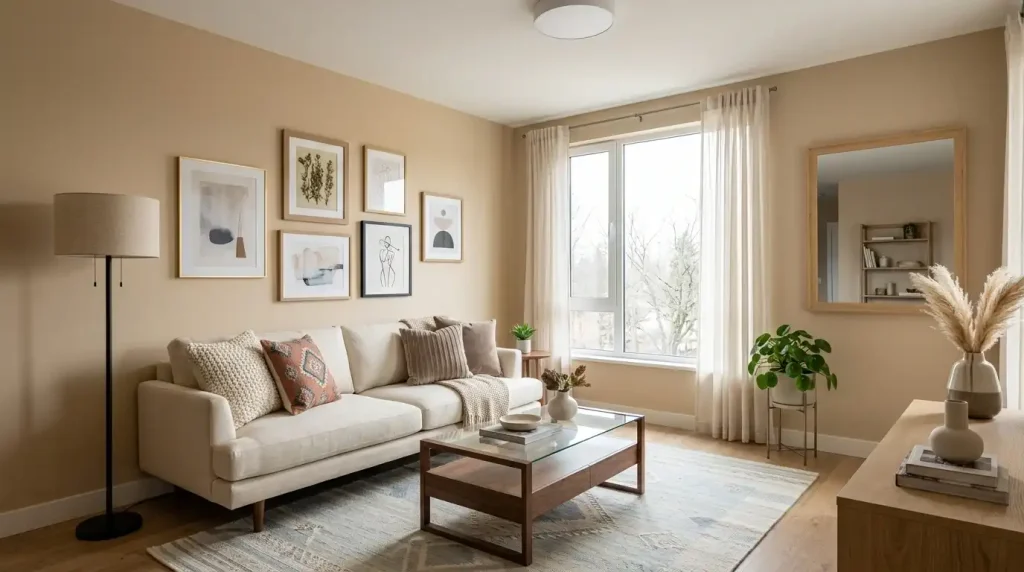
If your wall is suitable
Create a simple gallery wall using:
- Framed prints
- Personal photographs
- Small artwork
- Botanical illustrations
- Mirrors
- Lightweight decorative pieces
Keep the frames visually related rather than making every piece identical.
If you like the look of stronger statement pieces, you can also explore Metal Wall Art for Modern Living Rooms while keeping the actual wall weight and hanging method appropriate for your rental.
If your wall is not suitable
Move the artwork off the wall.
Lean large artwork against the wall, place smaller pieces on furniture, or use a freestanding shelf or bookcase as your display surface.
That gives you the visual effect without making the wall responsible for holding everything.
5. Use one large mirror as a focal point
A large mirror can solve several rental-living-room problems at once.
It can:
- Fill an awkward blank area
- Reflect available light
- Add vertical scale
- Become a focal point
- Make a small room feel less visually closed in
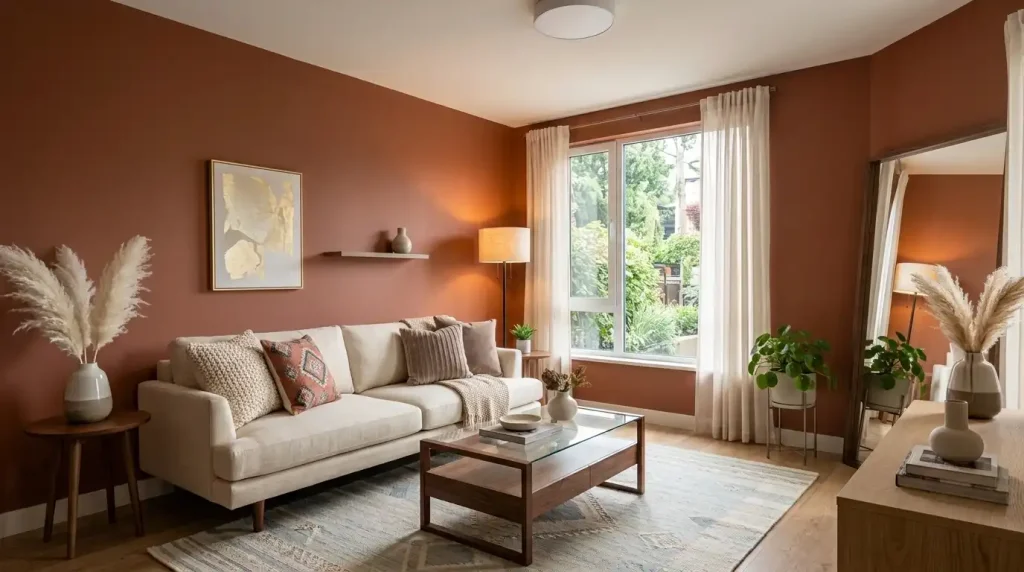
A leaning mirror is especially useful when you want to avoid wall hardware.
Place it where it reflects something worth seeing, such as a window, lamp, artwork, or attractive part of the room.
Avoid positioning it so that the first thing it reflects is a cluttered corner or the television unless that is intentional.
And if you have children, pets, or a high-traffic layout, make sure a leaning mirror is stable and appropriately secured according to the manufacturer’s instructions.
6. Add color through textiles instead of paint
If the biggest problem is “I hate these beige walls,” do not assume the answer is more beige decor.
Instead, introduce a controlled color palette through things you can take with you.
Start with two or three colors.
For example:
| Base | Accent | Supporting color |
| Cream | Terracotta | Olive |
| Warm beige | Deep blue | Walnut |
| Soft gray | Sage | Natural wood |
| White | Rust | Charcoal |
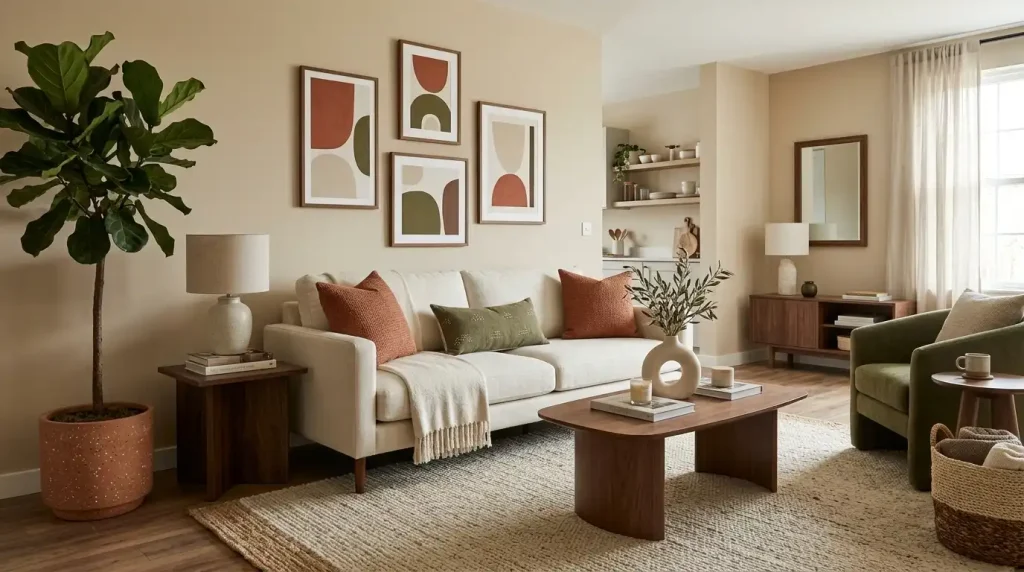
Then repeat those colors across different materials.
For example:
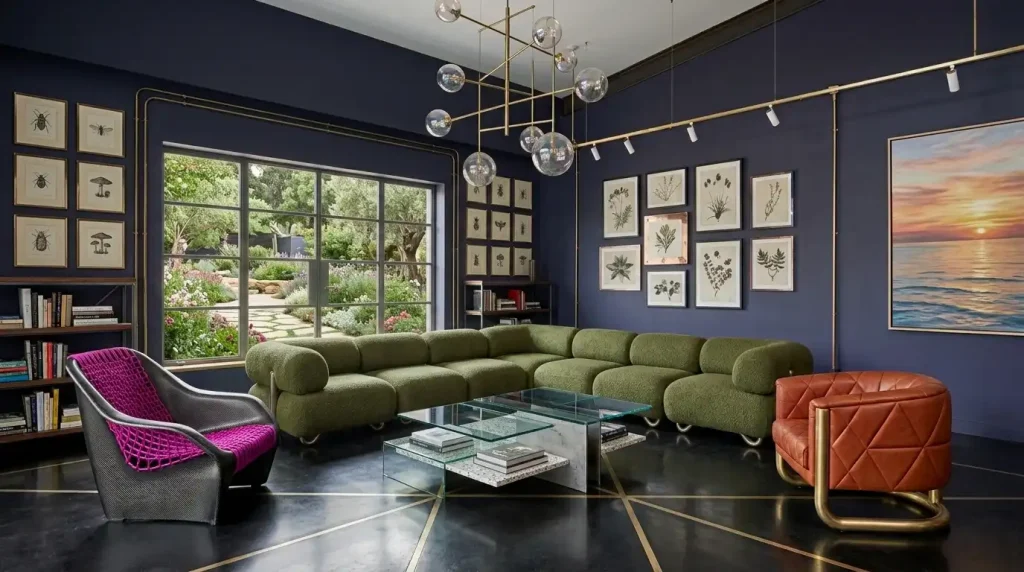
Sage cushion → sage-toned artwork → small plant → muted green detail in the rug
The repetition makes the color feel intentional rather than scattered.
This is more effective than buying five unrelated colorful accessories.
If you want to change a neutral room seasonally without replacing large pieces, see How to Add Seasonal Color to a Neutral Home.
7. Give the sofa more visual importance
Your sofa is probably one of the largest objects in the room. Use that to your advantage.
If the walls cannot become the focal point, the seating area can.
Try:
- Two or three different cushion sizes
- A textured throw
- One contrasting accent cushion
- A side table
- A floor lamp
- A rug connecting the seating pieces
You can also use a slipcover if the existing sofa is visually dated and the sofa’s construction makes a cover practical.
The goal is not to hide everything you own under fabric.
It is to make the sofa feel like a deliberate part of the room rather than something that arrived with the apartment.
If your rental mixes inherited, secondhand, or existing pieces with newer furniture, How to Mix and Match Old and New Furniture can help you make those pieces feel intentional together.
8. Use plants to fill vertical space
Plants are particularly useful when rental walls are blank because they introduce height, organic shape, and color without requiring a permanent wall treatment.
Use different heights rather than placing every plant on the same surface.
For example:
- One taller floor plant in an empty corner
- One medium plant on a side table
- One trailing plant on a suitable shelf
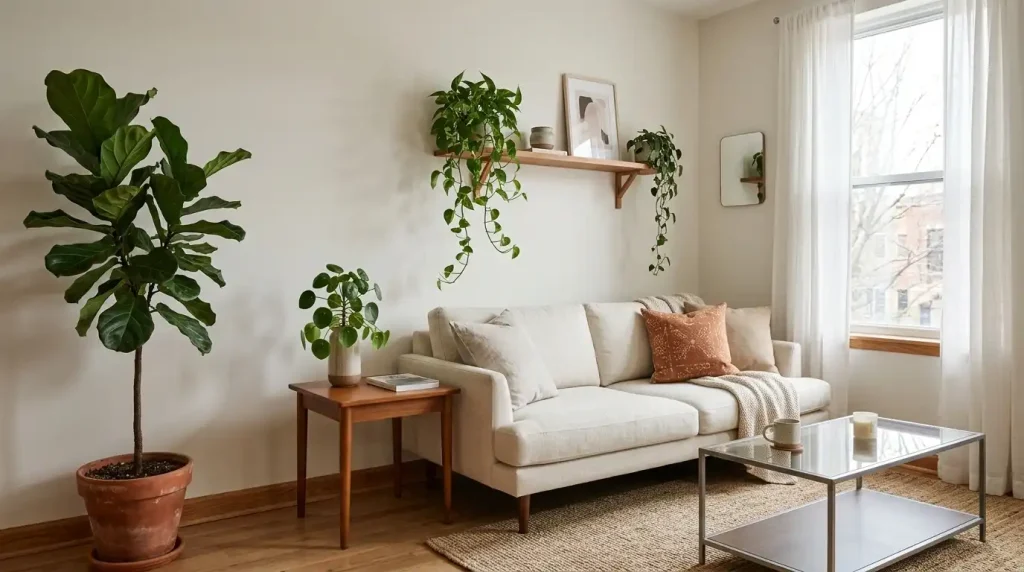
If natural light is limited, choose plants based on the actual light conditions rather than choosing them only because they look good in photographs.
And if real plants are impractical, high-quality faux greenery can still provide the visual structure.
The key is restraint.
One tall plant in the right corner usually looks more intentional than six small plants competing for attention.
If you have an awkward empty corner to solve, see How to Decorate an Empty Living Room Corner on a Budget.
9. Style the furniture surfaces instead of decorating every wall
When people think about decorating a rental, they often look at the walls first.
Look at your horizontal surfaces instead.
A coffee table, console, bookcase, or side table can become a small styling zone.
A simple arrangement can combine:
Something tall + something layered + something organic
For example:
- Tall vase or lamp
- Two stacked books
- Small plant or bowl
Then leave some empty space.
That last part matters.
A surface covered from edge to edge can make a small rental feel more crowded, while a few intentional objects create visual hierarchy.
Use trays when several small items need to stay together. The tray creates a visual boundary and also makes it easier to move everything when you need the surface back.
For a more detailed approach to this specific area, see How to Style Your Coffee Table Like a Pro.
10. Add a removable accent only if your wall passes the test
Peel-and-stick wallpaper is tempting because it can create the dramatic effect of a painted accent wall without traditional paint.
But this is exactly where you should not assume that “removable” means universally safe.
Consider removable wallpaper when:
- Your lease allows it
- Your wall is compatible with the product
- The existing paint is properly cured
- You have tested a small area
- You are prepared to remove it carefully
Skip it when:
- Your lease prohibits wall coverings
- The wall is unsuitable
- The paint is fragile or peeling
- You cannot verify compatibility
- Losing paint during removal would create a problem
And remember: you do not need an accent wall to make the room interesting.
A large rug, curtains, artwork, lighting, and a strong furniture arrangement can create plenty of visual interest without wallpaper.
If you want to explore wallpaper styles for inspiration, see Living Room Wallpaper Ideas, but treat any specific removable product according to its own surface requirements.
11. Create a focal point that has nothing to do with the walls
This is the strategy most rental decorating advice underuses.
Instead of asking:
“How can I make this wall look less boring?”
ask:
“What should someone notice first when they walk into the room?”
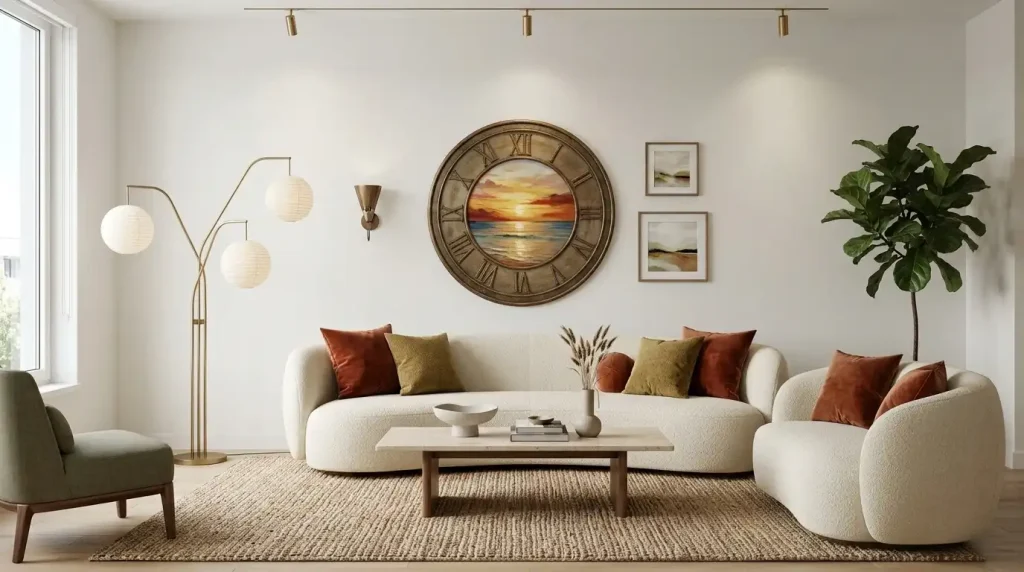
That focal point could be:
- A colorful sofa
- A beautiful rug
- A large mirror
- A statement floor lamp
- A sculptural coffee table
- A large plant
- A carefully styled bookcase
- A strong seating arrangement
Once you have a focal point, the wall becomes the background instead of the problem.
This is especially helpful in rentals where the wall color is completely outside your control.
The safest way to choose rental wall decor
Not every decorating idea carries the same level of risk.
Think about your options in three groups:
| Approach | Wall contact | Rental considerations | Best use |
| Leaning art or mirror | None | Lowest wall-contact option | Large visual impact |
| Freestanding shelf/bookcase | None | No wall contact | Art + storage |
| Curtains with approved no-drill hardware | Minimal/none | Depends on hardware and lease | Windows + softness |
| Lightweight removable decor | Adhesive | Depends on surface and weight | Small art |
| Peel-and-stick wallpaper | Full surface | Depends strongly on wall | Accent wall |
| Nails/screws | Permanent holes | Lease-dependent | Heavy art or shelves |
| Paint | Full surface | Lease-dependent | Major color change |
This table is not a universal legal risk rating. Your lease, local rules, wall condition, and landlord requirements determine what is actually permitted.
For U.S. renters, it is also useful to document the property’s condition when moving in and keep records of existing damage. Rental rules and security-deposit requirements vary by jurisdiction.
What to do first if your rental living room feels completely unfinished
Do not buy everything at once.
Use this order:
Step 1: Check the rules
Read the lease for restrictions on painting, wall coverings, adhesives, nails, and other alterations.
Step 2: Identify the biggest visual problem
Is it:
- Empty walls?
- Bad lighting?
- A dated floor?
- Bare windows?
- A boring sofa?
- Lack of color?
- Poor furniture arrangement?
Fix the largest problem first.
Step 3: Establish the room’s palette
Choose one base color and two supporting colors from the pieces you already own or plan to keep.
Step 4: Add the largest portable layer
Usually this means a rug, curtains, or a major piece of furniture.
Step 5: Fix the lighting
Add floor and table lighting where needed.
Step 6: Add one focal point
Choose a mirror, artwork, plant, sofa, lamp, or other strong element.
Step 7: Add smaller decor last
Only add accessories after the larger visual relationships work.
This order helps prevent a common problem: decorating around a room that still has a weak foundation.
A small rental living room? Use fewer, larger moves
A small living room does not necessarily need less personality.
It usually needs less visual fragmentation.
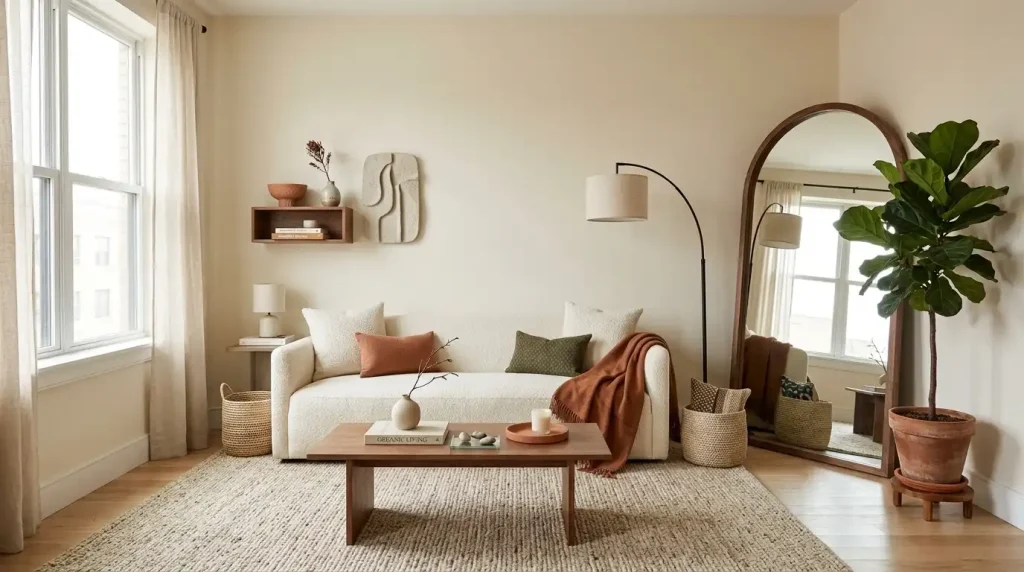
Instead of:
- Five tiny wall prints
- Several small rugs
- Lots of miniature accessories
- Multiple unrelated colors
try:
- One appropriately sized rug
- One strong mirror or artwork piece
- One tall plant
- One floor lamp
- A controlled cushion palette
- A few larger accessories
The room can then feel layered without looking crowded.
This is particularly useful when the rental has white walls. You do not have to cover every blank section.
Negative space is part of the design.
If storage is the bigger issue than decoration, see Living Room Storage Ideas for Small Apartments.
What not to do when decorating a rental without paint
Do not trust the word “removable” by itself
Check the actual product instructions and your wall surface.
Do not overload adhesive strips
A product’s weight limit applies to the specific setup described by the manufacturer. Different strip sizes and configurations can have different limits, so do not treat all adhesive hangers as interchangeable.
Do not put heavy objects on questionable walls
If you are unsure, use a freestanding or leaning solution instead.
Do not cover every blank wall
A room can look more designed when some wall area remains quiet.
Do not buy decor before deciding on the palette
This is how rentals end up with a blue pillow, orange print, gray rug, yellow lamp, and five different wood tones that do not relate to each other.
Do not assume an idea is safe because another renter used it
Two apartments can have completely different paint finishes, wall textures, and lease requirements.
Can you decorate rental walls without painting?
Yes. The safest approach depends on what your lease permits and what your walls can handle.
For zero wall contact, use leaning mirrors, floor plants, freestanding shelves, furniture, rugs, curtains with suitable no-drill hardware, and portable lighting.
For lightweight wall decor, removable hanging systems may work on compatible smooth surfaces when used within the manufacturer’s instructions.
For peel-and-stick wallpaper, treat it as a conditional option rather than a guaranteed renter-safe solution. Check the specific product’s surface requirements and test it before committing to an entire wall.
How do you make a rental living room look expensive without painting?
Focus on scale, texture, lighting, and consistency rather than expensive objects.
A simple combination can look much more finished:
Large rug + full-looking curtains + layered lighting + one large focal piece + restrained accessories
Then repeat a few materials or colors throughout the room.
For example:
Cream + walnut + olive + brass
can appear cohesive even when the furniture comes from different places.
The expensive-looking effect usually comes from relationships between pieces—not from filling the room with expensive decorations.
The DecorHubs approach: decorate the room, not the wall
At DecorHubs, we look at decorating as a relationship between the whole room rather than a collection of isolated accessories.
For a rental, that distinction matters even more.
You cannot always change:
- Wall color
- Flooring
- Light fixtures
- Built-ins
- Cabinets
- Architectural details
But you can often change how those fixed elements work with what you bring into the room.
That means the strongest rental transformation may not be the most dramatic one.
It may simply be:
better scale → better lighting → stronger textiles → clearer focal point → fewer but more intentional accessories.
That approach also means your decor can move with you when the lease ends.
Key Takeaways
- You can make a rental living room feel personal without painting the walls.
- Start with large visual elements such as a rug, curtains, lighting, and furniture before buying small accessories.
- Use color through textiles, artwork, plants, and decor instead of relying on wall paint.
- Leaning mirrors and artwork are useful when you want to avoid wall contact.
- Adhesive hanging products are surface- and weight-dependent, not universally damage-free.
- Peel-and-stick wallpaper can work in some rentals, but the wall surface, paint finish, product instructions, lease, and testing all matter.
- If your room still feels boring, create a focal point rather than simply adding more decorations.
- When in doubt, choose a portable or freestanding solution.
Related Next Steps
- Living Room Decor Ideas — Continue building the room around layout, color, lighting, and styling.
- How to Hide TV Wires and Cables in a Living Room — A useful next step if visible cords are making the rental feel unfinished.
- Living Room Storage Ideas for Small Apartments — Helpful when the main problem is clutter rather than wall color.
- Living Room Curtains vs. Blinds — Compare window treatments when curtains are part of your rental update.
Sources
- 3M Command — Picture Hanging Strips: Product specifications, compatible surfaces, weight guidance, and removal instructions.
- Tempaper & Co. — How to Install Peel-and-Stick Wallpaper: Surface compatibility, textured-wall limitations, and sample-testing recommendations.
- HUD — Move-In/Move-Out Inspection Format (Occupancy Handbook 4350.3): Move-in inspection and documentation guidance relevant to rental-property condition records.
Join the Conversation
What Do You Think?