
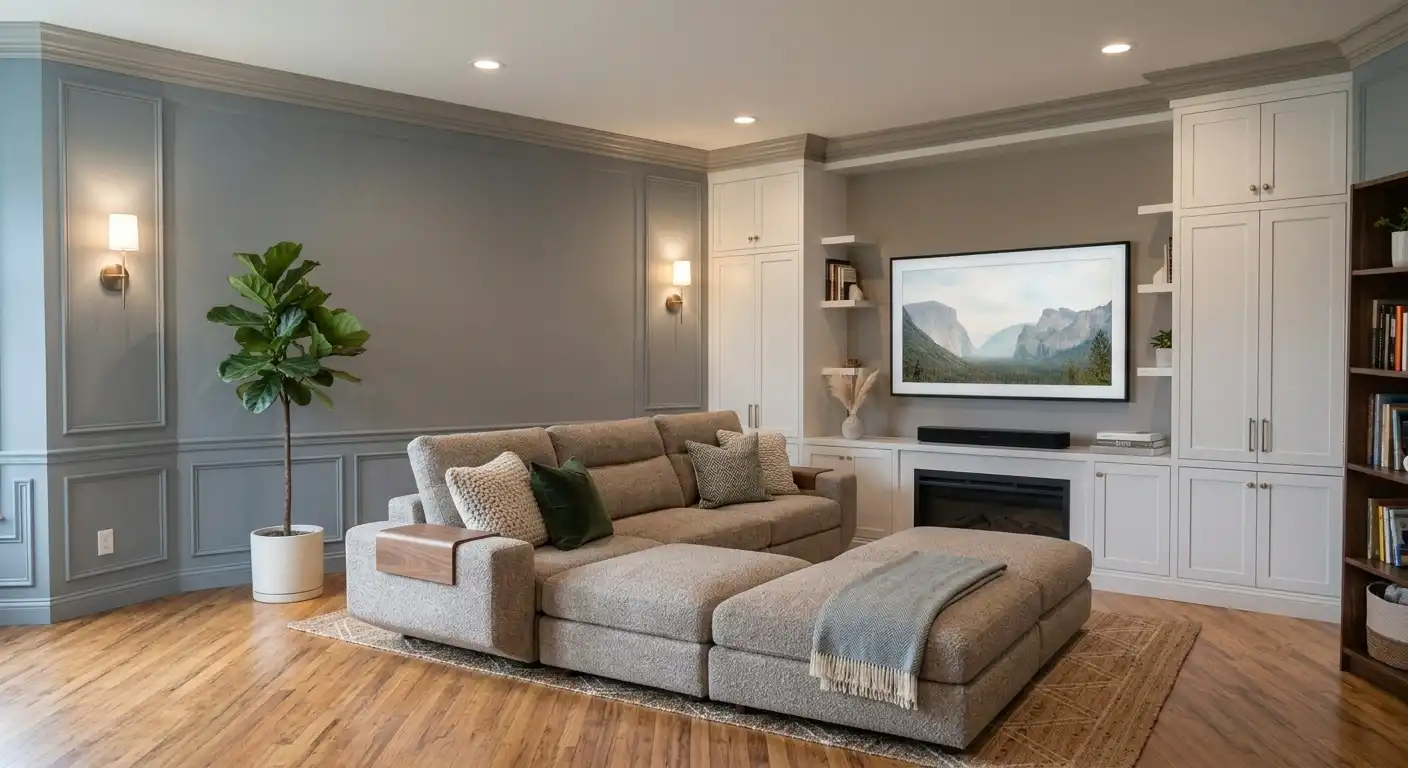
A tangle of cords under a TV can undo an otherwise well-decorated living room. The good news: almost every setup mounted or on a console, rental or owned, drywall or brick has a realistic fix that doesn’t involve tearing into drywall.
Quick answer: For most homes, the fastest fix is a paintable cord cover (raceway) that runs from the TV to the outlet, plus a small storage box or basket for the cable box and power strip. If you’re mounting the TV and want a completely clean wall, use a code-compliant in-wall power kit instead of fishing the factory power cord through the wall. That part matters more than most guides mention.
Below are all 7 real methods, when each one fits your setup, and how to actually do it, not just what it’s called.
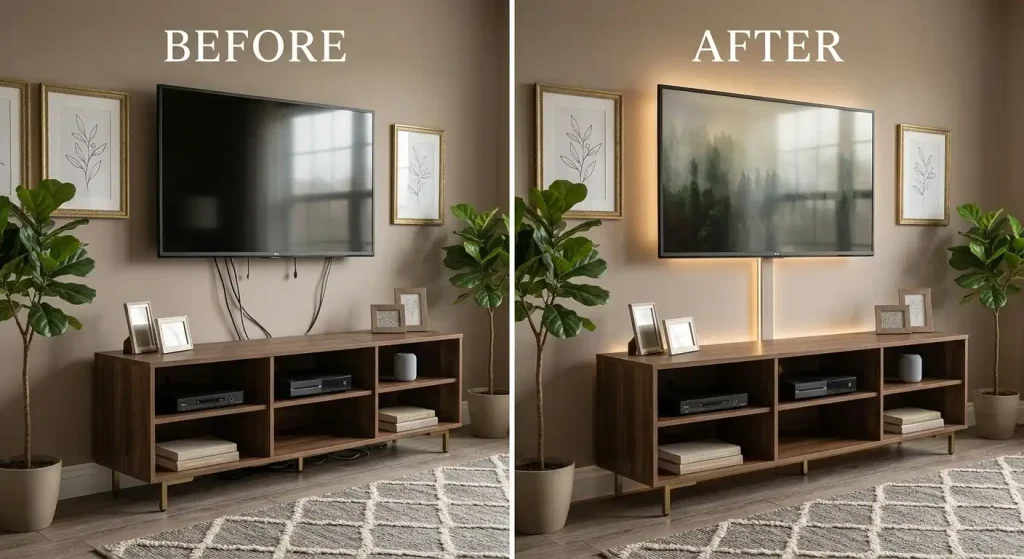
What You’re Actually Hiding (This Decides Your Method)
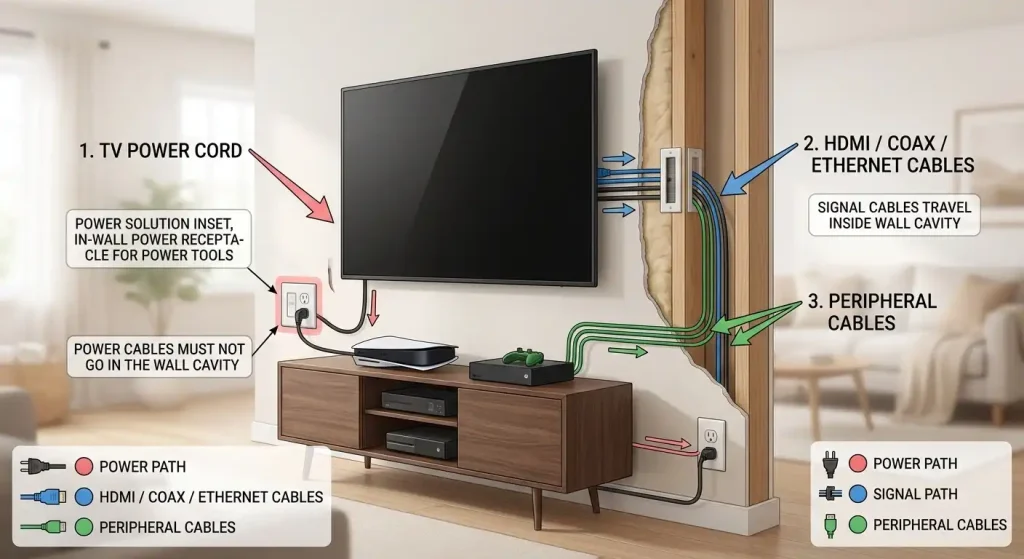
“TV wires” usually means three different things, and each has different rules:
| Cable type | What it is | Can it go inside a wall? |
| Power cord | Plugs the TV into an outlet | No — not without a special in-wall power kit |
| Signal cables | HDMI, coaxial, optical audio, speaker wire | Yes, generally safe to run in-wall |
| Peripheral cords | Cable box, streaming device, soundbar, router power | Usually stay outside the wall near the equipment |
This distinction is the reason a lot of “just cut two holes and fish the cords through” advice runs into trouble: it lumps the power cord in with everything else.
The Safety Rule Most Guides Skip
Before choosing a method, know this: the National Electrical Code (NEC 400.12) does not allow a standard flexible power cord including a TV’s factory power cord or an extension cord to be concealed inside a wall, floor, or ceiling. This applies across the U.S. under the electrical code that most states and municipalities adopt.
It’s not a minor technicality. A power cord’s insulation isn’t rated to sit inside an enclosed wall cavity, where heat can’t dissipate the way it does in open air. The U.S. Fire Administration attributes an estimated 24,000 residential fires a year to electrical causes, and improperly installed wiring is a recurring factor.
What this means practically:
- Signal cables (HDMI, coax, speaker wire) are fine to route inside the wall.
- The power cord needs to either stay outside the wall in a cover, or go through a listed in-wall power kit built for this exact purpose (Method 2 below).
- If someone suggests fishing a standard power cord through drywall with no kit involved, that’s the one shortcut worth skipping even though it’s the version that shows up most often in casual DIY videos.
Compare the 7 Methods
| Method | Best for | Permanence | Renter-friendly | Approx. cost |
| 1. Paintable cord cover / raceway | Any wall, any TV setup | Fully reversible | Yes | $15–$40 |
| 2. Code-compliant in-wall power kit | Wall-mounted TV, wanting zero visible cords | Semi-permanent (small holes) | No, unless landlord approves | $30–$100 |
| 3. Floating shelf with a cord cutout | Mounted TV with equipment stored nearby | Reversible with wall anchors | Usually yes | $25–$80 |
| 4. Storage basket or box | Hiding the cable box, router, and power strip | Fully reversible | Yes | $15–$35 |
| 5. Media console with a cord channel | TV on a stand or console, not mounted | Fully reversible | Yes | Varies with furniture |
| 6. Flat cable under a rug | Cords crossing open floor | Fully reversible | Yes | $10–$25 |
| 7. Molding or baseboard channel | Whole-room cable runs, home theaters | Semi-permanent | No | $30–$70+ |
Method 1: Paintable Cord Cover (Raceway)
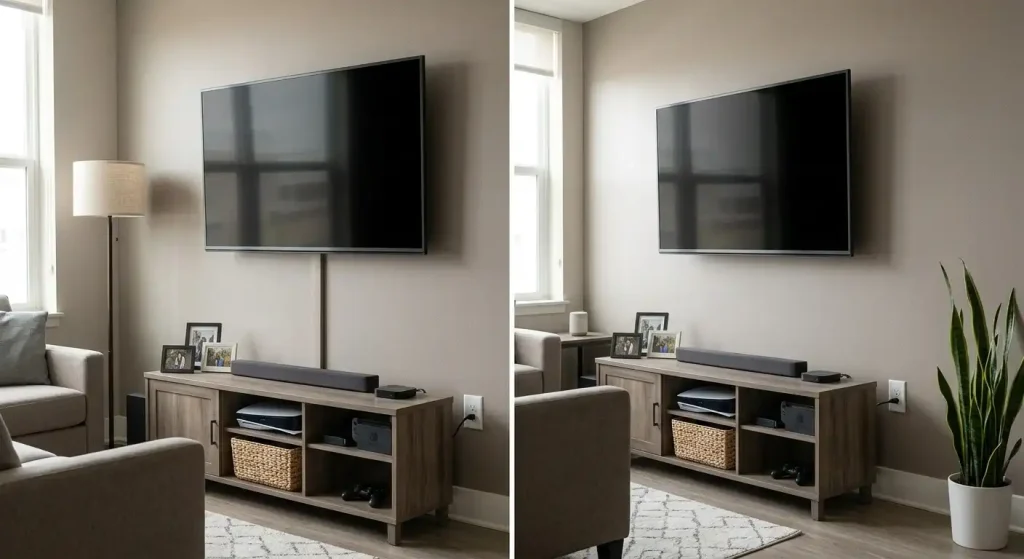
This is the option to reach for first if you’re renting, unsure which method to pick, or don’t want to commit to a wall modification. It works whether the TV is mounted or on furniture — and it’s also the safest starting point on a brick or concrete wall, since it avoids drilling into masonry entirely.
- Measure the distance from the TV to the outlet or media console.
- Bundle the cords together with a cable tie or cord organizer sleeve so they sit as one unit.
- Cut the cord cover channel to length with a utility knife or hand saw.
- Mount the base strip to the wall using its adhesive backing (or screws, for a firmer hold — on brick or concrete, use a masonry-rated adhesive or anchors instead of standard drywall screws).
- Lay the cords in and snap the cover into place.
- Paint the cover to match the wall most are paintable, and this step is what makes them disappear rather than just look tidy. Lightly scuff a glossy cover first and use a plastic-friendly primer so the paint adheres.
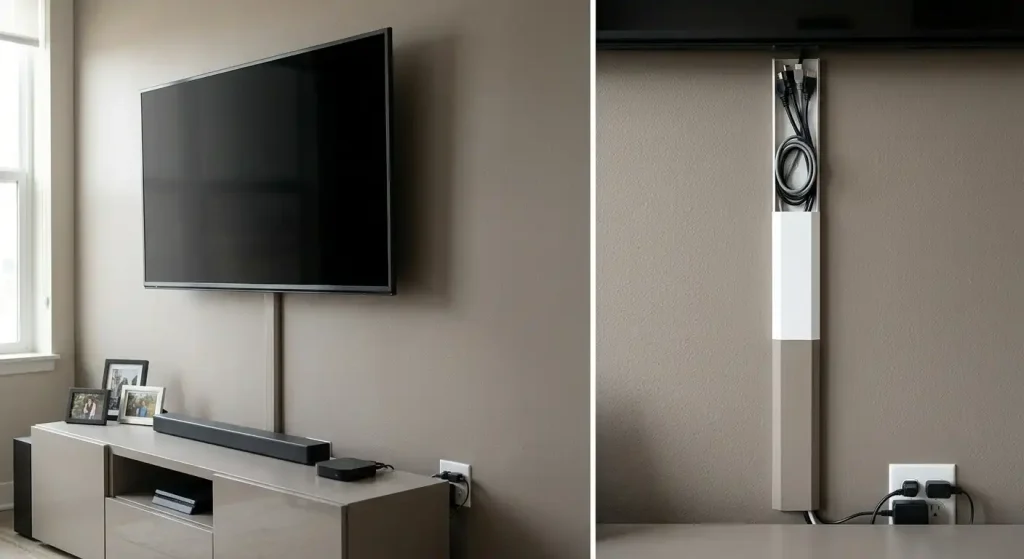
This method hides signal cables and low-voltage cords without issue. If the TV’s power cord is part of the bundle, it’s staying on the surface of the wall inside the cover, which is the code-compliant way to conceal it, since it’s never actually inside the wall cavity.
Method 2: Code-Compliant In-Wall Power Kit
Skip this method if you’re renting, don’t want any drywall work, or your wall is brick/concrete (masonry installs need a professional assessment first — see the FAQ below). For homeowners with a standard drywall setup who want zero visible cords behind a mounted TV, a listed in-wall power kit is the correct way to get that look without violating code.
- Confirm stud and wiring locations with a stud finder before drilling anything.
- Cut the upper hole behind where the TV will hang and the lower hole near the outlet, using the kit’s included template.
- Install the kit’s wall plates, which route power through in-wall-rated cable (not a standard cord) between two junction boxes.
- Run signal cables (HDMI, etc.) through the same or a second opening in the kit.
- Plug the TV into the upper plate and the kit’s lower plate into the wall outlet.
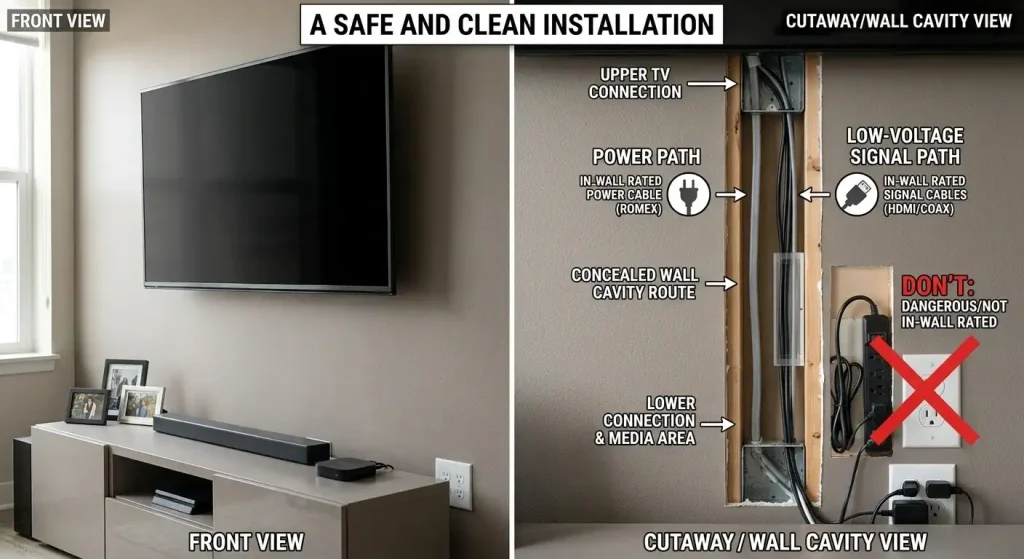
This is the setup that gets a mounted TV to look like it has no cords at all, and it’s the version installers use specifically because it keeps the wiring code-compliant. If drilling into a wall isn’t something you want to DIY, this is a reasonable job to hand off it’s a short, well-defined task for an electrician or TV mounting service.
Method 3: Floating Shelf With a Cord Cutout
This fits homes where the TV is mounted and the cable box, streaming device, or soundbar needs a home nearby, without a full console underneath.
- Choose or build a shelf with a small notch or drilled cutout at the back edge, positioned to line up behind the TV.
- Mount the shelf using wall anchors rated for the combined weight of the shelf and equipment.
- Set the equipment on the shelf and feed its cords down through the cutout.
- Drop the cords straight into a wall-mounted cord cover (Method 1) so they travel to the outlet without ever crossing open wall space.
If you’re building the shelf yourself, DecorHubs’ DIY Floating Shelves guide walks through the cutting and mounting steps the cord cutout is just one extra step added during that build.
Method 4: Storage Basket or Box
A clean TV wall with a visible tangle of equipment underneath still reads as unfinished. This method solves for the cable box, router, and power strip specifically not the TV itself.
- Pick a basket or box slightly larger than the equipment it will hold, with at least one open side or vented panel.
- Cut or use an existing gap for the cords to exit toward the outlet.
- Set the equipment inside, cords facing the back or the gap.
- Place the basket on a shelf, inside a console, or on the floor near the TV.
- Keep it ventilated — cable boxes and routers generate heat, and a fully sealed container can cause them to overheat.
For layout ideas that pair well with this approach, DecorHubs’ Living Room Storage Ideas for Small Apartments covers furniture that hides equipment and cords together.
Method 5: Media Console With a Cord Channel
This is the fix for a TV that sits on furniture rather than being wall-mounted, where the problem shifts from “cords on the wall” to “cords behind the console.”
- Route all cords to one side of the console and bundle them with a sleeve.
- Feed cords through the console’s back panel cutout, if it has one.
- Use a power strip with a cover, or drop it into a small cable box inside the console.
- Position the console so its back faces a wall rather than the room, keeping any remaining slack out of the main sightline.
This pairs well with general layout thinking from DecorHubs’ How to Style a Coffee Table Like a Pro, since coffee table placement and console placement affect the same walking path.
Method 6: Flat Cable Under a Rug
Use this when a cord has to cross an open floor to reach an outlet, a common issue when the only nearby outlet isn’t behind the TV or console.
- Choose a flat cable protector (not a round one) rated for foot traffic.
- Run it along the shortest path from the equipment to the outlet, avoiding high-traffic pinch points where possible.
- Lay the protector flat against the floor and secure it if the product allows.
- Avoid taping cords directly to hard flooring without a cover; it creates a trip hazard and can damage the flooring finish.
One caution worth knowing: the U.S. Consumer Product Safety Commission specifically warns against running a cord loose under a rug or carpet with no protective cover, since a covered cord can’t dissipate heat properly and this has been linked to overheating and fire risk. A rated flat cable protector isn’t the same as tucking a bare cord under a rug the protector is the part that makes this safe. This is a floor-specific fix and isn’t a substitute for the wall-based methods above; use it only for the segment of cord that actually needs to cross the floor.
Method 7: Molding or Baseboard Channel
This is the most involved option, and it makes the most sense for a full media wall or home theater setup rather than a single TV with a couple of cords.
- Choose a cable raceway sized for baseboard or crown molding placement, or install foam molding with a hollow channel.
- Run the bundled cords along the top of the baseboard or just under the crown molding.
- Secure the channel to the wall with adhesive or small screws, following the trim line around the room.
- Paint the molding to match existing trim so the channel reads as part of the room’s architecture rather than an add-on.
Because this involves altering trim, it’s the one method on this list that’s genuinely not renter-friendly — plan on this for a home you own, or one where the landlord has approved trim changes.
How to Decide Which Method Fits Your Home
| If you… | Best method |
| Are renting | Method 1 (cord cover), Method 4 (basket), or Method 6 (flat cable) |
| Want a fully invisible wall behind a mounted TV | Method 2 (in-wall power kit) |
| Have equipment to store near a mounted TV | Method 3 (floating shelf) or Method 4 (basket) |
| Have the TV on a console or stand | Method 5 (cord channel) |
| Have cords crossing open floor | Method 6 (flat cable under a rug) |
| Have a brick or concrete wall | Method 1 (surface raceway) — safest starting point before any masonry work |
| Are decorating a whole media wall, not just one TV | Method 7 (molding channel) |
| Want a quick weekend fix on a small budget | Method 1 + Method 4, no tools beyond scissors and a level |
Common Mistakes to Avoid
- Running the factory power cord inside the wall. Covered above it’s the one shortcut that creates real risk, not just an aesthetic issue.
- Overstuffing a cord cover. Most covers are rated for a specific number and gauge of cables; forcing in too many can prevent the cover from sitting flush or closing properly.
- Sealing equipment in an airtight box. Cable boxes and routers need airflow to avoid overheating.
- Running a bare cord under a rug with no protective cover. As noted in Method 6, this is a recognized fire-risk pattern, not just an inconvenience.
- Ignoring the outlet location before buying furniture. A console with a back cutout only helps if it lines up with where the power actually is.
- Skipping the stud finder. Drilling blind risks hitting wiring or plumbing that isn’t where you’d expect.
Frequently Asked Questions
Is it safe to run TV wires inside the wall?
Signal cables like HDMI and coaxial are generally fine inside a wall. The TV’s power cord is not, unless it’s part of a listed in-wall power kit a standard power cord isn’t rated for enclosed spaces under the National Electrical Code.
Can I paint a cord cover to match my wall?
Most plastic cord covers and raceways are paintable with standard latex paint. Lightly scuff the surface first so the paint adheres, and use a primer made for plastic if the cover is glossy.
How do I hide a cable box if I don’t have a TV stand?
A wall-mounted shelf with a basket, a slim storage box with a cutout for cords, or a small shelf placed just below or beside the TV all work without needing a full console.
Do I need an electrician for this?
Not for cord covers, baskets, or furniture-based solutions those are DIY-friendly. An electrician or TV mounting professional is worth it for an in-wall power kit, since it involves cutting into drywall near an existing circuit.
Will hiding cords behind furniture cause overheating?
It can, if the space is fully enclosed with no airflow. Leave a gap, use a vented cord box, or choose open-back furniture for equipment that runs warm.
Can I use these methods on a brick or concrete wall?
Yes — use Method 1 (surface raceway) with masonry-rated adhesive or anchors. Skip Method 2 (in-wall power kit) unless a professional has assessed the wall first.
What if I add more devices later will I have to redo everything?
No, if you leave extra room in your cord cover or console cutout now. A new device just means feeding one more cord into the existing channel.
Key Takeaways
- Match the method to the cable type: signal cables can go in the wall, power cords generally shouldn’t.
- A surface-mounted, paintable cord cover (Method 1) is the most flexible, lowest-risk option for almost any setup drywall or masonry.
- A fully invisible mounted-TV wall requires a code-compliant in-wall power kit (Method 2), not a fished power cord.
- The cable box, router, and power strip need their own hiding plan (Methods 3 and 4) not just the TV cord.
- Renters have several no-damage options (Methods 1, 4, 5, and 6) that look just as finished as permanent ones.
- A cord under a rug needs a rated flat cable protector, not just the rug itself, to stay safe.
Related Next Steps
- Living Room Storage Ideas for Small Apartments — for furniture that hides equipment and cords together
- DIY Floating Shelves — for a shelf built with a cord-routing cutout
- How to Style a Coffee Table Like a Pro — for arranging the room once the cords are out of sight
- Decorate an Empty Living Room Corner on a Budget — for disguising a power strip or router with decor
- Living Room Decor Ideas — for finishing the room once the media wall is clean
Sources and References
- National Fire Protection Association — NFPA 70, National Electrical Code (NEC) — Article 400 covers flexible cords and cables, including the restriction on concealing them inside walls, floors, or ceilings
- U.S. Fire Administration, FEMA — Residential Building Electrical Fires report — source for the estimated 24,000 residential electrical fires reported each year
- U.S. Consumer Product Safety Commission — Limit Extension Cords To Reduce Risk Of Fire — source for the warning against running cords under rugs or carpets

Join the Conversation
What Do You Think?