
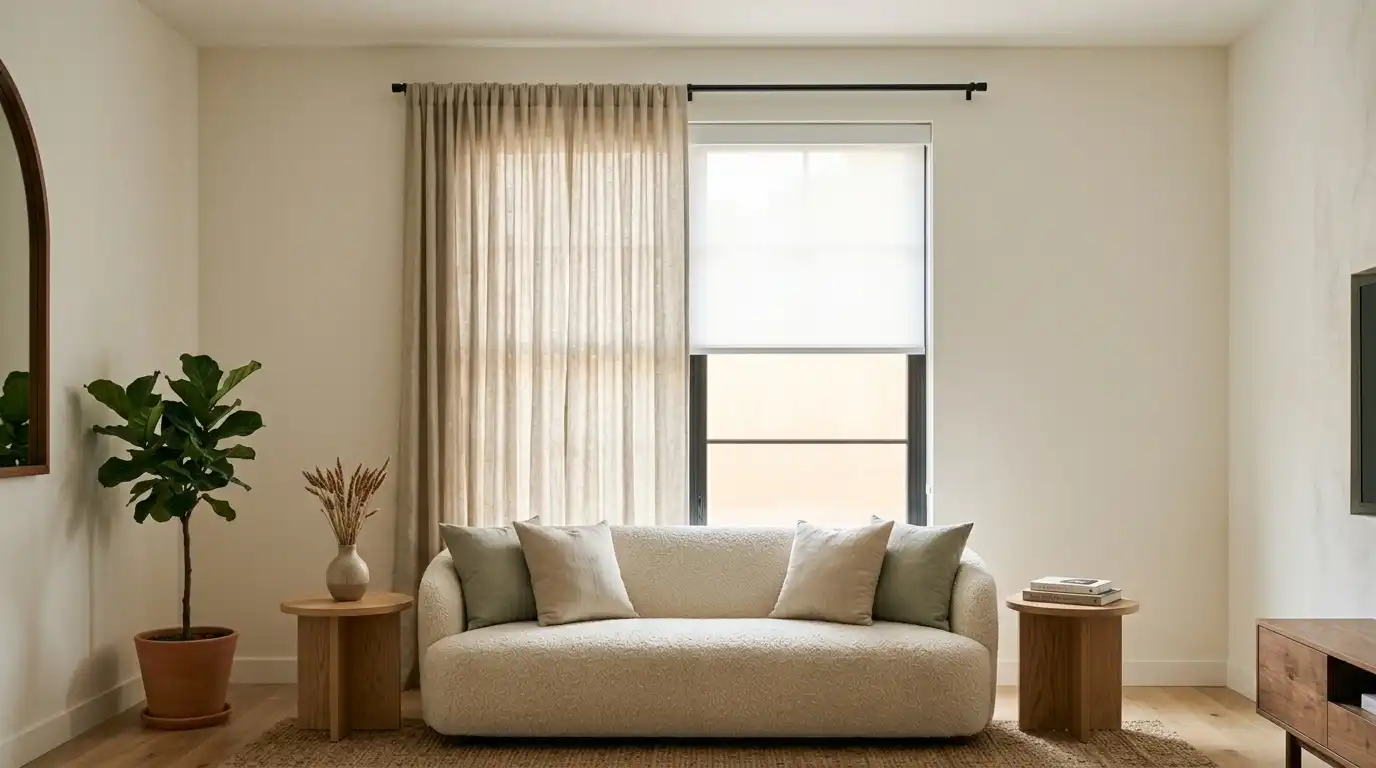
The short answer: Choose curtains when you want softness, texture, visual height, and a warmer living-room feel. Choose blinds when you need a cleaner profile, adjustable light control, or want to keep the window area visually compact. If you need both flexibility and softness, layering blinds with curtains can solve more than one problem at the same time.
The right answer depends on what your window has to do and what surrounds it. This guide helps you work that out in about two minutes. For wider inspiration, browse our living room decor ideas.
Find Your Situation in 30 Seconds
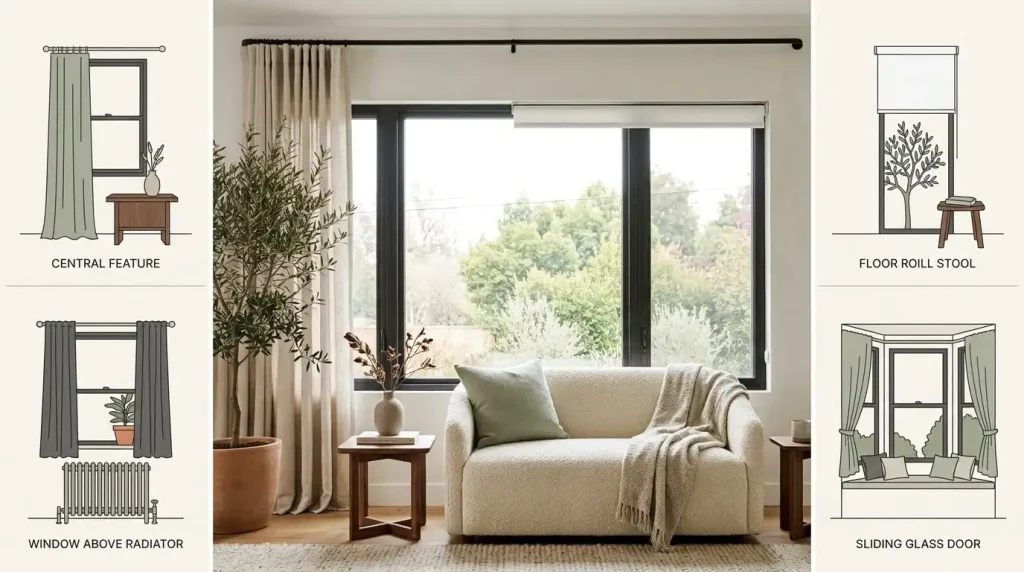
| Your living room has… | Lean toward | Why |
| Wall space on both sides of the window | Curtains | Panels stack back onto the wall and leave the glass clear |
| Almost no wall beside the window | Roller or Roman shades | Nothing needs room to stack |
| A sofa, desk or radiator right below the window | Shades or sill-length curtains | Floor-length fabric gets in the way, and over a radiator it can trap heat |
| Sun glare on the TV | Shades, or blinds with tilting slats | You can fine-tune the light instead of closing everything |
| Street-level windows with close neighbors | Curtains over sheers, or privacy-lined shades | Sheers alone become see-through from outside once your lights are on |
| Sliding glass doors | Vertical blinds, panel-track shades, or ceiling-track curtains | You need to walk through every day |
| A very wide window | Curtains, or several shades side by side | One very wide blind can be heavy and awkward to operate |
| A bay window | Curtains on a bay rod or track, or one shade per pane | Each follows the angles better than a single flat treatment |
| Pets that climb, or small children | Cordless shades | No cords, and nothing to swing from (see the safety section) |
What You’re Actually Choosing Between
Terminology differs by country, and it confuses shoppers.
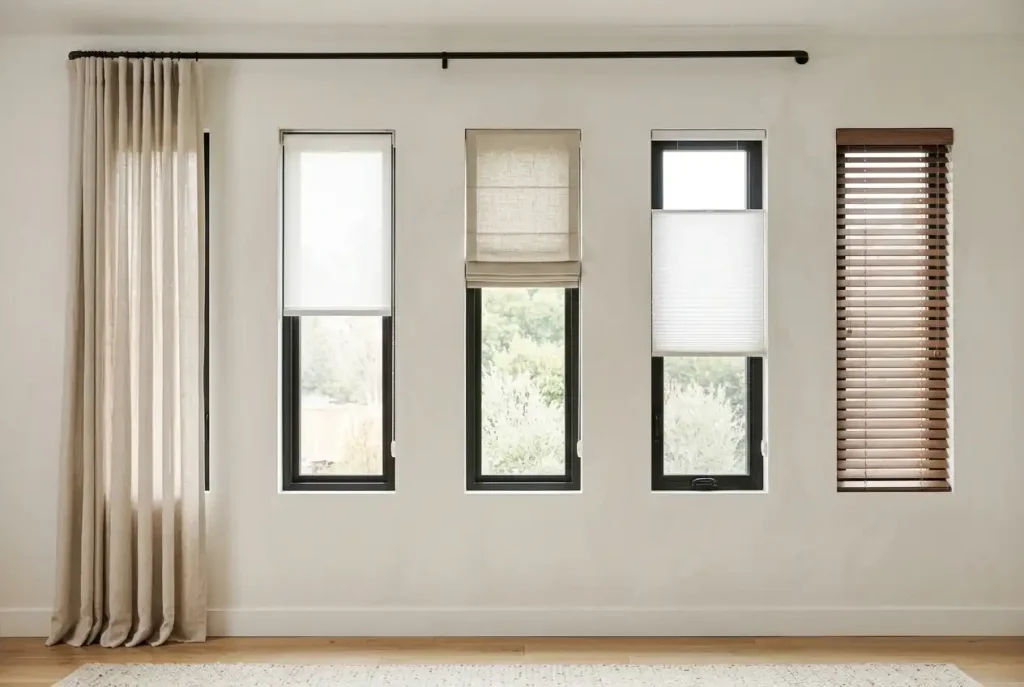
- Curtains (also called drapes or drapery) are fabric panels hung from a rod or track. They can be sheer, lined, blackout or thermal.
- Blinds in the US usually means slatted products: Venetian (horizontal), vertical, and faux-wood or aluminum versions.
- Shades are fabric coverings that roll or fold: roller, Roman, cellular (honeycomb) and zebra (dual-layer). In the UK and Australia, “blinds” often covers all of these.
This matters because the choice you’re facing is often really “curtains or shades.” When people say “blinds,” they frequently mean a roller or Roman shade.
Curtains vs Blinds in a Living Room: Side by Side
| Factor | Curtains | Blinds / shades |
| Look and feel | Soft and textured; works across most styles | Tailored and clean; suits modern and minimal rooms |
| Light control | Good, but there are side gaps unless fitted well | More precise, especially slatted blinds and zebra shades |
| Privacy at night | Excellent when lined; sheers alone are not private | Excellent when closed |
| Insulation | Good when lined, full and hung close to the glass | Varies: cellular shades are strongest, slatted blinds weakest |
| Space needed | Stack-back room and rod clearance | Minimal; can sit inside the frame |
| Upkeep | Vacuum or launder per the care label | Wipe or dust; easiest overall |
| Cost | Usually higher, since fabric volume drives price | Usually lower for basic types; higher for motorized or cellular |
| Effect on room scale | High-mounted rods make windows and ceilings look taller | Neutral; they disappear into the window |
| Sound | Heavy, lined fabric helps soften echo | Little effect |
Neither column wins outright. Many “curtains are better” or “blinds are better” claims online come from retailers selling one of them, so weigh the trade-offs against your own room.
The 4-Question Living Room Test
This is a practical way to organize the decision, not a scientific method.
1. What problem is the window causing? Name it: glare on the TV, neighbors seeing in, a cold draft, a bare and echoey room, or nothing except “it looks unfinished.” Glare and precise light control point to blinds or shades. Coziness, softness and warmth point to curtains.
2. What’s around the window? Look at the wall on either side, the gap to the ceiling, and whatever sits below (a radiator, a sofa back, a console). Curtains need somewhere to go when open. Shades don’t.
3. What look do you want? Curtains suit almost every style, from minimalist to traditional. Blinds and shades lean cleaner and more contemporary. Roman shades sit in between, with fabric softness in a tailored shape.
4. How much upkeep will you really do? Be honest. Curtains collect dust and need periodic cleaning. Blinds take a quick wipe, though slats show dust quickly. Either way, the treatment only stays looking good if the upkeep suits your habits.
How to read your answers
- Mostly “soft, cozy, wall space available”: curtains.
- Mostly “tight space, glare, easy cleaning”: shades or blinds.
- Split answers: layer them.
Light, Glare and Privacy in the Living Room
Living rooms are used every hour, so one window has to handle morning sun, afternoon glare, evening TV and night privacy.
Blinds and shades give finer control. Tilting slats redirect light, zebra shades alternate sheer and solid bands, and roller shades can be set at any height. If a west-facing window hits your screen at 4 pm, this is where shades earn their place. Often you don’t need a full blackout: a light-filtering shade set halfway can cut glare while keeping daylight.
Curtains manage light in broader strokes: open, closed, or sheer. Their strength is softness. A sheer panel diffuses harsh sun into a gentler glow that a hard roller shade doesn’t produce.
Privacy needs a specific check. Sheers give daytime privacy, but once it’s dark and your lights are on, people outside can often see in. For evening privacy you need a lined curtain, an opaque or privacy-lined shade, or a sheer layered with something solid.

The after-dark test: before you commit, stand outside (or ask a neighbor) after dark with your living room lights on and check what can be seen. It takes five minutes and can prevent an expensive mistake.
Energy and Comfort: What the Evidence Says
Insulation is a genuine advantage of well-chosen coverings, but the details matter. These figures come from the U.S. Department of Energy (DOE):
- Curtains and drapes: medium-colored draperies with white plastic backings can reduce heat gain by 33%. Most conventional draperies, when drawn in cold weather, can reduce heat loss from a warm room by up to 10%. They work best hung as close to the window as possible and falling to the sill or floor.
- Blinds: when completely closed, highly reflective blinds can reduce heat gain by around 45%. Because of their slats, it’s hard to control heat loss through interior blinds.
- Cellular (honeycomb) shades: tightly installed cellular shades can reduce heat loss through windows by 40% or more. The DOE puts that at roughly 10% in overall heating-energy savings, so treat it as a window-level figure, not a guaranteed drop in your bill.
The most practical finding is about behavior, not products. In a DOE-funded study of the U.S. installed base, roughly 75% of window coverings were not adjusted on a daily basis. Whatever you buy only saves energy if you open and close it with the sun and the season.
What this means for you: if your living room is cold or sun-baked, choose lined curtains hung close to the glass, cellular shades, or both. If comfort isn’t a problem, choose on look and light control.
Living Room Scenarios: What to Choose When…
The room is small
Shades (roller or Roman) mounted inside the frame free up the most visual and physical space. If you still want curtains, use lighter fabrics and hang them high and wide so they stack onto the wall rather than over the glass. The goal is to avoid adding visual bulk. Pair the window with smart furniture choices too, such as these living room storage ideas for small apartments.
Ceilings are low
Curtains hung near the ceiling draw the eye upward. Shades inside the frame add no height effect, so on low ceilings a high-mounted curtain rod is your best trick.
There’s a sliding door or large glass wall
Curtains on a ceiling track can work, but they’ll be in your way every time you use the door. Vertical blinds, panel-track shades, or a track-mounted curtain that parks fully to one side are usually easier to live with.

A radiator or heater sits under the window
Floor-length curtains can trap heat behind the fabric so the room doesn’t feel it. Choose sill-length curtains that stop above the radiator, or a shade.
Your TV faces a window
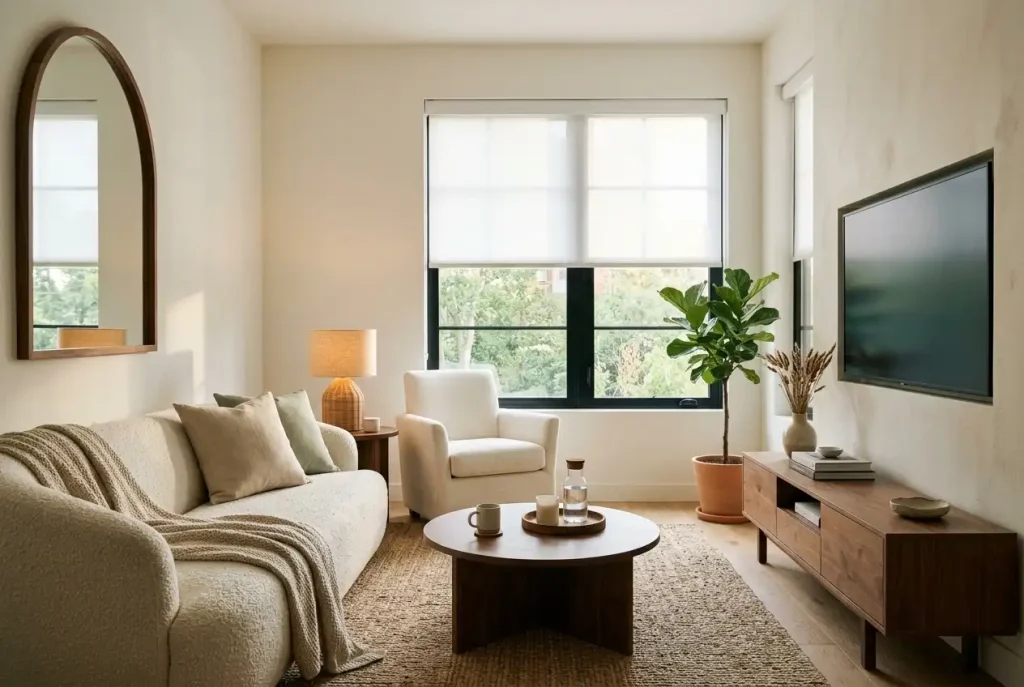
Prioritize adjustability. A light-filtering shade you can set halfway usually beats curtains here. You can also layer: a shade for glare, curtains for evenings. If the TV wall is your focal point, see how to hide TV wires and cables in your living room for a cleaner look.
You have pets or young children
Skip corded products near play areas. Choose cordless or motorized shades. If a pet climbs curtains, shades are the safer bet, and heavy, well-lined curtains resist tugging better than lightweight sheers.
You rent
Check your lease first. Tension rods work inside window frames for lightweight curtains, and cordless shades often install with brackets that leave small screw holes. Removable options exist but are less secure with heavy fabric.
You want a hybrid look
Layering is often the most flexible living room solution:
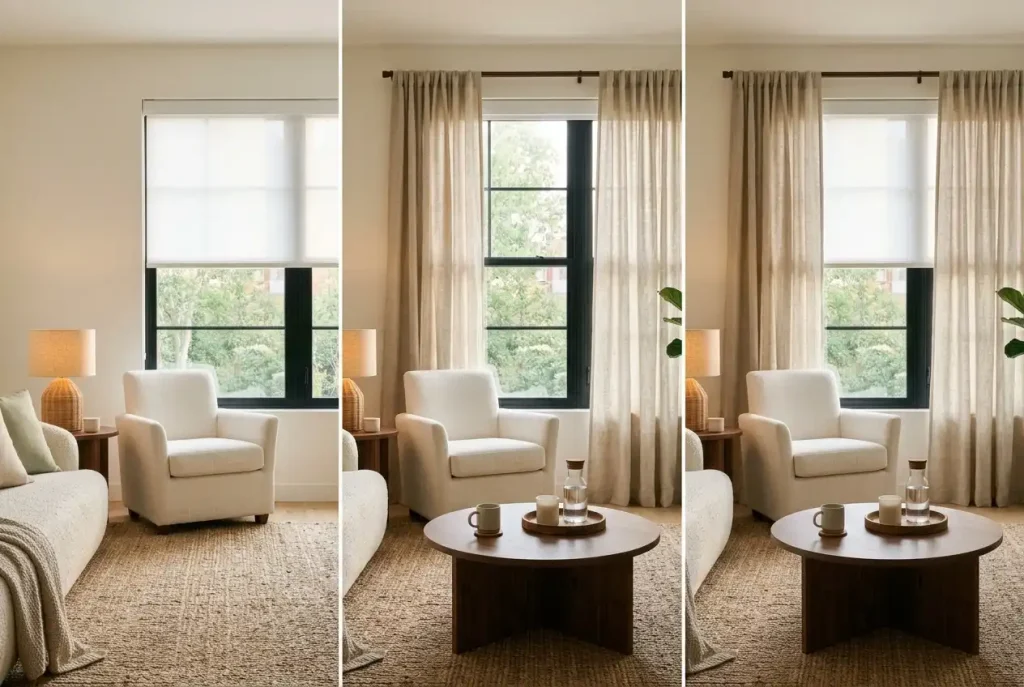
- Sheer curtain + lined curtain on a double rod: daytime privacy plus full evening closure.
- Roller or Roman shade inside the frame + curtains outside: precise control by day, softness and drama at night.
- Zebra shade + side panels: clean lines with a soft frame.
Layering costs more and takes more wall space, so it suits rooms where window treatments are a major part of the design. Don’t layer just because it looks good in photos. If the window is small, the wall space is limited, or furniture already crowds the area, two treatments can add unnecessary visual weight.
Safety: Cords, Kids and Pets
Corded window coverings are a known hazard. The U.S. Consumer Product Safety Commission (CPSC) counted at least 209 reported fatal and nonfatal strangulations on window coverings among children 8 and younger between January 2009 and December 2021. Nearly 48% of them (100) were fatal. The CPSC describes these as a minimum count, not a complete one.
Practical rules:
- With young children, choose cordless or motorized shades and blinds. The CPSC recommends cordless coverings as the safest option.
- If you have existing corded products, keep cords out of reach and don’t place cribs, beds, sofas or other climbable furniture beneath them.
- Curtains that operate with a wand or pull rod avoid loose cords entirely.
- Requirements differ by product type and country, so check the current rules that apply where you live.
Safety should outrank the visual difference between curtains and blinds.
What Does It Cost?
Prices vary too much by fabric, size and custom versus ready-made to quote reliable figures. The logic is more useful:
- Curtains cost more when you need wide panels (you typically want 1.5 to 2.5 times the window width in fabric) and when you add lining, interlining or custom headings. Ready-made panels are the cheapest route to a high-end look.
- Blinds and shades cost more when they’re motorized, cellular, extra-wide or custom-cut.
- Wide windows change the math. As the number of shades rises, the gap between curtains and shades often narrows.
- Think in cost per year. A well-made treatment that suits the room lasts longer than a cheap one you replace early.
Curtain Placement Cheat Sheet
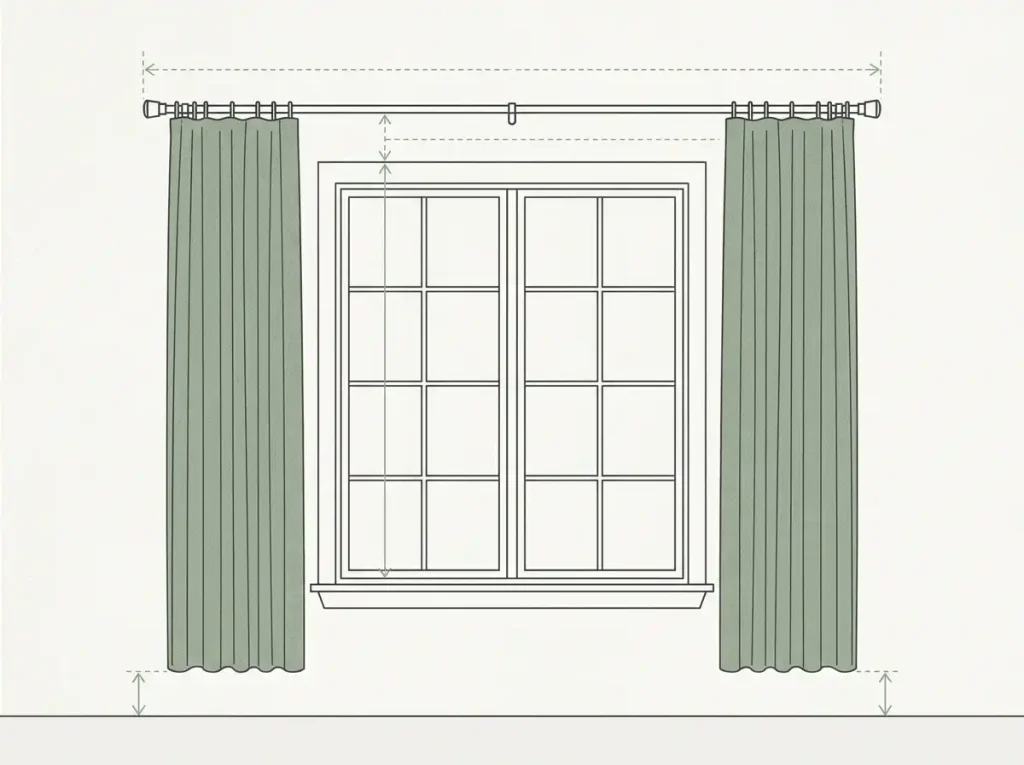
If you choose curtains, these common design guidelines separate “off the rack” from polished:
- Rod height: mount it roughly four to six inches above the window trim, and higher in rooms with tall ceilings or when you want extra height.
- Rod width: extend it past the frame, commonly three to six inches per side, so panels stack onto the wall instead of covering the glass.
- Fullness: combined panel width of about two to two-and-a-half times the window width looks full. Lighter fabrics can get away with about 1.5 to 2 times.
- Length: hover about an inch above the floor or just kiss it. Panels that stop several inches short look unfinished.
Common Mistakes to Avoid
- Mounting the rod right on the window trim. It makes windows and ceilings look smaller.
- Buying panels that are too narrow. Flat, thin curtains look cheap even in beautiful fabric.
- Relying on sheers for night privacy. They turn see-through once your lights are on.
- Covering a radiator with floor-length curtains. It blocks the heat.
- Letting curtains stack over the glass. A wide rod keeps the window clear when open.
- Choosing by photo instead of sample. Fabric and color change a lot in your own light, so order swatches.
- Ignoring how it operates. Make sure the treatment can open fully without hitting furniture, doors or handles.
- Never opening or closing them. Comfort and energy savings only come from use.
Frequently Asked Questions
Are curtains or blinds better for a living room?
Curtains are usually the better default for warmth, softness and insulation. Blinds and shades win when space is tight, glare matters or upkeep needs to be minimal. The best answer depends on your window, your wall space and how you use the room.
Do curtains make a living room look bigger?
They can. Hung high and wide, curtains draw the eye up and outward, which makes both the ceiling and the window feel larger. Shades inside the frame don’t create that effect.
Can you use both curtains and blinds?
Yes, and it’s common. Mount a shade or blind inside the frame and hang curtains on a rod outside it. You get precise daytime control plus evening softness.
Do curtains or blinds block more light?
It depends on the product, fabric, fit and installation. Blackout-lined curtains and blackout shades can both block a lot of light, but gaps around the edges let light in. Shades fitted inside the frame and curtains that extend well past it perform best.
Are blinds cheaper than curtains?
Not always. Basic ready-made blinds are often cheaper than custom curtains, but both categories span a wide price range. Size, fabric, lining, hardware, customization and motorization all change the final cost.
Are curtains outdated?
No. They suit minimalist, modern, traditional and maximalist styles alike. Choose based on your room and lifestyle, not trends.
Should living room curtains touch the floor?
Ideally they either just touch it or hover about an inch above. Shorter curtains only make sense when something like a radiator or furniture is in the way.
What’s best for sliding glass doors?
Something that doesn’t get in your way each time you walk through: vertical blinds, panel-track shades, or a ceiling-track curtain that stacks fully to one side.
Key Takeaways
- Curtains are the stronger default for living rooms. Blinds and shades win in tight spaces, for glare control and for low upkeep.
- Judge the window’s surroundings first: wall space, ceiling gap and anything below it.
- Layering a shade with curtains solves most “I can’t choose” situations, but skip it when space is tight.
- Sheers don’t give night privacy. Lined curtains or opaque shades do. Test after dark.
- For homes with children, choose cordless.
- Hang curtains high, wide and full for the best result.
- Insulation only helps if you actually open and close your coverings through the day.
Related Next Steps
- Get more inspiration in our living room decor ideas
- Working with tall walls? See how to decorate a room with high ceilings
- Tidy up the screen wall with our guide to hiding TV wires and cables in the living room
- Short on space? Try these living room storage ideas for small apartments
- Explore the full home decor guide or browse all living room articles
Sources and References
- U.S. Department of Energy, Energy Efficient Window Coverings: https://www.energy.gov/energysaver/energy-efficient-window-coverings
- U.S. Department of Energy, Residential Windows and Window Coverings: A Detailed View of the Installed Base and User Behavior: https://www.energy.gov/eere/buildings/articles/residential-windows-and-window-coverings-detailed-view-installed-base-and
- Lawrence Berkeley National Laboratory (U.S. DOE), Residential Windows & Attachments: https://windows.lbl.gov/residential-windows-attachments


Join the Conversation
What Do You Think?