
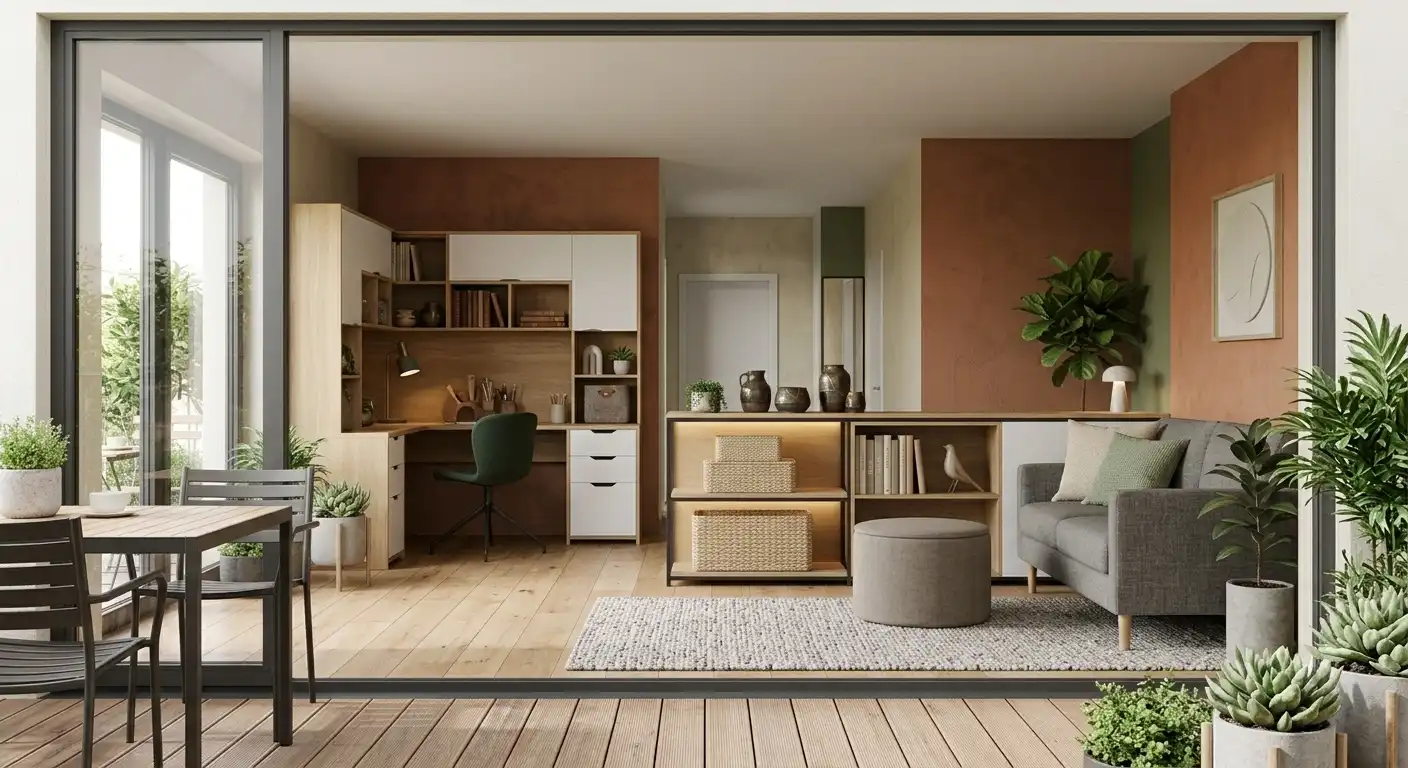
A small apartment living room does not usually need more storage everywhere. It needs better storage in the places where clutter actually collects.
When one room has to handle relaxing, watching TV, working, reading, entertaining, and storing everyday belongings, it can quickly become the apartment’s main drop zone. Blankets land on the sofa, chargers gather around the TV, books spread across the coffee table, and miscellaneous items end up with no obvious home.
The best living room storage ideas for small apartments solve those problems without turning the room into a wall of cabinets and shelves.
The goal is simple: store more without sacrificing comfortable movement, useful floor space, or the calm look of the room.
That usually means choosing furniture that does more than one job, using vertical space carefully, hiding the things that create visual clutter, and giving frequently used belongings storage close to where they are actually used.
Start With What Is Making the Room Feel Cluttered
Before buying a storage unit, look at what is currently making your living room difficult to use.
A small apartment living room might contain:
- Books and magazines
- Throw blankets and pillows
- Remote controls
- Chargers and cables
- Gaming equipment
- Toys
- Pet supplies
- Paperwork
- Work-from-home items
- Bags
- Decorative objects
- Seasonal items
These things should not automatically go into the same type of storage.
A bookcase makes sense for books and a small selection of decorative objects. A cabinet is better for cables, paperwork, electronics, or things you do not want visible. A basket beside the sofa works well for blankets because you can reach it without leaving the seating area.
This distinction matters because storage capacity and organization are not the same thing.
A room can have plenty of shelves and still look messy if everything is visible and nothing has a clear category. Current organizing guidance also points out that overloaded open shelving can make a room feel visually chaotic even when the belongings themselves are organized.
So before asking, “What storage should I buy?”, ask:
“What keeps ending up in the wrong place?”
That answer should guide the storage.
Let Your Furniture Provide the Storage
In a small living room, large furniture pieces already take up valuable floor space. Whenever possible, choose pieces that perform more than one useful job.
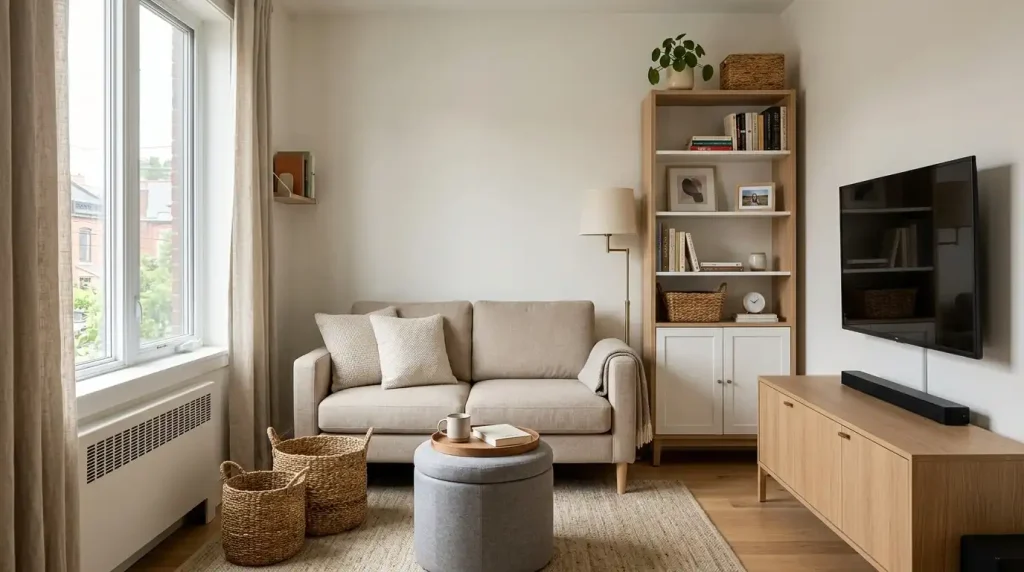
A storage ottoman can provide a footrest, extra seating, and concealed storage. A lift-top coffee table can provide a work surface as well as storage. A TV console can hold electronics while hiding cables and accessories.
The idea is not to buy multifunctional furniture simply because it sounds space-saving. The second function needs to be genuinely useful.
For example, if you already need a coffee table, choosing one with a lower shelf or hidden compartment can add storage without introducing another piece of furniture. If you rarely use the storage function, however, a bulky multifunctional piece may simply make the room harder to move around.
Recent small-space furniture guidance makes the same distinction: a multifunctional piece only truly saves space when both functions are useful and the furniture still works comfortably within the room.

Good places to combine storage and function
- Ottoman + hidden storage
- Coffee table + drawers or shelf
- Bench + concealed compartment
- Side table + drawer
- TV console + closed cabinets
- Console table + lower storage
- Bookcase + room divider
The best piece is usually the one that replaces something you already need, rather than adding another object to the room. If you want more ideas for styling the coffee table itself once storage is sorted, see how to style your coffee table like a pro.
Use Vertical Space Before Taking More Floor Space
When a living room is short on floor space, the walls become more valuable.
A tall, narrow bookcase can hold books, baskets, plants, and selected decor without spreading storage across the entire floor. Floating shelves can make use of wall space above furniture. A tall cabinet can provide concealed storage while keeping its footprint relatively compact.
This is one of the most reliable strategies for small apartments because the room’s height often remains underused.
But vertical storage does not mean covering every wall with shelves.
Too many open shelves can create the opposite effect: instead of making the room feel organized, they can give every small object a visible place to compete for attention.
A better approach is to decide which walls should remain visually quiet.
For example, you might use one tall shelving unit for books and display while keeping the TV wall relatively simple with a low closed console.
That creates storage density without visual density.

Use Corners and Narrow Gaps Intentionally
Corners are often treated as leftover space, but they can be useful when the storage is scaled correctly.
A tall, narrow shelving unit can work beside a sofa, near a doorway, or in an otherwise awkward corner. A slim cabinet can provide hidden storage without requiring the footprint of a full-size sideboard. If you’re working with a corner that’s currently empty rather than cluttered, see how to decorate an empty living room corner on a budget for ideas that work alongside storage.
The important part is to measure the space first.
Do not buy furniture simply because its listed width looks small. Measure:
- Available width
- Available depth
- Ceiling height
- Door and drawer clearance
- Walking space around it
- Nearby outlets
- Window and curtain clearance
A storage unit that fits into a corner but forces people to squeeze past it is not a successful small-space solution.
Clear circulation is part of good storage design.
Think About Depth, Not Just Width
One of the easiest mistakes in a small living room is choosing furniture based only on how wide it is.
Depth can have an even bigger effect on how the room feels.
A cabinet that extends too far into the room can reduce the usable walkway. A deep bookcase may hold more items but can make a narrow room feel crowded. A shallow shelf may provide less capacity but preserve more floor space.
This is why “more storage” is not always the right goal.
You want the right amount of storage for the space it occupies.
For books, baskets, and small objects, a relatively shallow shelving unit may be enough. For larger electronics or household items, deeper closed storage may make more sense.
Measure the actual items you need to store instead of assuming that a larger cabinet will automatically be better.
Choose Between Open and Closed Storage Based on What You Own
Open and closed storage solve different problems.
Open storage works best when:
- You want books within easy reach
- You are displaying a small number of decorative objects
- You want the furniture to feel visually lighter
- You can keep the shelves edited
- You want to access items quickly
Closed storage works better when:
- You have cables and electronics
- You store paperwork
- You have toys or small miscellaneous items
- You want fewer objects visible
- Your living room already contains a lot of visual detail

A combination of both is often more practical than choosing only one.
For example, a media console might have closed cabinets underneath and one open shelf for books or decor.
IKEA’s current living-room storage guidance similarly recommends combining closed storage for less attractive everyday items with open or glass-front storage for selected things you want to display.
The important point is not whether open or closed storage is universally better.
It is what you are putting inside it.
Give Everyday Clutter a Home Near Where It Happens
Storage works best when it follows your habits.
If blankets are always left on the sofa, put a basket or storage ottoman beside the sofa. If remotes disappear into the cushions, give them a drawer or small container within reach. If chargers always collect beside the TV, create a dedicated cable and electronics zone in the media console. If books keep piling up beside your favorite chair, place a narrow bookcase or small side table there.
A simple rule is:
The more frequently you use something, the easier its storage should be to reach.
Less frequently used items can go into higher cabinets, deeper drawers, or less accessible areas. That makes the storage system easier to maintain because putting something away does not feel like another task.
Make the TV Area Part of the Storage Plan
The TV area can become one of the biggest sources of small-item clutter.
Remote controls, controllers, cables, routers, gaming accessories, DVDs, books, and other electronics often gather around the media area.
Instead of treating the TV stand as something that only holds the television, make it part of the room’s organization.
Use closed cabinets for items you do not want visible and open shelves for a limited number of books or decorative objects.
Keep cables grouped rather than allowing them to spread across the back or sides of the unit.
If the TV wall is already visually busy, closed storage can help create a calmer appearance.
If the room has very little floor space, a shallower media console may be more useful than a large entertainment center that extends deep into the room.
Use Storage to Define an Open-Plan Apartment
In a studio or open-plan apartment, the living room may share space with a dining area, workspace, or bedroom.
Storage can help define these zones without requiring a permanent wall.
A low bookcase behind a sofa, for example, can separate the seating area from another zone while still allowing light and sightlines to pass through.
A console behind the sofa can also provide:
- A surface for lamps or decor
- Drawers or baskets
- A visual boundary
- A place to store everyday items
The key is to avoid turning the storage piece into a solid barrier.
In an open apartment, the best divider is often one that organizes without making the room feel smaller.

Make Small Storage Pieces Do Specific Jobs
Baskets, boxes, and small containers are useful when they have a clear purpose.
A basket labeled mentally as “living room stuff” can quickly become a collection of unrelated clutter.
Instead, give each container a simple category:
- Throw blankets
- Pet toys
- Children’s toys
- Remotes and accessories
- Chargers
- Magazines
- Craft supplies
You do not need a separate container for every object.
The goal is to create broad enough categories that putting something away takes only a few seconds.
If you need to reorganize the entire container every time you use it, the category is probably too broad or the storage is too small.
Keep Renter-Friendly Storage Flexible
Renters often have fewer options for built-in cabinets and permanent wall storage.
That does not mean the living room has to remain cluttered.
Freestanding bookcases, slim cabinets, storage ottomans, baskets, side tables, and modular shelving can provide substantial storage without permanently changing the room.
If you are considering wall-mounted storage, always check your lease and the requirements of your rental before drilling or installing anything.
For renters, flexibility is also valuable.
A freestanding shelf can move to another wall, room, or apartment later. A modular unit can sometimes be rearranged as your needs change.
That makes movable storage particularly useful when you are not certain how long you will stay in the apartment. Many of the same freestanding, no-drill principles also apply to DIY home decor projects you can build or adapt yourself.
If the Living Room Is Also Your Home Office
Small apartments often require one room to perform several jobs.
If your living room doubles as a workspace, avoid allowing work materials to permanently spread across the seating area.
Instead, create a defined work-storage zone.
A compact cabinet, drawer unit, or attractive storage box can hold:
- Notebooks
- Chargers
- Documents
- Stationery
- Headphones
- Small office equipment
At the end of the workday, the goal should be to clear the work surface without having to move everything into another room.
This is another reason storage should follow routine rather than just available space.
Use Underused Space Without Filling Every Gap
You may have storage opportunities underneath furniture, beneath a console, or inside an ottoman.
These spaces can be useful for items you do not need constantly.
Think about:
- Seasonal decor
- Extra cushions
- Board games
- Spare blankets
- Hobby supplies
- Rarely used accessories
But do not feel obligated to fill every empty space.
A little empty space makes storage easier to access and gives the room a visual breathing room. Current organizing advice increasingly emphasizes leaving some capacity rather than filling shelves, drawers, and containers to their limits.
A storage system that is already full on day one leaves no room for the next thing you need to put away. Seasonal items in particular are worth reviewing against a seasonal home decor guide so you’re only storing what you’ll actually rotate back into the room.
When More Storage Is Actually the Wrong Solution
Sometimes the living room does not need another storage unit.
It needs fewer things.
If you already have shelves, baskets, cabinets, and drawers but the room still feels crowded, look at what you are storing.
Ask:
Does this belong in the living room?
Do I use it often enough to justify keeping it here?
Would another room be a better home for it?
Does it need to be visible?
Could several similar items be reduced to one category?
This is particularly important in a small apartment because storage furniture also consumes space.
Adding another cabinet may hide the clutter while simultaneously making the room more difficult to use.
The better solution may be to remove items first and then design storage around what remains.
A Better Way to Plan Living Room Storage
You do not need to reorganize the entire room in one afternoon.
Start with the area that causes the most daily frustration.
If the coffee table is always covered, solve that first. If the sofa is surrounded by blankets, create nearby blanket storage. If the TV area is full of cables and electronics, reorganize the media zone. If books are taking over every surface, create a dedicated book-storage area.
Then live with the change for a while.
You will learn something important from your habits: which items you actually reach for, which storage locations are convenient, and which solutions you never use.
That information is more useful than buying storage based only on how attractive it looks in a showroom or Pinterest image.
How to Make Small Living Room Storage Look Intentional
Good storage should support the room’s design rather than looking like an afterthought.
Keep the visual language consistent where possible.
For example, several matching baskets can create a calmer appearance than a collection of unrelated boxes. A limited number of objects on open shelves will usually feel more intentional than filling every shelf.
You can also repeat materials or finishes across the room:
- Similar wood tones
- Related basket textures
- Coordinated storage boxes
- Consistent hardware
- A restrained color palette
The goal is not to make everything identical.
It is to prevent the storage itself from becoming another source of visual noise.
This matters especially in small rooms because every large furniture piece has a stronger visual effect. For more on tying finishes and accents together on the walls around your storage, see metal wall art ideas for a modern living room.
The Storage Solution Should Fit the Room, Not the Other Way Around
There is no single best storage solution for every small apartment living room.
A reader with lots of books may need vertical shelving. Someone with children may benefit more from closed cabinets and accessible baskets. A renter may prioritize freestanding storage. Someone working from home may need concealed office storage. A studio apartment may benefit from storage that also creates zones.
The right choice depends on what the room needs to store, where clutter appears, how much floor space is available, and how much of the storage you want visible.
That is why the most useful approach is not to copy a room from a photo.
Study your own room first, then choose the storage that solves its specific problem. Browse the full living room category for more layout and styling ideas once your storage plan is in place.
FAQ
How can I add storage to a small apartment living room without making it feel crowded?
Use furniture that already belongs in the room, such as an ottomans, coffee tables, side tables, or TV consoles with useful storage. Add vertical storage while keeping walking paths clear.
What is the best storage for a very small living room?
Multifunctional furniture works well when floor space is limited, while tall narrow shelving helps when wall height is available. Closed cabinets are useful when visible clutter is the main problem.
Is open or closed storage better for a small living room?
A combination usually works best. Use open storage for books and selected decor, and closed storage for cables, paperwork, toys, electronics, and miscellaneous items.
How do I store blankets in a small living room?
A storage ottoman or basket beside the sofa keeps blankets close to where they are used. Less frequently used blankets can go under furniture or in a closed cabinet.
How can renters add living room storage without drilling?
Use freestanding shelving, narrow bookcases, cabinets, storage ottomans, baskets, and side tables. Check your rental agreement before installing wall-mounted storage.
How do I know if I need more storage or less stuff?
If your existing storage is already full and the room still feels crowded, decluttering may be more effective than adding another unit.
How can I hide clutter without making my living room look boring?
Use closed cabinets for everyday clutter and keep open shelves for a smaller selection of books, plants, art, and decorative objects. Repeating a few materials or finishes can help practical storage feel integrated into the room’s design.
Key Takeaways
- Start with what is creating clutter, not with a storage product.
- Let furniture perform more than one useful job when possible.
- Use vertical space when floor space is limited.
- Pay attention to depth and walking space, not just furniture width.
- Combine open and closed storage according to what you need to keep.
- Store frequently used items close to where you use them.
- Use storage to create zones in open-plan apartments.
- Renters can rely on flexible, freestanding solutions.
- Do not fill every shelf, basket, or cabinet simply because the space exists.
- If the room is still crowded after organizing, declutter before adding more storage.
The best living room storage for a small apartment is not the solution that holds the most stuff. It is the solution that makes everyday life easier while allowing the room to remain comfortable, functional, and visually calm.
Related Next Steps
- Living Room Decor Ideas — Build storage into the overall look and layout of the room.
- Decorate an Empty Living Room Corner on a Budget — Learn how furniture placement and corner styling affect the way a compact room feels.
- Living Room Category — Explore more ways to use unused wall height and layout space beyond storage alone.
- Home Decor Guide — Extend the same storage and organization principles to the rest of the apartment.
- DIY Home Decor Ideas — Find ways to personalize practical storage without relying entirely on new furniture.
Join the Conversation
What Do You Think?