

Yes, metal wall art can be an excellent choice for a modern living room. Its clean lines, depth, texture, and interaction with light can complement modern interiors particularly well.
But the material alone does not determine whether it will look good. The result depends on scale, design, finish, placement, lighting, and the visual details already in the room.
A simple geometric piece can make a plain living room feel more intentional. An undersized, overly detailed, or highly reflective piece can make the same room feel disconnected or visually busy.
The easiest way to decide is to ask:
Does the metal art strengthen the room’s existing visual structure, or am I simply filling an empty wall?
If it strengthens the room, metal wall art will usually work.
Quick Decision: Is Metal Wall Art Right for Your Living Room?
| If your living room has… | Consider… |
| Clean lines and simple furniture | Geometric, abstract, or linear metal art |
| A large empty wall | One larger statement piece |
| Neutral colors | Black, bronze, brass, or textured finishes |
| Lots of soft textiles | Organic shapes or warmer metallic finishes |
| Strong patterns already | A simple, low-detail design |
| Low natural light | Matte or lightly reflective finishes |
| A small wall | Open designs with visible negative space |
| A busy room | One simple piece rather than several small pieces |
The biggest mistake is treating metal wall art as a separate object. It should relate to the sofa, wall color, lighting, furniture shapes, and other materials already in the room.
Why Metal Wall Art Works in Modern Living Rooms
Modern living rooms often rely on simple forms, open surfaces, and restrained decoration. That can create a clean appearance, but it can also leave a room feeling flat.
Metal wall art can add dimension without introducing another large pattern or block of color.
Unlike a flat print, dimensional metal art can:
- Create subtle shadows
- Add texture to a plain wall
- Contrast with soft upholstery
- Echo architectural lines already present in the room
- Create a focal point without requiring many accessories
One of its biggest advantages is the relationship between light, shadow, and depth.
For example, a black linear metal sculpture above a cream sofa may look understated during the day but develop more visible shadows when illuminated from the side in the evening.
This makes metal particularly useful when you want a modern living room to feel more layered without adding lots of decorative objects.
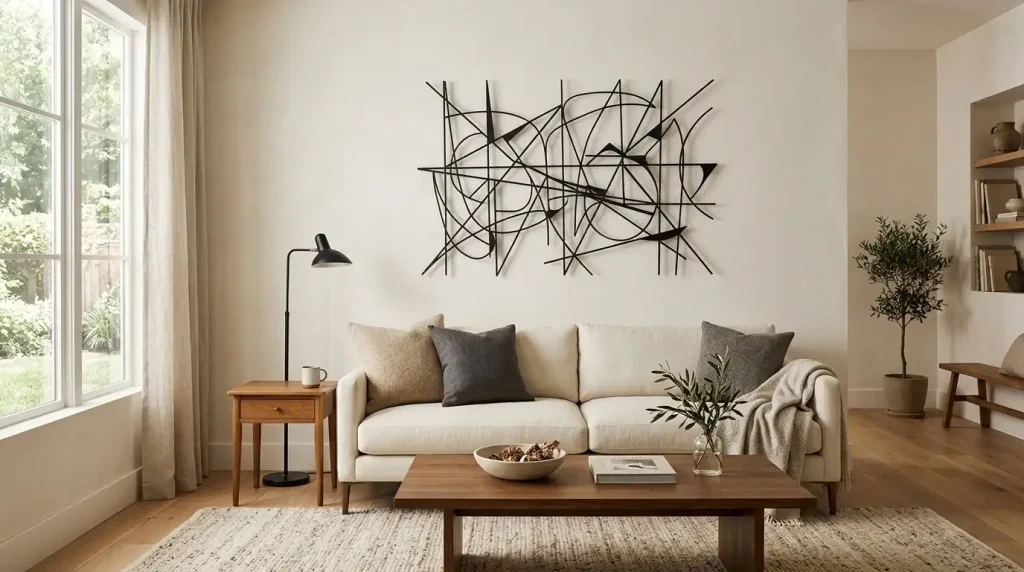
The finish matters too
A highly polished surface can create strong reflections, especially near windows or direct lighting. Matte, brushed, or lightly textured finishes tend to produce a more controlled appearance.
So the question is not simply:
“Is metal wall art modern?”
A better question is:
“What type of metal wall art fits the visual character of my room?”
Match the Metal Art to Your Room’s Visual Language
The best metal wall art usually looks as though it belongs in the room before you notice it as a separate decoration.
Start by looking at the visual language of your living room.
Consider:
- Are the furniture lines mostly straight or curved?
- Are the surfaces mostly soft or hard?
- Is the room mostly matte or reflective?
- Does the room already have strong patterns?
- Does the space need warmth, structure, or more visual depth?
Choose Geometric or Linear Art for a Clean Modern Room
A living room with straight-lined sofas, slim furniture legs, rectangular windows, or simple lighting often works well with:
- Geometric shapes
- Abstract lines
- Grid-style compositions
- Minimal architectural forms
- Simple asymmetrical designs
These designs repeat shapes already found in the room, which makes the artwork feel connected to the space.
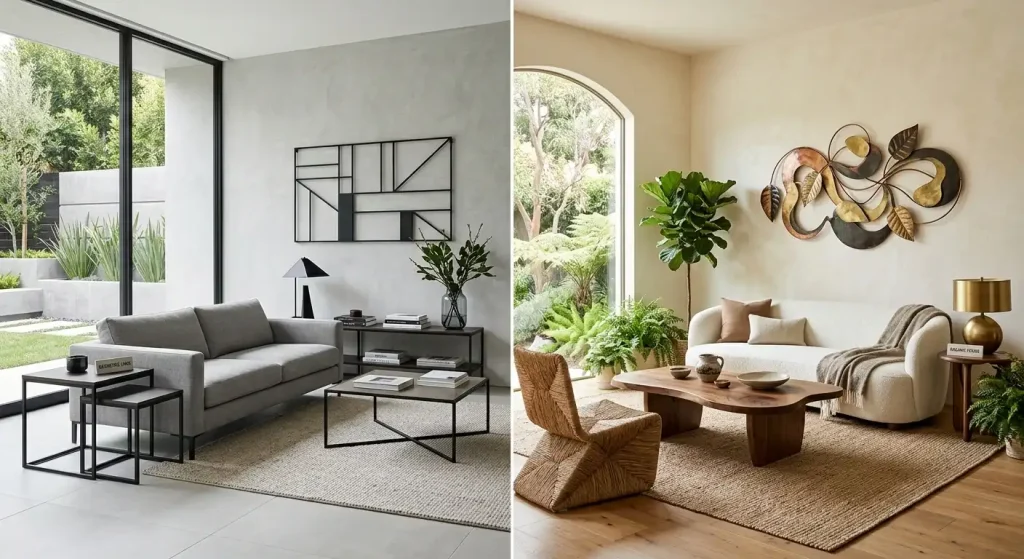
Choose Organic Metal Art When the Room Feels Too Hard
Not every modern living room needs sharp lines.
If your room includes:
- A curved sofa
- Natural wood
- Bouclé or textured upholstery
- Rounded tables
- Plants
- Stone surfaces
then organic metal designs may create better balance.
Look for:
- Abstract curves
- Branch-inspired forms
- Leaf shapes
- Flowing lines
- Irregular sculptural compositions
This creates a useful contrast:
soft materials → structured metal → visual balance
The metal adds structure while the organic form prevents the room from feeling overly rigid.
Be Careful With Highly Detailed Designs
Detailed metal art can become visually heavy.
A large, relatively simple room may support an intricate sculptural piece. A smaller living room that already contains patterned rugs, decorative pillows, shelving, plants, and multiple furniture finishes may not.
In a visually busy room, use this rule:
More wall presence, less design complexity.
One larger, simple piece can often look calmer than several small, detailed decorations.
How Big Should Metal Wall Art Be Above a Sofa?
Scale is often more important than the material itself.
A beautiful piece can still look wrong if it is too small for the furniture below it.
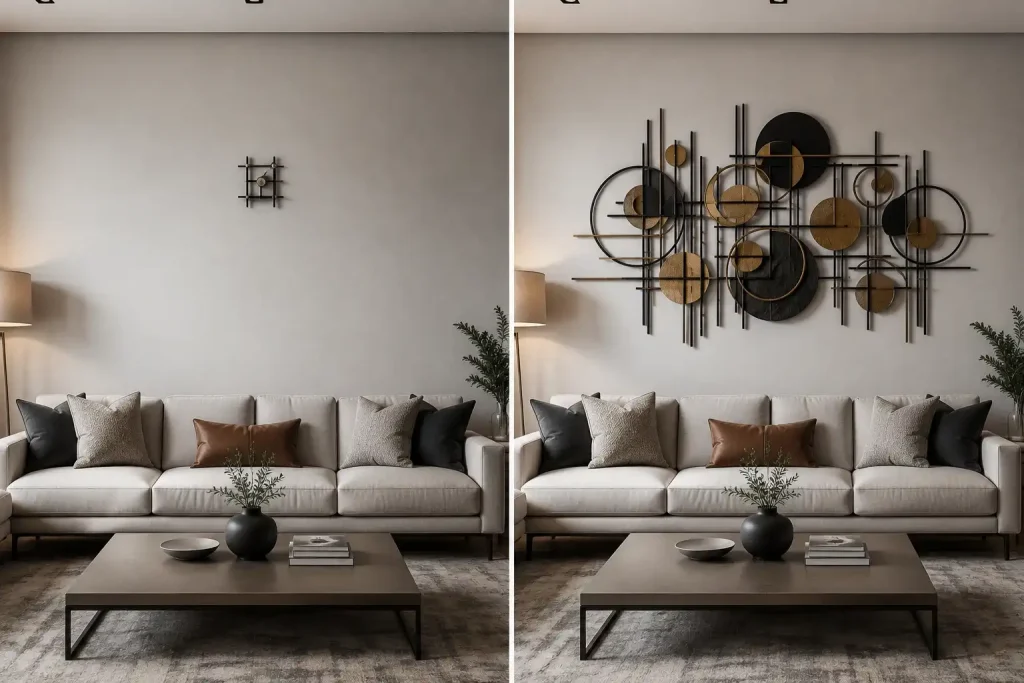
When artwork is placed above a sofa, a useful starting point is roughly two-thirds to three-quarters of the sofa’s width. This is a practical guideline, not a strict design rule.
Example
If your sofa is 84 inches wide, a combined artwork width of approximately 50 to 63 inches can be a useful starting range.
That could mean:
- One large horizontal piece
- A two-panel arrangement
- Three connected panels
- One open sculptural composition
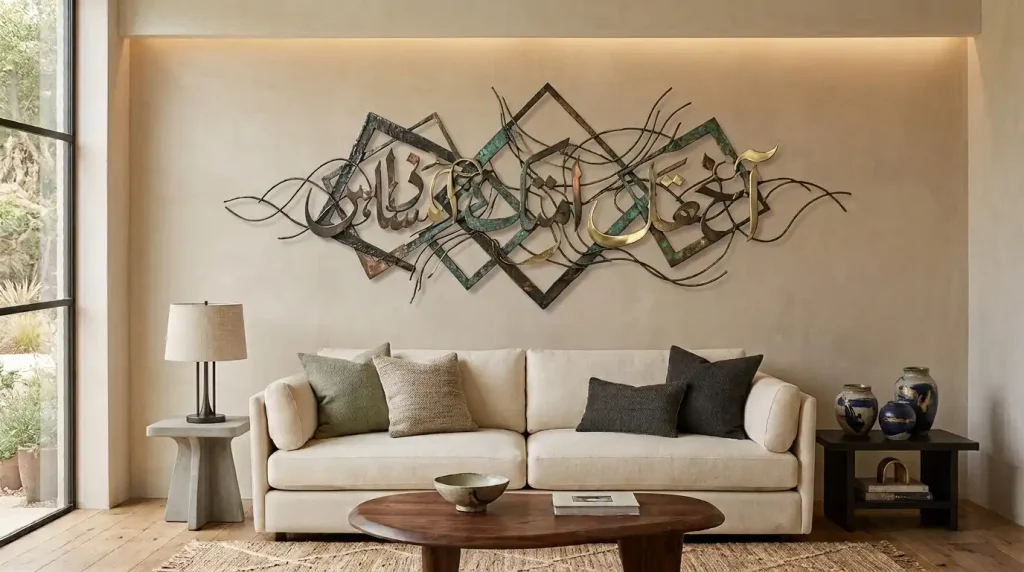
But do not measure the sofa alone.
Also consider:
- Available wall width
- Ceiling height
- Side tables
- Lamps
- Windows
- Doorways
- The amount of empty wall around the seating area
Center the Art Around the Seating Area
In an open-plan living room, the entire wall may not be visually centered around the sofa.
If the sofa is offset because of a window, doorway, fireplace, or room layout, centering the artwork on the entire wall can make the seating area feel disconnected.
Instead, think:
art → sofa → seating zone
rather than automatically:
art → entire wall
The artwork should visually anchor the furniture it belongs to.
Which Metal Finish Works Best in a Modern Living Room?
There is no single best metal finish. Choose one based on the colors, materials, and lighting already present.
Matte Black: Best for a Clean Architectural Look
Matte black works especially well with:
- White walls
- Cream walls
- Light wood
- Gray upholstery
- Minimalist furniture
It provides strong contrast without introducing another dominant color.
One limitation: black metal can disappear against a very dark wall. In that situation, look for texture, depth, or enough lighting to create separation.
Bronze and Warm Brown: Best for Adding Warmth
Bronze, aged brass, and warm brown metallic finishes can soften a modern room.
They pair naturally with:
- Oak
- Walnut
- Beige upholstery
- Warm neutrals
- Earthy colors
- Soft ambient lighting
These finishes are particularly useful when the room already feels modern but slightly cold.
Brass and Gold: Use as an Accent
Brass or gold metal art can add warmth and visual interest.
For a modern living room, brushed, aged, or muted finishes are generally easier to integrate than highly polished gold.
If the room already has several decorative metallic accents, keep the artwork simpler so it does not become the dominant element.
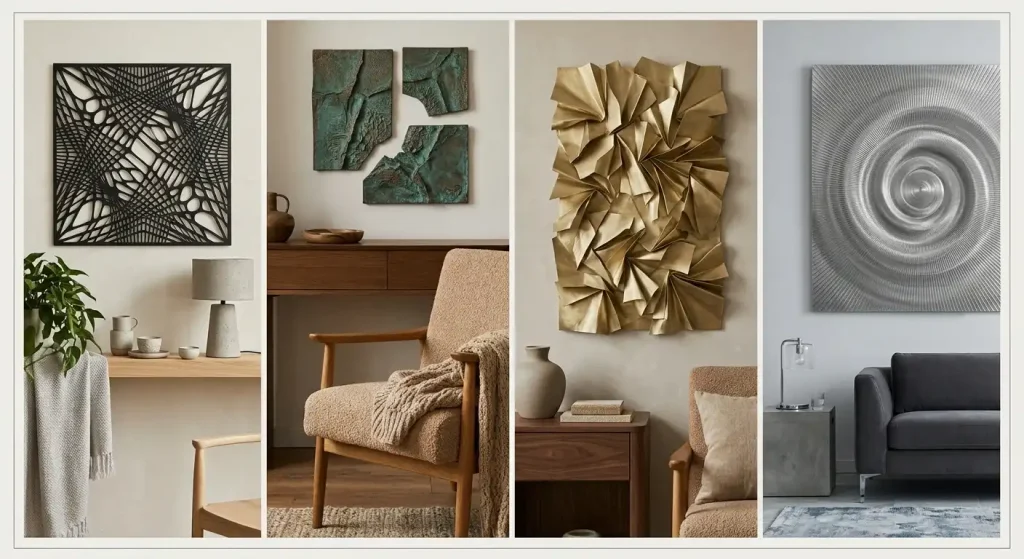
Silver and Chrome: Best for Contemporary Spaces
Silver-toned metal can work well with:
- Black
- White
- Gray
- Glass
- Cool-toned stone
The main risk is visual coldness.
If the room already contains chrome lighting, steel furniture, glass, and gray surfaces, adding another highly reflective metal element may make the space feel sterile.
Balance it with:
- Wood
- Textiles
- Plants
- Warm lighting
- Softer upholstery
Use the Contrast Triangle to Choose the Right Metal Art
A useful DecorHubs styling principle is the Contrast Triangle.
Look at three characteristics of your living room:
- Form — Are the dominant shapes straight or curved?
- Surface — Are the materials mostly soft or hard?
- Finish — Are surfaces mostly matte or reflective?
Then choose metal wall art that creates contrast in one or two areas, rather than trying to contrast everything at once.
Example
Imagine a living room with:
- Straight-lined furniture
- Soft upholstery
- Mostly matte surfaces
A good choice could be:
- Simple linear metal art
- Some sculptural depth
- A matte or lightly textured finish
The room already has softness, so the metal introduces structure.
Because the finish is not highly reflective, it does not add unnecessary glare or visual noise.
This makes the Contrast Triangle more useful than simply asking whether metal art is “modern.” It helps answer the more important question:
Which metal design is right for this particular room?
Where Should You Place Metal Wall Art?
Above the Sofa
This is often the strongest location because the artwork can connect the wall to the room’s main seating area.
A horizontal piece generally works well above a wide sofa.
Avoid:
- Crowding the sofa with oversized artwork
- Hanging the piece so high that it looks disconnected
- Using a very small piece above a large sofa
The artwork should feel visually attached to the furniture without overwhelming it.
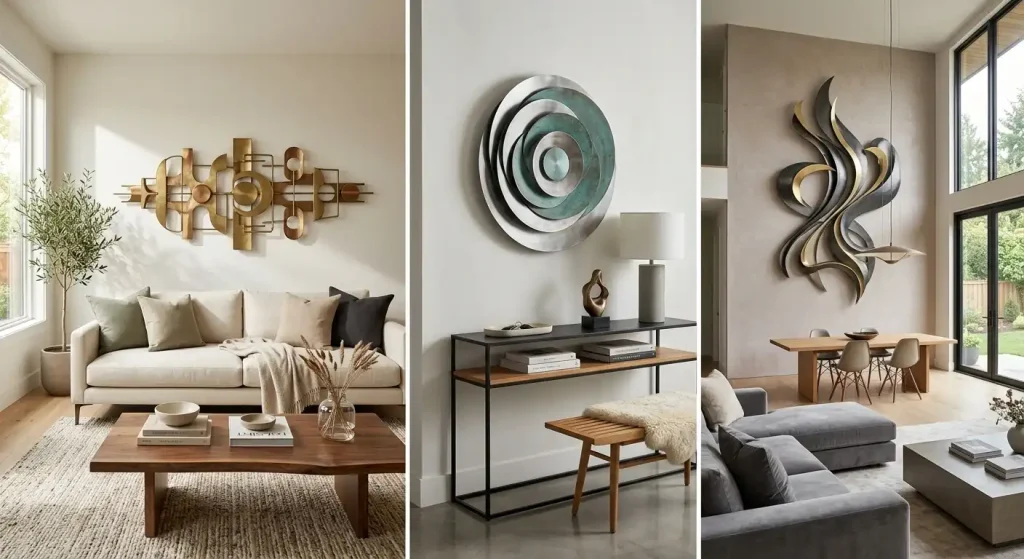
On an Empty Feature Wall
A large uninterrupted wall may be better suited to one statement piece than several small decorations.
Consider:
- Large abstract metal art
- Open geometric designs
- Multi-panel arrangements
- Sculptural compositions
Use the size of the wall as a guide, but always consider what is happening elsewhere in the room.
Above a Console Table
Metal wall art can add height and structure above a console.
This works especially well when the console is relatively simple and the wall above it feels empty.
The artwork should relate to the console’s width and visual weight rather than simply being centered on the available wall — the same proportion of thinking that applies when you style a coffee table or console surface applies to what you hang above it.
Near a Fireplace
Metal art can work around a fireplace, but check the room’s focal-point hierarchy first.
If the space already has:
- A television
- A large fireplace surround
- Built-in shelving
- A mirror
- Statement lighting
then another dominant decorative element may create competition.
Sometimes the most balanced choice is no additional wall art.
Is Metal Wall Art Good for a Small Modern Living Room?
Yes, but small rooms benefit from more restraint.
A common mistake is choosing a tiny piece simply because the room is small.
That can make the artwork look lost rather than intentional.
Instead, consider:
- One correctly proportioned piece
- An open design with negative space
- A thin-profile design
- A lighter or wall-blending finish
- Simple shapes
- Limited visual detail
Open metal artwork can create wall presence without visually covering the wall like a solid block.
This gives a small room a useful middle ground between:
- A large, visually heavy artwork
- A tiny decoration that disappears
The goal is not necessarily small art for a small room.
The goal is appropriate visual weight for the room.
Can Renters Use Metal Wall Art?
Yes. Renters can use metal wall art, but the mounting method matters.
Before installing anything, check:
- The artwork’s weight
- The manufacturer’s mounting instructions
- The type of wall
- Whether your lease restricts certain hardware
- Whether the mounting system requires drilling
For lighter pieces, approved removable hanging solutions may be an option if their weight rating and wall compatibility are appropriate.
For heavier metal artwork, use hardware designed for the wall construction and the actual load. Do not assume that a standard picture hook is suitable.
If permanent installation is not practical, consider:
- Lightweight metal designs
- Smaller sculptural pieces
- Leaning artwork where safe and appropriate
- A DIY, lower-commitment decor approach using removable mounting solutions rated for the artwork
The key is to choose the mounting method based on weight and wall type, not appearance alone.
When Is Metal Wall Art the Wrong Choice?
Metal wall art is not automatically the best solution for every modern living room.
Consider another material when:
The Room Already Has Too Many Hard Surfaces
A room dominated by glass, stone, steel, polished flooring, and minimal textiles may need softness rather than more structure.
Consider:
- Textile wall art
- Warm-toned artwork
- Natural materials
- Canvas
- Wood-based pieces
You Want the Wall to Disappear
Metal artwork usually adds some combination of contrast, texture, shadow, or reflection.
If you want an almost invisible, quiet wall, adding metal may work against that goal. A more tonal treatment, like subtle living room wallpaper in a low-contrast pattern, can sometimes achieve that “quiet wall” look more effectively than art of any material.
The Room Already Has Several Focal Points
Too many focal points compete for attention.
For example:
fireplace + television + gallery wall + statement lighting + large metal art
can make a living room feel fragmented.
Choose one primary feature and let the other elements support it.
The Artwork Is Much Too Small
An undersized piece can look more accidental than intentional.
If you cannot find the right size, consider:
- Waiting for a better-sized piece
- Using a connected multi-panel arrangement
- Choosing another artwork format
An empty wall can look better than artwork that clearly does not fit the space.
Metal Wall Art vs. Canvas: Which Is Better?
Neither is universally better.
The right choice depends on what your living room needs.
| If your room needs… | Consider… |
| More depth and texture | Metal wall art |
| A sculptural focal point | Metal wall art |
| More color | Canvas or framed art |
| Visual storytelling | Canvas, photography, or prints |
| A softer atmosphere | Canvas or textile art |
| An architectural feel | Metal wall art |
| Detailed imagery | Canvas, photography, or prints |
| More flexibility when changing styles | Prints or framed art |
| Light and shadow as part of the decor | Metal wall art |
The real decision is not simply:
Metal vs. canvas
It is:
Do I need more dimension, or do I need more color and imagery?
That question usually makes the choice much easier.
How Lighting Changes the Look of Metal Wall Art
Metal artwork should be evaluated together with the room’s lighting.
In Strong Natural Light
Highly reflective finishes may create glare or distracting reflections.
Matte and brushed finishes are generally easier to control in bright rooms.
In Soft Evening Light
Dimensional metal can create subtle shadows that make the artwork appear more layered.
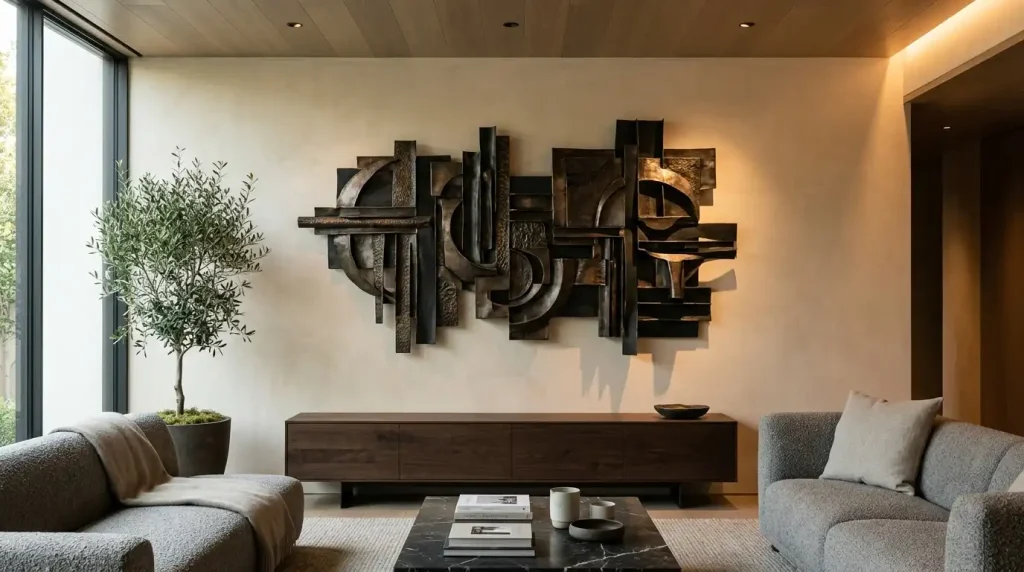
With Direct Accent Lighting
Accent lighting can make textured or layered metal art more dramatic.
However, strong directional light can also create harsh shadows.
Before permanently installing a large piece, test how it looks at different times of day:
- Morning
- Afternoon
- Evening
- With lamps turned on
This simple test helps you choose a finish based on how it actually behaves in your home rather than relying only on a product photograph.
What to Check Before Buying Metal Wall Art
1. Measure the Wall and Furniture
Record:
- Sofa width
- Available wall width
- Ceiling height
- Distance from the sofa to the ceiling
- Nearby windows and doors
Use these measurements before choosing the artwork size.
2. Check the Depth
Some metal pieces sit close to the wall. Others project outward and create deeper shadows.
If the artwork is near a walkway, excessive depth can become impractical.
3. Check the Weight and Mounting System
Large metal artwork may require different hardware depending on:
- Artwork weight
- Wall construction
- Mounting system
Follow the manufacturer’s instructions and use hardware appropriate for the actual load.
For heavy pieces, avoid guessing.
4. Check the Edges and Finish
For living-room use, look for:
- Smooth edges
- Secure connections
- Consistent finish
- No exposed sharp corners in traffic areas
This is especially important when the artwork projects outward from the wall.
5. Visualize It at Full Size
A design can look beautiful in a product photograph but feel completely different from across the room.
Before buying, use:
- Painter’s tape
- A paper template
- A room-planning tool
Mark the approximate dimensions on the wall and step back.
The goal is to judge visual scale, not just whether you like the design up close.
How to Maintain Metal Wall Art
Maintenance depends on the metal and finish, so always follow the manufacturer’s care instructions first.
For general upkeep:
- Dust the surface regularly with a soft, dry cloth.
- Avoid abrasive cleaners that could scratch the finish.
- Do not use harsh chemicals unless the manufacturer specifically recommends them.
- Check textured or layered pieces for dust buildup.
- Keep an eye on any visible coating damage or corrosion, especially in humid environments.
For indoor living-room artwork, simple, gentle maintenance is usually preferable to aggressive cleaning.
Common Mistakes to Avoid
1- Choosing Metal Art Simply Because the Wall Is Empty
An empty wall does not automatically need artwork.
First ask whether the room actually needs:
- Art
- Lighting
- Storage
- A mirror
- More warmth
- Or simply more visual breathing room
See our guide on decorating an empty living room corner on a budget for lower-commitment ways to fill a bare space.
2- Ignoring Existing Patterns
If the rug, pillows, curtains, furniture, and accessories already contain strong shapes, highly detailed metal artwork can create too much competition.
3- Going Too Small
If the piece looks like a small object floating above a large sofa, the problem is usually proportion.
4- Hanging It Too High
Artwork should relate visually to the furniture below it.
A piece that is technically centered on the wall can still feel too high for the seating area.
5- Matching Every Metal Finish Exactly
Your wall art does not have to perfectly match every lamp, table leg, cabinet handle, and other metallic detail.
Modern rooms often feel more natural when finishes are coordinated rather than identical.
6- Choosing the Finish Without Considering Light
A finish that looks beautiful in a showroom or product photograph may create unwanted glare beside a bright window.
Always consider the actual lighting conditions in your room.
Frequently Asked Questions
Is metal wall art still popular for modern living rooms?
Yes. Metal wall art remains a useful option for modern interiors because it can add depth, texture, structure, and light-and-shadow effects without requiring many decorative objects. The key is choosing a piece that fits the room’s scale and visual language.
What color metal wall art is best for a modern living room?
There is no universal best color. Matte black works well for strong architectural contrast, while bronze and warm metallic finishes can add warmth. Silver and chrome suit cooler contemporary rooms, while brushed brass can work as a warm accent.
How big should metal wall art be above a sofa?
A useful starting point is artwork that is roughly two-thirds to three-quarters of the sofa’s width. For example, an 84-inch sofa could work with a combined artwork width of approximately 50–63 inches. Always adjust for the wall, ceiling height, surrounding furniture, and overall visual balance.
Does metal wall art make a small living room look smaller?
Not necessarily. Open designs with negative space can actually provide visual presence without making the wall feel covered. In a small room, avoid overly heavy designs and choose artwork with appropriate scale and visual weight.
Is metal wall art better than canvas for a modern living room?
Neither is always better. Metal is particularly useful when the room needs depth, texture, structure, or sculptural interest. Canvas and framed art may be better when the room needs more color, imagery, storytelling, or softness.
Should metal wall art match other metal finishes in the room?
No. It does not need to match every metallic detail exactly. Coordinating finishes is usually more important than creating a perfect match. Consider the overall warmth, contrast, and visual balance of the room.
Final Verdict: Is Metal Wall Art Good for a Modern Living Room?
Yes—when it fits the room’s scale, visual language, lighting, and overall balance.
Metal wall art works particularly well in modern living rooms because it can introduce:
- Depth
- Shadow
- Texture
- Structure
- Contrast
without requiring a large collection of decorative accessories.
The strongest choice is usually one that:
- Is correctly sized for the furniture below it
- Complements the room’s dominant shapes
- Uses a finish that works with the lighting
- Adds contrast without making the room feel colder
- Creates one clear focal point
- Feels connected to the room rather than randomly placed on the wall
If your room is already busy, choose a simpler design.
If your room feels flat, consider a dimensional piece.
If your room feels cold, balance metal with warm wood, textiles, plants, and softer finishes.
The material is not what makes the art modern. The relationship between the art and the room does.
Key Takeaways
- Yes, metal wall art can work very well in a modern living room.
- Scale is often more important than the material itself.
- Use geometric and linear designs in clean architectural spaces.
- Use organic forms when a room needs softness or contrast.
- Matte and textured finishes are often easier to integrate than highly reflective finishes.
- Open metal designs can work particularly well in smaller rooms.
- Consider natural and artificial lighting before choosing a finish.
- The artwork should relate to the sofa, furniture, wall, and overall room layout.
- Metal does not need to perfectly match every other metallic finish.
- Do not add metal art simply because a wall is empty.
Related Reading
- Living Room Decor Ideas — more ways to style walls, furniture, and focal points in your living room.
- Decorate an Empty Living Room Corner on a Budget — lower-commitment options if you’re not ready to commit to a large metal piece yet.
- How to Style Your Coffee Table Like a Pro — apply the same proportion and balance thinking to the furniture beneath your wall art.
- Living Room Wallpaper Ideas — an alternative if you want your wall to feel quieter rather than more sculptural.
- DIY Home Decor Ideas — budget and renter-friendly ways to decorate before investing in a statement piece.
- Home Decor Guide — start here to define your room’s overall style direction.
Sources
- U.S. Consumer Product Safety Commission, “Anchor It!” public safety campaign on securing wall-mounted and top-heavy items: https://www.cpsc.gov/Safety-Education/Safety-Education-Centers/AnchorItgov
- U.S. Consumer Product Safety Commission, Tipover Prevention Project technical report on anchoring hardware and connection-point strength: https://www.cpsc.gov/s3fs-public/pdfs/Tipover-Prevention-Project-Anchors-without-Tools.pdf

Join the Conversation
What Do You Think?