Home decor is the practice of arranging furniture, color, texture, lighting, and accessories to make a living space functional and visually pleasing. It covers everything from picking a paint color to choosing the right rug size to layering seasonal accents. Get it wrong and a room feels flat, cluttered, or oddly cold no matter how expensive the furniture is. Get it right and even a rented studio apartment can feel like a home you’re proud to invite people into.
In this guide you’ll learn:
- What home decor actually means and how it differs from interior design
- How to figure out your personal home decor style before you buy anything
- A room-by-room framework for decorating any space in your house
- How to use color, lighting, and layout like a professional
- Budget-friendly and DIY home decor strategies that actually look good
- The most common home decorating mistakes and how to avoid them
How to Decorate Your Home: A Step-by-Step Process
Decorating a home from scratch can feel overwhelming, but it becomes manageable when broken into a clear sequence. This is the exact process DecorHubs recommends for anyone starting with an empty or half-furnished room.
Step 1: Define Your Function First
Before choosing a single color or item, write down what the room actually needs to do. A living room that hosts guests weekly needs different seating than one used mainly for solo TV watching.
Step 2: Choose a Home Decor Style
Pick one primary home decor style to anchor your decisions, whether that’s modern, farmhouse, minimalist, or traditional. Having a style reference point prevents the mismatched, showroom-floor look that happens when every piece is bought separately without a plan.
Step 3: Set a Realistic Budget
Decide how much you are comfortable spending on the room before you start shopping. Instead of following a fixed percentage split, prioritize spending according to what the space actually needs. Start with essential furniture and functional pieces, then account for lighting, rugs, window treatments, textiles, and accessories. If you already own some of these items, move more of your budget toward the areas that need the biggest improvement.
Step 4: Build the Foundation Pieces
Start with the largest, most permanent items first, such as your sofa, bed, or dining table, then build the rest of the room around their color and shape.
Step 5: Layer in Color and Texture
Add rugs, throw pillows, curtains, and blankets to introduce texture and tie your color palette together across the room.
Step 6: Add Lighting Layers
Combine ambient overhead light, task lighting like lamps, and accent lighting such as sconces or string lights so the room works at every time of day.
Step 7: Finish With Personal Accessories
Bring in art, plants, books, and personal objects last, since these are what make a space feel lived-in rather than staged.
Step 8: Step Back and Edit
Walk away for a day, then come back and remove anything that feels unnecessary, since most rooms improve more from subtraction than addition.
What Is Home Decor?
Home decor is the process of using furniture, colors, textures, lighting, textiles, artwork, and accessories to make a home functional, comfortable, and visually cohesive. Unlike structural renovation, decorating generally works within the existing space rather than changing its underlying construction.
Many people think home decor is the same as interior design, but it’s not. Interior design is a professional field related to space planning, building codes, building technical plans and technical drawings. Interior decorating, on the other hand, simply looks at the look and feel of the interior and involves choosing furniture, color schemes, textiles and accessories but not the layout or structure.
Home Decor vs Interior Design vs Interior Decorating
| Aspect | Interior Design | Interior Decorating | Home Decor |
| What it means | Planning and shaping the function, layout, and overall interior environment of a space | Styling an existing space through furniture, colors, textiles, art, and accessories | The broader everyday approach to making a home attractive, comfortable, and personal |
| Main focus | Space planning, functionality, structure, and overall interior environment | Aesthetics, furniture, color schemes, materials, and styling | Personal style, decor choices, atmosphere, and visual appeal |
| Structural changes | May involve walls, electrical layouts, lighting plans, and other structural decisions | Usually works within the existing structure | Generally focuses on non-structural changes |
| Common elements | Layouts, lighting plans, built-ins, materials, and space functionality | Furniture, paint colors, curtains, rugs, artwork, and accessories | Wall art, cushions, rugs, furniture, plants, accessories, and seasonal pieces |
| Who uses it | Often involves an interior designer or design professional | Can be done by a decorator or by the homeowner | Anyone can use home decor ideas to style and personalize their space |
| Best for | Major renovations, new construction, or complex space-planning needs | Refreshing and styling an existing room | Everyday decorating, personalization, and creating a desired look or atmosphere |
The Core Elements of Home Decor
Every well-decorated room, regardless of style, is built from the same core building blocks. Professional decorators refer to these as the fundamentals of a room, and skipping any one of them is usually why a space feels unfinished.
- Color palette: the wall colors, furniture tones, and accent colors used throughout a room
- Furniture: the functional pieces like sofas, beds, tables, and storage
- Texture: the mix of materials such as wood, wool, linen, metal, and glass
- Lighting: ambient, task, and accent light sources
- Layout: how furniture and traffic flow are arranged in the space
- Accessories: art, pillows, rugs, plants, and decorative objects that add personality
Why Home Decor Matters in 2026
Home decor matters in 2026 because Americans are spending more time at home than they did a decade ago, and that shift has made the home environment a bigger factor in daily wellbeing. Research on residential environments has linked higher levels of household clutter to increased stress, anxiety, and depressive symptoms among adults, a pattern documented in a peer-reviewed study on residential environment and mental health as well as UCLA’s long-running CELF research on clutter and cortisol levels.
A well decorated home affects mood, productivity, and even how guests perceive your household. Organized, well-lit spaces are widely associated with improved focus and lower anxiety.
The Rise of Personal Style Over Trend-Chasing
A major shift shaping home decor in 2026 is the move away from chasing whatever is trending on social media and toward building a home that reflects personal taste. Pinterest’s 2026 trend report highlights a growing search interest in personalized, identity-driven home styles over generic showroom looks, signaling that homeowners want spaces that feel like them rather than a trend template.
Home Decor and Home Value
Home decor also plays a real role in resale value. Industry data on the U.S. remodeling market shows updated interior finishes and thoughtful staging remain among the factors buyers notice most when touring a home. (Source: Harvard Joint Center for Housing Studies – Improving America’s Housing 2025) . You don’t need a renovation budget to see this benefit. Fresh paint, updated lighting, and a decluttered layout alone can shift how a space is perceived.
Pro Tip: Before buying anything new, try removing a few items that aren’t serving the room. Reducing visual clutter can make the pieces you keep feel more intentional.
Popular Home Decor Styles Explained
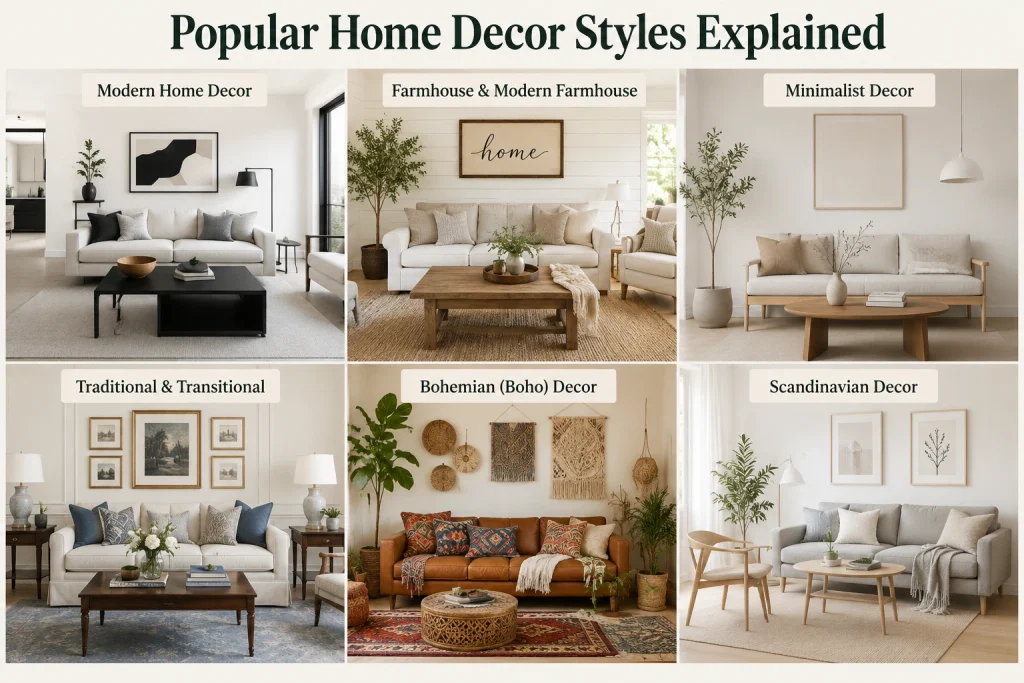
Choosing the right home decor style is one of the most important early decisions in any decorating project, because it acts as the filter for every future purchase. Below are several popular home decor styles commonly used in homes today.
Modern Home Decor
Modern home decor refers to a style built around clean lines, neutral colors, minimal ornamentation, and function-first furniture. It favors materials like steel, glass, and smooth wood, and it tends to avoid heavy patterns or ornate detailing.
Farmhouse and Modern Farmhouse
Farmhouse style blends rustic materials like reclaimed wood and shiplap with cozy, practical furniture. Modern farmhouse softens that rustic base with cleaner lines and a more neutral palette, making it a popular choice for a comfortable, updated look.
Minimalist Decor
Minimalist decor strips a room down to only what is functional and meaningful, using a restrained color palette and very few decorative objects. It works especially well for small space decor since it reduces visual clutter.
Traditional and Transitional
Traditional decor draws on classic furniture shapes, symmetry, and richer color palettes, while transitional decor blends traditional comfort with modern simplicity for a more timeless, less formal look.
Bohemian (Boho) Decor
Boho decor layers pattern, texture, and global-inspired accessories like woven baskets, plants, and vintage rugs for a relaxed, collected-over-time feel.
Scandinavian Decor
Scandinavian decor emphasizes light wood tones, soft neutral colors, and simple functional furniture designed to maximize natural light, a practical response to the long winters of its Nordic origin.
Expert Insight: You don’t have to pick just one style. Most professionally decorated homes actually blend two, such as modern farmhouse or Scandinavian minimalist. As a practical styling guideline, let one primary style dominate most of the room and use a secondary style through selected accessories and details.
Room-by-Room Home Decorating Ideas
Every room in a home has different functional needs, which means home decorating ideas that work in a bedroom won’t necessarily work in a kitchen. Here is a breakdown of what matters most in each major space.
Living Room Decor Ideas
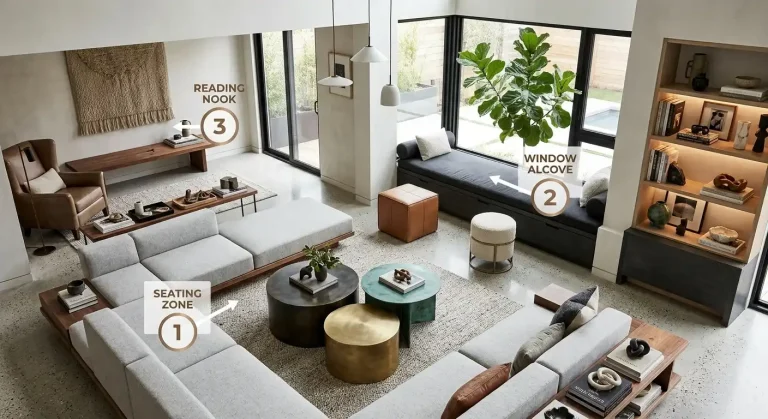
The living room is usually the most decorated and most used shared space in a home. Anchor it with a sofa sized to the room, add a rug large enough that at least the front legs of your furniture sit on it, and layer in lighting beyond a single overhead fixture. For a deeper walkthrough, see our full living room decor ideas guide.
Bedroom Decor Ideas
Because the bedroom is primarily used for sleep and rest, prioritize a calm atmosphere over short-lived trends. Choose a bed frame proportional to the room, layer soft bedding textures, and keep lighting warm and dimmable rather than bright and overhead-only. Our bedroom decor ideas guide covers this room style by style.
Kitchen Decor Ideas
Kitchen decor blends function and style more than any other room, since the space still has to work as a kitchen first. Open shelving, statement lighting over an island, and a cohesive hardware finish are the fastest ways to visually update a kitchen without a renovation. If you’re working with limited square footage, our small kitchen design ideas guide goes into layout, storage, and budget planning in detail.
Bathroom Decor Ideas
Bathroom decor often gets overlooked, but small changes like a new mirror, matching towel sets, and a woven bath mat can transform the space for under $150. See our bathroom decor ideas guide for more easy updates.
Outdoor Decor Ideas
Outdoor decor extends your home’s style to patios, porches, and backyards using weather-resistant furniture, outdoor rugs, and layered lighting like string lights or lanterns.
Color, Lighting, and Layout Fundamentals
These three fundamentals decide whether a room feels balanced or off, regardless of how nice the individual furniture pieces are.
The 60-30-10 Color Rule
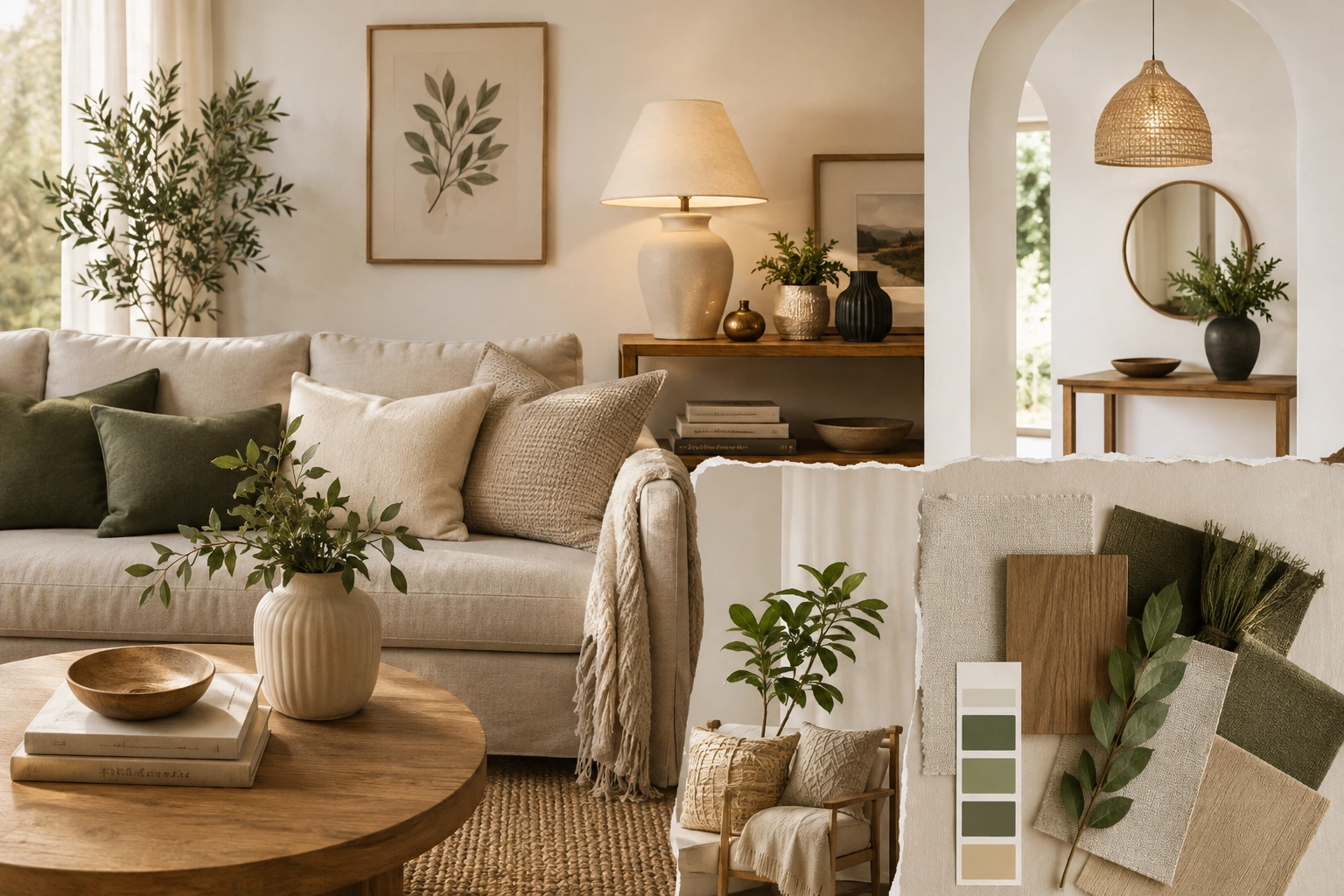
The 60-30-10 rule is a classic decorating formula where 60 percent of a room is a dominant color, usually walls and large furniture, 30 percent is a secondary color through items like curtains or an accent chair, and 10 percent is an accent color used in small pops like pillows or art.
Layering Light the Right Way
A well-lit room uses three types of light working together: ambient light for overall illumination, task light for reading or cooking, and accent light to highlight art or architectural features. Relying on a single ceiling fixture can leave a room feeling flat or unevenly lit.
Furniture Layout Basics
Arrange furniture around how people actually move through and use the room. Leave comfortable walking paths between major pieces, keep seating close enough for easy conversation, and avoid blocking doors, windows, or frequently used areas.
Before moving heavy furniture, measure both the room and the furniture itself. A layout that looks balanced on paper may feel cramped once people, doors, and everyday movement are taken into account.
Small Space Decor: Making the Most of Limited Square Footage
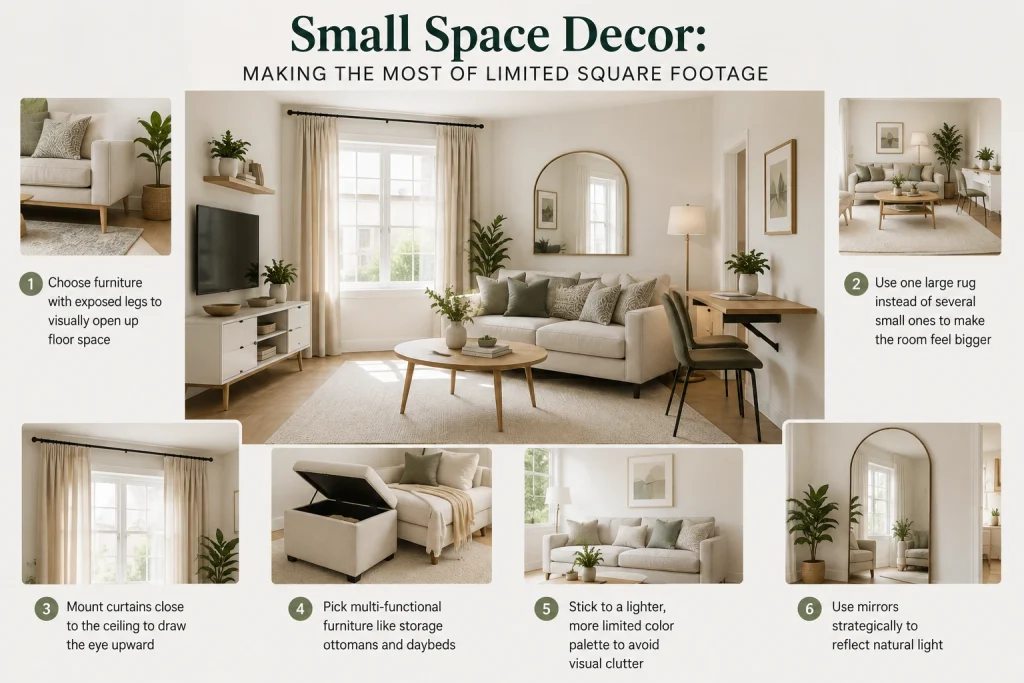
Small-space decorating is especially useful for apartments, studios, and other homes where every square foot needs to work harder.
The best ways to decorate a small space are:
- Choose furniture with exposed legs to visually open up floor space
- Use one large rug instead of several small ones to make the room feel bigger
- Mount curtains close to the ceiling to draw the eye upward
- Pick multi-functional furniture like storage ottomans and daybeds
- Stick to a lighter, more limited color palette to avoid visual clutter
- Use mirrors strategically to reflect natural light
These same principles apply directly to compact kitchens — see our small kitchen design ideas guide for a room-specific breakdown.
DIY Home Decor: Budget-Friendly Projects That Work
DIY home decor refers to decorating projects homeowners complete themselves instead of buying finished, retail-priced pieces. DIY is a popular way to refresh a space without replacing every major piece, especially when you’re working with a limited budget. Our DIY home decor ideas collection has a full list of projects to try room by room.
Budget DIY Projects Worth Trying
- Repainting an old dresser instead of replacing it
- Building a simple floating shelf from pre-cut wood
- Framing fabric remnants as inexpensive wall art
- Making your own throw pillow covers from discounted fabric
- Refreshing cabinet hardware for an instant kitchen update
Pro Tip: Paint is often one of the simplest ways to make a noticeable change without replacing major furniture. A single gallon typically covers roughly 350–400 square feet, although coverage varies by surface, paint, and application.
Home Decor Planning Tools Comparison: Top Options at a Glance
| Resource | Best For | Cost | How It Helps |
| Inspiration and mood boards | Free | Collect room ideas, colors, furniture styles, and recurring design patterns | |
| Room-planning tools | Testing layouts | Free or paid | Experiment with furniture placement before buying |
| Paint swatches | Choosing wall colors | Usually free | Compare colors in the actual lighting of your room |
| Thrift and consignment stores | Budget-friendly finds | Varies | Find unique furniture and accessories at different price points |
| Professional decorator | Personalized guidance | Paid | Get help with larger or more complex decorating projects |
Different resources solve different decorating problems. Use visual tools for inspiration and planning, physical samples for color decisions, and professional help when a project becomes too complex to manage comfortably on your own.
Common Home Decorating Mistakes to Avoid
Mistake 1: Buying Furniture Before Measuring the Room
Buying furniture without measuring the room is one of the easiest ways to create layout problems.
Mistake 2: Matching Instead of Coordinating
Buying an entire matching furniture set from one store often looks flat and impersonal compared to coordinating pieces from different sources around a shared color palette.
Mistake 3: Ignoring Lighting Temperature
Mixing warm and cool toned light bulbs in the same room creates a visually jarring effect that most homeowners notice without knowing why the room feels off.
Mistake 4: Skipping the Rug Size
A rug that’s too small for the seating area is one of the fastest ways to make a room look unfinished, since it visually shrinks the whole space.
Mistake 5: Decorating Every Wall
Leaving some negative space on walls and shelves allows the pieces you do display to stand out, rather than competing for attention.
A Smarter Way to Approach Home Decor
Good home decor is not about filling a room with beautiful things. It is about making a series of connected decisions that work together.
A common decorating mistake is choosing individual pieces before deciding how the room needs to function. A rug may look beautiful on its own, for example, but the wrong size can make the entire seating area feel disconnected. The same applies to lighting, furniture scale, color, and accessories.
Instead of treating each decorating decision separately, DecorHubs uses a simple framework that moves from the most important decisions to the most personal ones.
The DecorHubs 4-Layer Method
1. Foundation — Start With the Biggest Elements
Begin with the elements that determine the visual structure of the room: flooring, major furniture, rugs, and other large-scale pieces.
Ask:
- What is the largest piece in this room?
- Does the furniture fit the room’s scale?
- Does the rug connect the main seating or activity areas?
- Are the major pieces working together visually?
The goal is to establish proportion and structure before adding smaller details.
2. Function — Make the Room Work
Once the foundation is established, consider how the room will actually be used.
Think about movement, seating, storage, natural light, task lighting, and the activities that happen there. A beautiful arrangement that makes it difficult to walk through the room or use the furniture comfortably is not a successful decorating solution.
3. Feeling — Build the Visual Atmosphere
Now introduce the elements that influence how the room feels: color, texture, materials, patterns, and lighting atmosphere.
Instead of choosing every color independently, look for relationships between them. A neutral room can gain depth through different textures, while a colorful room can feel more cohesive when a few colors are repeated across multiple elements.
4. Finishing — Add Personality Last
The final layer is where the room becomes personal.
Add artwork, plants, books, decorative objects, cushions, photographs, and other accessories that reflect the people who live there. These details should complete the room rather than compensate for problems with its foundation or function.
Why This Order Matters
The four layers are arranged intentionally:
Foundation → Function → Feeling → Finishing
Each stage answers a different decorating question:
| Layer | Main Question | What You Decide |
| Foundation | What should anchor the room? | Furniture, rug, flooring, major pieces |
| Function | How should the room work? | Layout, movement, lighting, storage |
| Feeling | How should the room feel? | Color, texture, materials, atmosphere |
| Finishing | What makes it personal? | Art, plants, accessories, personal details |
This approach also creates a useful decision hierarchy. Instead of asking, “What decor should I buy?” start by asking, “What does this room need first?”
That small change can prevent unnecessary purchases and make decorating decisions easier to evaluate.
A Practical Example
Imagine a living room that feels unfinished.
The instinct may be to buy more cushions, artwork, or decorative accessories. But the problem may actually be earlier in the decorating sequence.
The sofa might be too small for the room. The rug might not visually connect the seating area. The lighting may be limited to one overhead fixture. Or the furniture arrangement may leave too much unused space.
Using the DecorHubs method, you would first examine the Foundation, then the Function, before changing the room’s Feeling and finally adding Finishing details.
This is not a rule that every room must follow perfectly. It is a decision-making tool designed to help you identify what deserves attention first.
A DecorHubs Principle to Remember
Decorate the structure before decorating the surface.
When the major pieces, layout, and atmosphere are working together, accessories become much easier to choose because you already know what the room needs.
That is the real purpose of the DecorHubs Layering Method: not to tell you exactly what to buy, but to give you a clearer way to decide what comes next.
Start Here: Which Home Decor Guide Do You Need?
- Decorating your whole home? Start with the step-by-step decorating process above.
- Decorating a living room? Explore our living room decor guide.
- Working with a small space? Start with the small-space decorating ideas above, or see our dedicated small kitchen design ideas guide.
- Not sure what your style is? Start with the home decor styles section above.
- Decorating on a budget? Start with our DIY home decor ideas guide.
- Your room feels unfinished? Use the DecorHubs 4-Layer Method above to identify what needs attention first.
Frequently Asked Questions
How do I decorate my home from scratch?
Start by defining how each room will be used, then choose one home decor style, set a budget split across furniture, lighting, and accessories, and build the room in that order rather than buying decorative pieces first.
How do I choose the right home decor style?
Browse a mix of Pinterest boards and real rooms you’ve liked in person, then look for the pattern in color, materials, and shapes that repeats across your favorites, since that pattern usually points to your style.
What are the most popular home decor styles right now?
Popular home decor styles include modern farmhouse, minimalist, Scandinavian, traditional, and boho, each appealing to different balances of warmth, simplicity, and personality.
How can I make my home look more stylish without a big budget?
Start with decluttering, then improve the lighting and create a more consistent color palette. These changes can create a noticeable visual improvement without replacing major furniture.
How do I decorate a small home on a budget?
Use one larger rug instead of multiple small ones, choose multi-functional furniture, and stick to a limited neutral palette with a few accent colors to keep a small space feeling open rather than cluttered.
What home decor items should every home have?
Every home benefits from a properly sized rug, layered lighting beyond one overhead fixture, at least one piece of real art or a curated print, and soft textiles like throw pillows or a blanket to add texture.
Is hiring a professional decorator worth it for home decor?
For a single room or budget project, guides and planning tools like Pinterest can help you get started, while a professional decorator can be useful for larger or more complex projects.
What is the difference between home decor and interior design?
Home decor and interior decorating focus on furniture, color, and accessories within an existing space, while interior design involves structural changes like layout, walls, and building code compliance.
How much does it typically cost to decorate a living room?
The cost can range from a few hundred dollars for a simple refresh to several thousand dollars for substantial furniture replacement, depending on room size, materials, quality, and how much you already own.
Can DIY home decor projects actually look professional?
Yes, DIY home decor projects like repainting furniture or building simple shelving can look professional when the color palette and proportions match the rest of the room, since finish quality matters more than whether a piece was store-bought.
Conclusion: Your Next Steps in Home Decor
Home decor is not about spending the most money or following every trend. It’s about understanding the fundamentals of color, lighting, layout, and style, then applying them in the right order using a framework like the DecorHubs Layering Method covered above. The homeowners who end up with spaces they genuinely love are the ones who plan with intention rather than shop room by room without a system.
Quick Summary:
- Choose one home decor style before buying furniture
- Build a room in order: foundation, function, feeling, finishing
- Small, consistent changes like lighting and rug size often beat expensive overhauls
Next Steps:
- Choose your primary home decor style using the styles section above.
- Choose one room and apply the DecorHubs 4-Layer Method.
- Explore the relevant room guide for detailed decorating ideas.
Ready to go deeper? Explore DecorHubs for more home decor inspiration across every room, style, and season, and check out our seasonal decorating and DIY project guides as you plan your next update.