
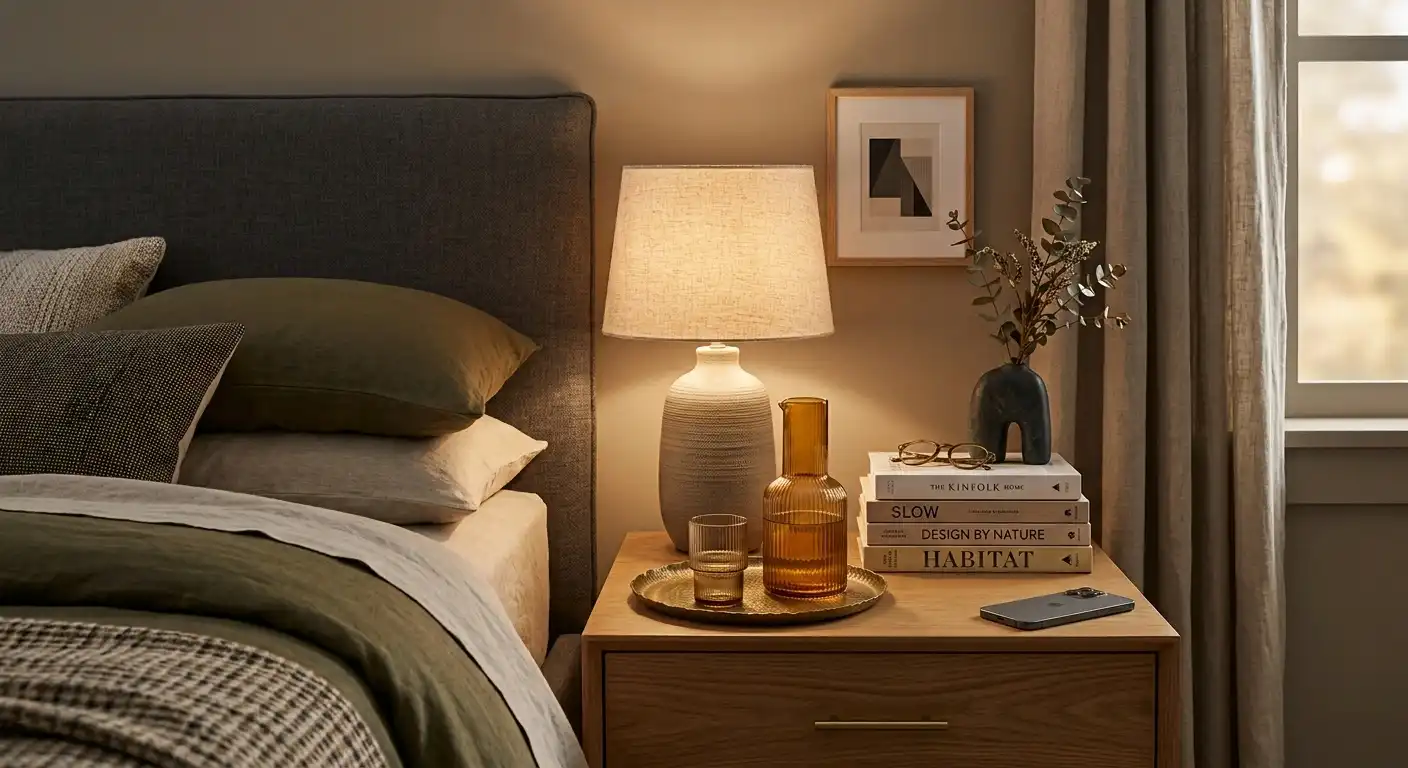
A nightstand is one of the smallest surfaces in your bedroom, but it’s also one of the most looked-at. It’s the last thing you see at night and the first thing you reach for in the morning, which is exactly why a cluttered or awkward one makes the whole room feel unfinished even if everything else is styled well.
The good news: styling a nightstand well isn’t about buying more decor. It’s about understanding a simple visual formula height, function, and personality, in that order and then adapting it to your own style, space, and bed setup.
This guide walks through that formula, how to adjust it for different design styles, and what to do if your nightstand situation isn’t the “two matching tables and a lamp” default because most bedrooms aren’t.
The Real Reason Most Nightstands Look Unfinished
Before adding a single object, it helps to understand why some nightstands look intentional and others look like a landing pad for whatever you set down before bed.
Two things are usually happening:
- The height and scale are off. A nightstand that’s too tall or too short for the bed disrupts the visual line of the room, and objects placed on it without any height variation look flat, no matter how nice they are individually.
- Everything on it is either purely functional or purely decorative, never both. A nightstand covered in chargers, lotion, and receipts feels like clutter. A nightstand styled like a still-life photo, with nothing you’d actually use at 11 p.m., feels stiff and gets messy again within a week.
A well-styled nightstand solves both problems at once: it looks intentional and it holds up to nightly use.
Start With Proportion: Get the Height and Scale Right First
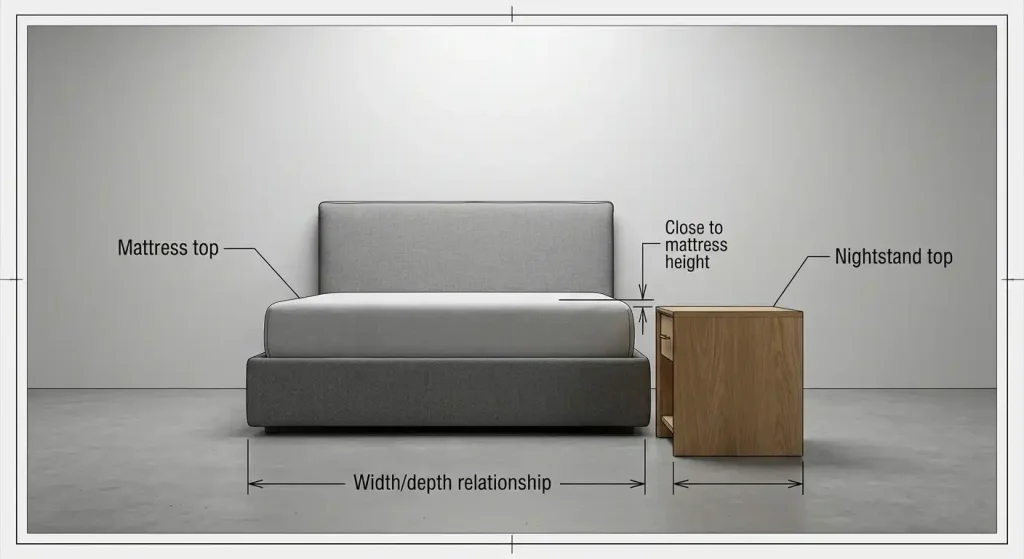
Styling decisions only look “off” when the underlying proportions are wrong, so this is worth settling before you add decor.
The core rule: the top of your nightstand should sit level with the top of your mattress, or within about 2–4 inches above or below it. This keeps items within easy reach when you’re lying down and keeps the bedside line visually balanced instead of stair-stepped.
| Mattress height (floor to top) | Nightstand height range | Typical bed type |
| 18–22 in | 18–24 in | Low platform beds, minimalist frames |
| 23–27 in | 22–28 in | Most standard and upholstered beds |
| 28–32 in | 26–32 in | Pillow-top mattresses, beds on box springs |
| 33+ in | 30–36 in | Antique or high-profile beds, thick toppers |
If you’re shopping for a new nightstand, measure your mattress height first — not the other way around. If you’re styling a nightstand you already own and the height is genuinely mismatched with your bed, a slim lamp or a stack of books can help visually close the gap, but no amount of styling fully fixes a nightstand that’s several inches too low or too tall for daily use.
Width and depth matter too. As a general guide, aim for a nightstand roughly one-third to one-half the width of your headboard, with enough depth (about 16–20 inches) to hold a lamp and one or two personal items without feeling crowded. In a small bedroom, a narrow 14–16 inch deep table often looks more proportional than a bulky one, even if it holds slightly less.
The Height-Layering Formula (Use This for Any Style)
Once proportion is settled, use this simple layering method. It works whether your style is modern, boho, or traditional, because it’s about visual structure, not aesthetic.
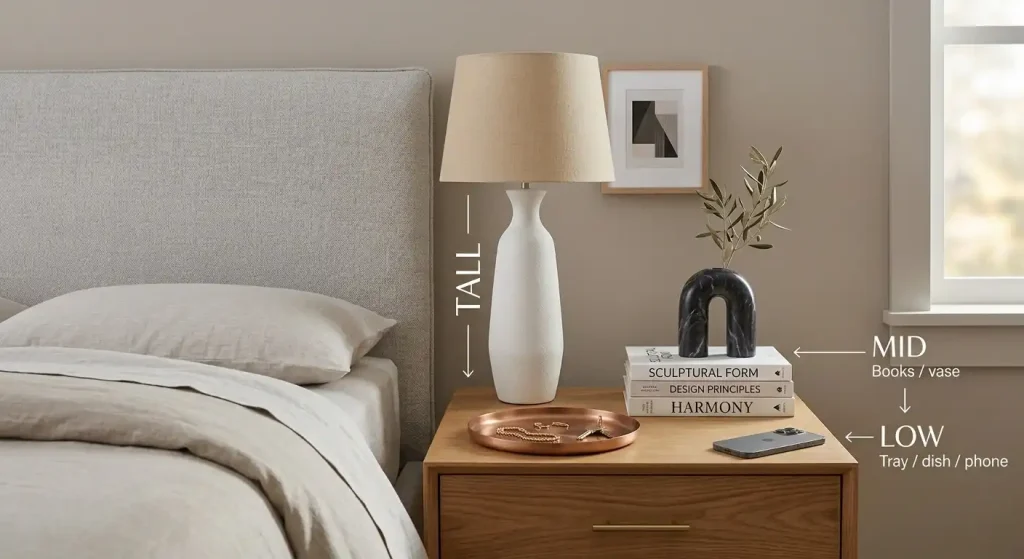
- Tall anchor (12–20 inches): A lamp, a slim vase, or a piece of art leaning against the wall. This gives the eye a starting point and keeps the nightstand from feeling squat.
- Mid-height layer (4–8 inches): A stack of 2–3 books, a small tray, or a short vase. This is where the majority of the “character” lives.
- Low, functional layer (under 3 inches): A ring dish, a coaster, a phone charger, or a small candle. This is what you’ll actually touch at night, so keep it within easy reach and limit it to 1–2 items.
Aim for an odd number of objects three or five rather than an even, symmetrical cluster. Odd groupings read as curated; even groupings often read as “matching set from a store,” which is fine for a hotel but less personal for a home.
Nightstand Styling Ideas by Design Style
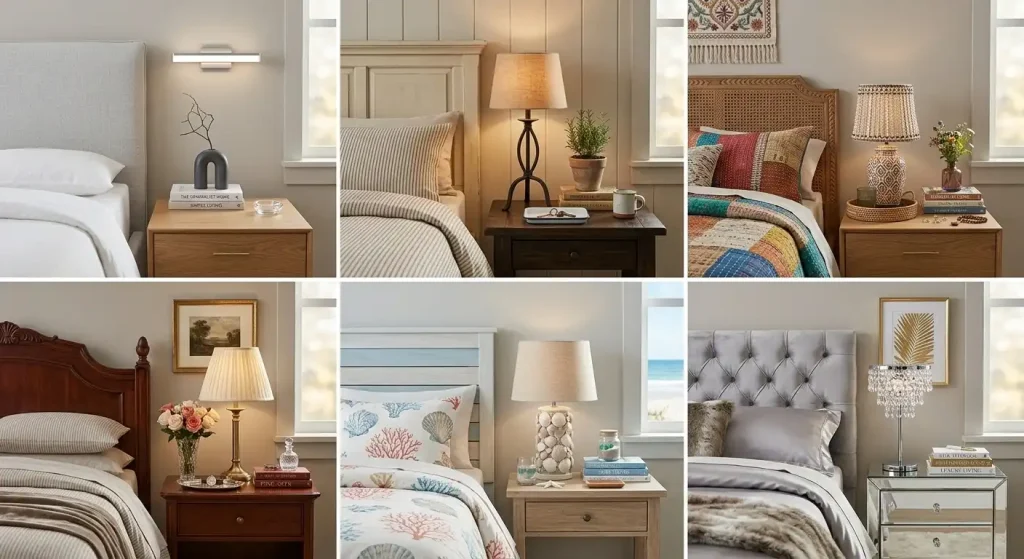
Use the layering formula above as the skeleton, then adjust the materials and colors to match your room.
Minimalist and Modern
Keep the surface mostly clear. One sculptural lamp, one small tray to corral a phone and charger, and a single stem in a bud vase is usually enough. Choose matte black, warm wood, or stone finishes over anything glossy or ornate, and resist the urge to add a fourth object — negative space is the style here.
Modern Farmhouse and Rustic
Lean into texture instead of color: a stoneware vase, a stack of linen-bound books, a woven basket underneath for extra storage, and a warm-toned lamp with a linen shade. Distressed wood or a nightstand with visible grain reinforces the look better than anything painted glossy white.
Boho and Eclectic
This is the style where slightly imperfect, mismatched objects actually work in your favor. Mix a textured ceramic vase, a small woven tray, a candle in a hand-thrown holder, and one framed piece of art leaning rather than hanging. Layer a small textile, a scarf or woven mat under the grouping to unify mismatched pieces.
Traditional and Transitional
Symmetry does more work here than in any other style. If you have two nightstands, mirror the arrangement almost exactly: matching lamps, a small stack of books on each side, and one personal object (a framed photo, a small dish) that differs slightly between the two so it doesn’t feel like a showroom display.
Coastal
Light woods or whitewashed finishes, a glass or ceramic lamp base, and one or two natural elements, a small dish with shells, a piece of driftwood, or a linen-textured shade keep this style from tipping into theme-park territory. Avoid literal nautical objects (anchors, ship wheels); the effect works better when it’s suggested through material and color than spelled out.
Glam
A mirrored or lacquered nightstand tray instantly elevates a plain surface. Add a lamp with a metallic base, a small stack of coffee-table books in neutral tones, and one faceted glass or crystal object. Keep the palette tight to one metal tone (brass or nickel, not both) so it reads polished rather than busy.
Quick Reference: Style-by-Style Formula
| Design Style | Core Formula |
| Minimalist and Modern | Sculptural lamp + small tray + one bud vase |
| Modern Farmhouse and Rustic | Stoneware vase + linen books + woven basket + warm lamp |
| Boho and Eclectic | Ceramic vase + woven tray + candle + leaning art |
| Traditional and Transitional | Matching lamps + book stack + one personal object |
| Coastal | Glass or ceramic lamp + one natural element + linen shade |
| Glam | Mirrored tray + metallic lamp + neutral books + one faceted object |
What Should Actually Be on a Nightstand? (Function First)
Style only holds up if the nightstand still works at 11 p.m. with the lights off. Before decorating, make sure it can comfortably hold:
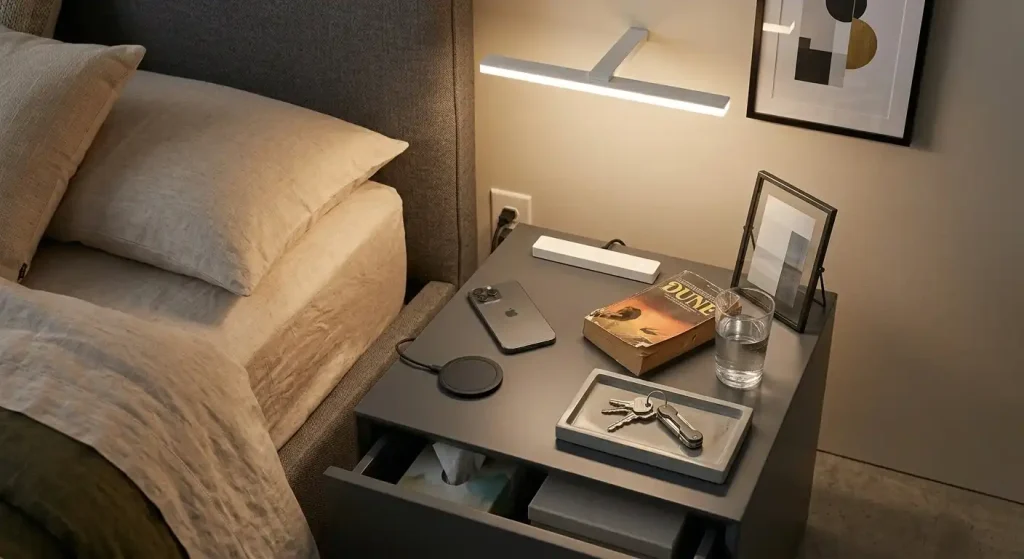
- A light source you can reach without sitting up (lamp, dimmable smart bulb, or a plug-in sconce if you’re short on surface space)
- A spot for your phone or a small charging dish, ideally near an outlet
- One thing you actually use — a book, lip balm, water glass, or reading glasses
- A little hidden storage (a drawer or basket) for what you don’t want visible: medication, earplugs, or hand cream
Everything beyond that is decorative. A nightstand that’s 100% decorative photographs well but rarely survives daily use — items get pushed aside within a week, which is why “real” nightstands usually have one drawer or shelf doing the practical work while the top surface stays curated.
Matching Nightstands vs. Mismatched: How to Decide
You don’t need identical nightstands, and current design sensibility has moved away from requiring it. Here’s how to choose:
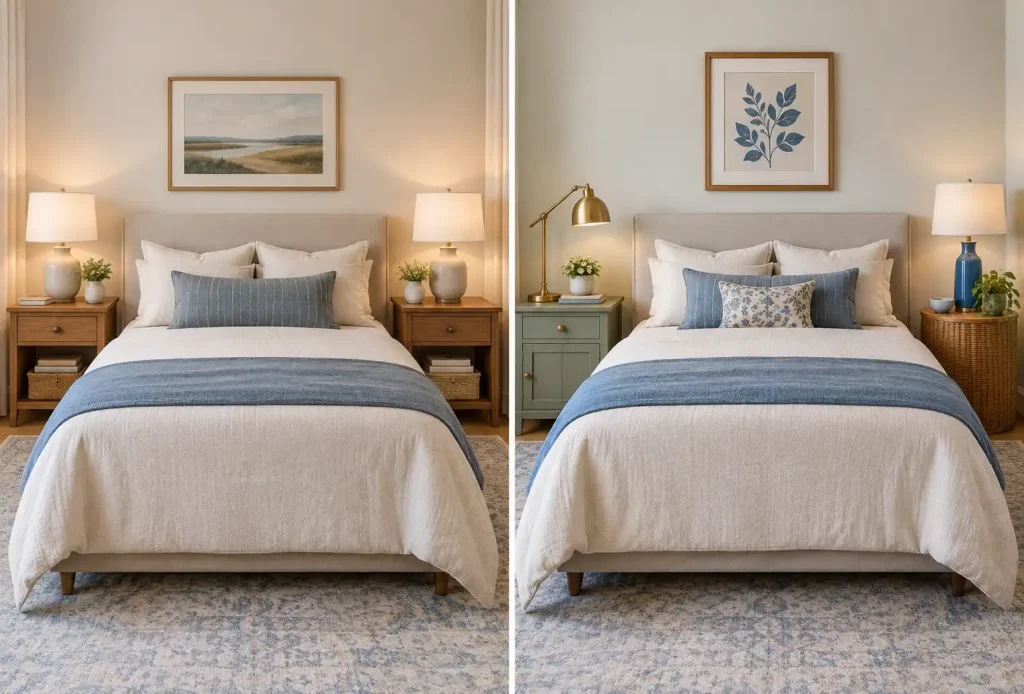
Go matching if:
- Your bedroom is small, and visual repetition helps the space feel calmer and larger
- You want a formal or traditional look
- You and your partner have very different storage needs, but you still want the room to read as cohesive (matching bases with different internal organization solves both)
Go mismatched (intentionally, not accidentally) if:
- Your style is boho, eclectic, or collected-over-time
- One side of the bed needs more storage than the other (a nightstand with drawers on one side, a slim table on the other)
- You already own two different pieces and buying new ones isn’t in the budget — pulling one shared element (same lamp style, same metal finish, or the same color of decor objects) across both sides ties them together without matching furniture
The unifying trick either way is repetition of one element the lamp, the vase color, or the material even when the furniture itself differs.
Small Bedrooms, Renters, and Tight Budgets
Most styling advice assumes a large bedroom with room to spare. Here’s how to adapt when that’s not the case:
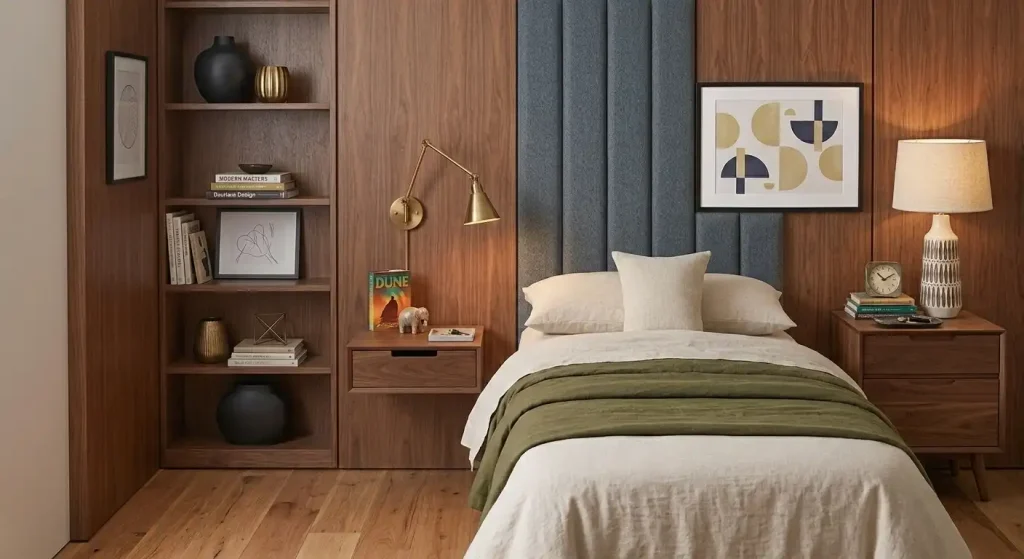
- Small space: A wall-mounted swing-arm lamp frees up the entire nightstand surface for personal items, and a narrow console (12–14 inches deep) takes up less floor space than a standard boxy nightstand without sacrificing function the same space-saving logic used in small-apartment storage solutions elsewhere in the home.
- Renters: Avoid anything that requires drilling for a sconce if your lease restricts wall changes; battery-operated, dimmable lamps solve the lighting problem without any wiring. Removable adhesive hooks on the side of the nightstand can hold a bag or robe without damaging walls.
- Tight budget: You don’t need a matching lamp pair or a designer tray. A secondhand lamp rewired with a new shade, a thrifted dish, and books you already own will style just as well as new pieces — the layering formula matters more than the price of the objects.
- No nightstand at all: A wall-mounted floating shelf, a stack of large hardcover books topped with a small tray, or a vintage stool all work as budget-friendly stand-ins, as long as the height still lines up with your mattress.
Common Nightstand Styling Mistakes
- Overcrowding the surface. If you can’t set down a water glass without moving something, it’s over-styled. Leave at least 30% of the surface visibly empty.
- Choosing a lamp that’s too small (or too large) for the table. As a rough guide, the lamp should be roughly 1.5 times the height of the nightstand, and the shade width should be a few inches narrower than the tabletop.
- Ignoring the drawer or shelf. If everything you actually use lives on top, the surface will never stay styled. Use hidden storage for daily-use items and let the top hold what you’re happy to see.
- Copying a photo styled for zero nightly use. Many inspiration photos are styled for a camera, not a bedtime routine; they skip the charger, the water glass, and the book. Style for how you’ll actually use the space, then photograph it after, not the other way around.
- Symmetrical overkill. Two identical nightstands, styled identically down to the last object, can feel more like a hotel than a home. Let at least one personal item differ between sides.
Frequently Asked Questions
Do both nightstands need a lamp?
Not necessarily. Two lamps look symmetrical and suit traditional bedrooms, but one lamp plus a wall sconce or a shared overhead light works just as well.
How many items should be on a nightstand?
Three to five, using the tall/mid/low layering method. Fewer looks unfinished; more starts to feel cluttered.
Is it okay to have no nightstand?
Yes. Just keep a reachable light source and a surface near mattress height for your phone or water a wall shelf or stool works fine.
What height should nightstand decor be relative to the lamp?
Keep decor shorter than the lamp’s base so the lamp stays the tallest element on the surface.
Key Takeaways
- Get proportion right first: nightstand height should sit within 2–4 inches of your mattress top before you style anything on top of it.
- Use a simple tall/mid/low layering formula with an odd number of objects (usually three or five) that works across every design style.
- Keep one drawer or basket for daily-use items so the visible surface can stay curated instead of turning back into clutter within a week.
- Matching nightstands aren’t required; repeating one shared element (lamp style, finish, or color) ties mismatched pieces together just as effectively.
- Small spaces, renters, and tight budgets can all use this same formula with adjusted furniture choices: a wall lamp, a narrow console, or secondhand pieces work just as well as a full matching set.
Related Next Steps
- Explore full Bedroom Decor styling guides for pulling the rest of the room together around your nightstand choices.
- If you’re choosing new furniture, see this Small-Space Storage guide for scaling and organizing bedroom pieces in a compact room.
- For lighting specifics, a future cluster article on bedside lighting and lamp-sizing would extend this guide with more lamp/shade pairing detail.
- If you’re decorating on a fixed budget, see Decorate an Empty Corner on a Budget for more secondhand and DIY sourcing ideas.
- For renters, a future Renter-Friendly Bedroom Decor guide would expand on damage-free lighting and storage solutions referenced above.
Sources and References
Homes & Gardens — designer-sourced guidance on starting nightstand styling with practical, everyday essentials.
Sleep Foundation — bedroom environment and bedtime-lighting guidance.
Industry-standard bed and mattress height conventions from multiple furniture retailers, cross-checked for the mattress-to-nightstand height table above.
Join the Conversation
What Do You Think?