
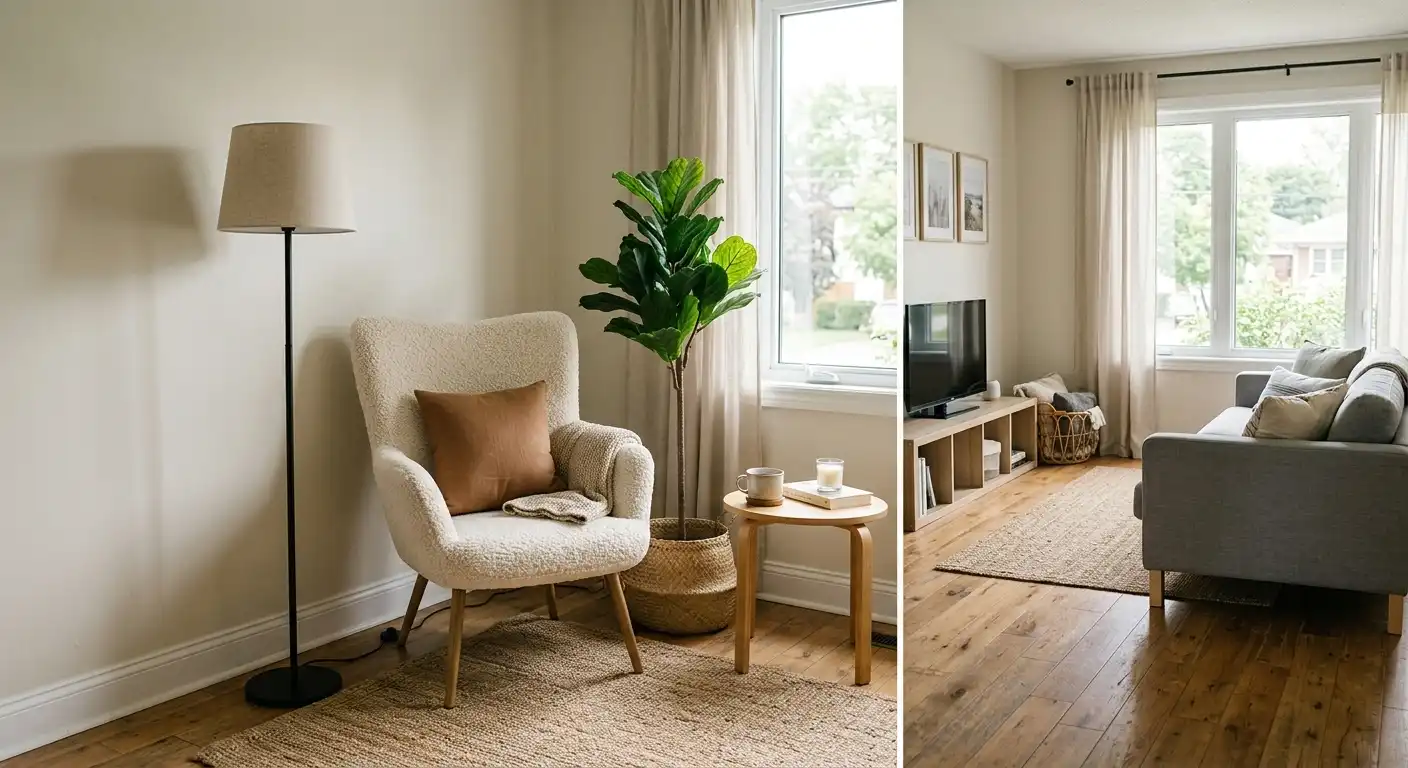
An empty living room corner does not always need a large piece of furniture or an expensive makeover. The best budget-friendly approach is to first decide why the corner feels empty, then give it either a clear function or enough visual presence to balance the room.
For most living rooms, you can solve the problem with one of these simple combinations:
- a tall plant and decorative basket
- a floor lamp and small chair
- a thrifted accent table styled with items you already own
- wall art with a low basket or floor cushion
- a small reading nook
- floating shelves
- extra storage that also adds visual weight
The biggest mistake is filling a large, tall corner with several tiny objects. A corner should usually be treated as a vertical zone. One properly scaled item or a small, intentional arrangement often looks better than many cheap decorations.
An empty living room corner can become a useful part of the room without requiring a major furniture purchase. Whether you need living room corner decor for a small space, a dark corner, or an awkward area beside the sofa, the right solution depends on the corner’s size, location, and purpose. For broader inspiration beyond just the corner, our full guide to living room decor ideas covers layout, color, and furniture placement in more depth.
Quick answer: The easiest way to decorate an empty living room corner is to start with one substantial piece that solves a real need, such as a floor lamp, tall plant, chair, storage piece, or artwork. Add only one supporting element if the corner still feels unfinished.
First, Decide Whether the Corner Actually Needs to Be Filled
Not every empty corner is wasted space.
A corner can provide visual breathing room, especially in a small or already busy living room. Before buying or moving anything, stand near the room’s main seating area and ask:
- Does the corner make the room feel unfinished?
- Is it visible from where people usually sit?
- Is it next to an important walkway?
- Do you need more seating, storage, or lighting?
- Does the corner have an electrical outlet?
- Does the room already have enough visual interest?
If the corner is empty but the room still feels balanced, leave it alone. Decorating every blank space can make a living room feel crowded.
A better goal is not to fill the corner. The goal is to give it a purpose or make it feel visually connected to the rest of the room. This approach also prevents the common mistake of adding random decor simply because a space is empty.
A Simple Rule for Decorating an Empty Corner
Before choosing decor, use three simple checks:
| Check | Ask yourself |
| Purpose | What does this corner need to do? |
| Scale | Is the main piece large enough for the available space? |
| Connection | Does it relate to the colors, materials, or style already in the room? |
This keeps the decorating process focused. A corner that needs lighting should not become a collection of decorative objects, while a corner that already has a strong focal point may need very little.
Use the Corner Purpose Test Before Choosing Decor
The easiest way to decide what belongs in your corner is to identify what your living room needs most.
| If your room needs… | A good budget corner solution |
| Height and softness | Tall plant or branches |
| Better lighting | Floor lamp |
| Extra seating | Small chair or floor cushion |
| Storage | Basket, cabinet, or corner shelves |
| Personality | Artwork or a gallery arrangement |
| A cozy function | Reading nook |
| More visual weight | Mirror or tall piece of furniture |
| A place for books | Small bookcase or wall shelves |
| Occasional work space | Compact desk or wall-mounted surface |
A useful rule: choose one primary purpose first. Then add only the supporting items needed to make that purpose work.
For example, if you choose a reading corner, start with a chair. Add a lamp if the area is dark and a small table only if you will actually use it.
This creates a functional mini-zone instead of a collection of unrelated objects.
10 Budget-Friendly Ideas for an Empty Living Room Corner

1. Add a Tall Plant in a Basket
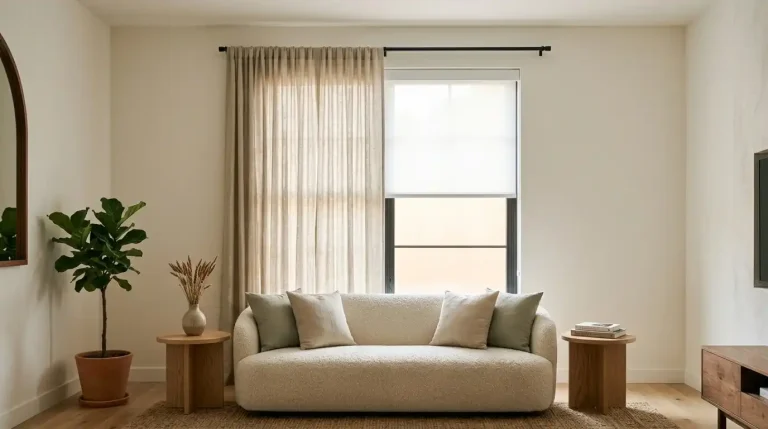
A tall plant is one of the simplest ways to give an empty corner height without making it feel heavy.
You do not need to buy an expensive indoor tree. Look for:
- a secondhand large planter
- an affordable nursery plant
- a smaller plant raised on a stand
- realistic faux greenery
- tall branches placed in a large vase
Use a woven basket or simple thrifted container as the outer cover to make an inexpensive planter look more finished.
For darker corners, choose a plant suited to the available light or use realistic faux greenery rather than forcing a light-loving plant into a dim space.
Best for: bright corners, neutral rooms, small spaces, and corners that need softness.
2. Use a Floor Lamp as Both Lighting and Decor
A floor lamp is a practical choice when the corner feels empty mostly because the room lacks height or warmth.
Look for a lamp that relates to the scale of the corner rather than a very small lamp that disappears into it. A simple secondhand lamp can also be transformed with:
- a new lampshade
- a different bulb
- paint suitable for the lamp material
- a cleaner, more modern shade
Floor lamps work particularly well when the corner is near a sofa or chair. In that situation, the lamp becomes part of the room’s function rather than just a filler.
3. Create a Cheap Reading Corner
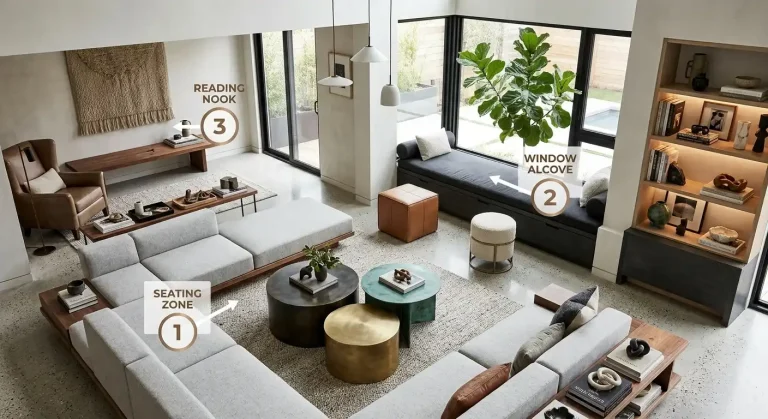
If you have enough floor space, turn the empty corner into a small reading nook.
You do not need to purchase a complete matching set. Start with furniture you already have:
- move an unused chair from another room
- add a small side table or stool
- place a lamp beside the chair
- add a throw or cushion you already own
- keep a few books nearby
The chair should be large enough to feel intentional but not so large that it blocks the walking path.
A corner reading nook works especially well in a large living room that feels unfinished or in a room with an awkward unused area.

4. Shop Your Home Before You Shop Online
One of the cheapest ways to decorate an empty corner is to reuse something you already own.
Try moving these items from other rooms:
- a chair
- side table
- small bookshelf
- lamp
- large basket
- mirror
- artwork
- plant
- storage cabinet
Before buying anything, place the item in the corner and live with it for a few days.
You may discover that the room only needed one substantial object. Rearranging existing furniture and accessories is also one of the lowest-cost ways to change a living room layout.
This is especially useful when you’re looking for cheap living room corner ideas and want to test a layout before spending money.
5. Style a Large Basket for Texture and Storage
A large basket can solve two problems at once: it fills visual space near the floor and provides storage.
Use it for:
- blankets
- throw pillows
- children’s toys
- magazines
- extra cushions
For more visual interest, choose a basket with texture and add a tall branch, rolled throw, or pillow.
This is a particularly useful option when you do not need furniture in the corner but the room feels visually unbalanced.
6. Make a Simple Art Corner
If floor space is limited, decorate upward instead.
A budget art corner could include:
- one large secondhand frame
- printable artwork
- your own photography
- a small collection of mismatched thrifted frames
- a textile wall hanging
- a mirror
Do not automatically buy several small pieces because they are cheaper. A large DIY or printable artwork can create more impact than many tiny decorations.
For a more relaxed look, lean a large framed piece against the wall on top of a small cabinet or even directly on the floor if it is safely positioned and the household situation allows it.
If you’d rather add pattern behind the frames instead of more objects, a small removable wallpaper panel can have a similar effect — see our living room wallpaper ideas for options that suit a single accent wall or corner.
7. Add a Small Storage Piece
An empty corner can become useful storage without looking like a storage area.
Consider:
- a narrow cabinet
- a thrifted bookcase
- a small chest
- stacked wooden crates
- a compact shelving unit
Choose a piece with enough visual weight for the corner. A very tiny cabinet may look lost beside a tall wall, while a medium-height piece with a lamp, artwork, or plant above it can create a complete arrangement.
Before buying larger furniture, mark its approximate footprint on the floor with painter’s tape or another removable marker. This gives you a better idea of how much space it will actually occupy.
Storage furniture is most useful when the living room needs a place for blankets, toys, books, or everyday items.
8. Install Simple Corner Shelves
If your budget is low and floor space is limited, wall-mounted shelves can turn an unused corner into a display or storage zone.
Use them for:
- books
- framed photos
- a small plant
- pottery
- collected objects
Keep the shelves visually simple. Too many small objects can make the corner look cluttered.
For renters, choose solutions that match what your lease allows. Avoid assuming that every rental permits drilling into walls.
9. Use a Mirror to Add Visual Presence
A tall mirror can make a corner feel intentional, particularly when it reflects light from a window or lamp.
However, a mirror is not automatically the right answer for every corner.
Before placing one, check what it reflects. Ideally, it should reflect:
- natural light
- an attractive part of the room
- artwork
- a visually open area

If it reflects clutter, a television, or an unattractive blank wall, it may not improve the space.
A thrifted mirror can often be a more affordable choice than a new decorative mirror. You can also change its appearance by refinishing the frame when the material is suitable for painting.
10. Build a No-Cost Decorative Vignette
If your budget is close to zero, use objects already in your home to create one intentional arrangement.
For example:
Tall element: floor lamp, branch arrangement, or plant
Medium element: small table, stool, or basket
Low or soft element: folded throw, books, or cushion
The goal is variation in height, not a collection of random objects.
Try grouping objects that share something visually, such as:
- similar colors
- natural materials
- warm wood tones
- one general style
The Best Budget Option for Different Types of Empty Corners
Small Living Room Corner Ideas
In a small living room, do not sacrifice walking space just to fill the corner.
Good options include:
- a tall plant
- a floor lamp
- wall art
- a slim basket
- floating shelves
In a small room, prioritize pieces that add height or function without taking much floor space. Avoid adding a bulky chair or cabinet unless the corner is genuinely large enough.
Large, High-Ceiling Corner
A small plant or tiny side table may look out of proportion in a tall corner.
Choose something with more vertical presence:
- tall plant
- floor lamp
- large artwork
- bookshelf
- layered art and furniture arrangement
The taller or wider the corner, the more important it is to choose an item with enough visual presence to match the space. As a simple test, stand at the room’s main viewing point and check whether the item feels proportionate to the wall around it. If it visually disappears, the piece may be too small.
Dark Corner
Focus on lighting before adding decorative objects.
A floor lamp can make the corner useful and improve the atmosphere of the surrounding seating area.
After adding light, decide whether the corner still needs a second element, such as a chair or plant.

Awkward Corner Behind a Door
Avoid furniture that interferes with the door swing.
A narrow wall arrangement, artwork, or a slim decorative object may be safer than a large piece of furniture.
Corner Next to the Sofa
This is a natural location for:
- a floor lamp
- a small side table
- a plant
- a reading chair if space allows
The best choice depends on what the sofa area already lacks.
Corner Near a Window
Keep the arrangement low or offset enough to preserve natural light and allow curtains or blinds to operate normally.
Depending on the space, you could use:
- a plant
- a slim chair
- a small table
- a floor lamp
- low storage
Avoid placing tall furniture where it blocks the window, interferes with curtains, or reduces useful daylight.
A Quick Corner Decision Guide
| Corner problem | Start with | Avoid |
| Feels too empty vertically | Tall plant or floor lamp | Several tiny objects |
| Feels dark | Floor lamp | Adding decor before fixing the lighting |
| Has a tight walkway | Wall art or slim shelves | Bulky furniture |
| Needs a function | Chair or storage | Decorative filler |
| Has a high ceiling | Tall or large-scale piece | Tiny decor |
| Already looks busy | Simple basket, plant, or artwork | Multiple bold pieces |
| Needs more natural light | Mirror or suitable plant | Blocking the window |
| Needs occasional work space | Compact desk or wall surface | Oversized desk |
How to Decorate the Corner Step by Step
If you are unsure which idea to choose, follow this simple process.
Step 1: Measure the Available Floor Space
You do not need a complex room plan. Measure:
- the width of the corner area
- how far an object can project into the room
- nearby walking space
- the approximate wall height
This prevents buying something that fits on paper but blocks the room in real life. Also check the clearance around the piece. People should be able to walk comfortably, doors should open fully, and curtains or blinds should remain usable.
Step 2: Choose the Corner’s Main Job
Pick one:
- lighting
- seating
- storage
- display
- greenery
- reading
- work
Do not start by choosing random decor.

Step 3: Add One Main Piece
Choose the item with the greatest visual or functional role.
Examples:
- chair
- tall plant
- cabinet
- lamp
- mirror
Step 4: Add Only One or Two Supporting Elements
For example:
Chair + lamp + small side table
or
Plant + basket
or
Cabinet + artwork
This is usually enough.
Step 5: Check the Room From Its Main Viewing Angle
Sit on the sofa and look toward the corner.
Ask:
- Does the arrangement feel connected to the room?
- Is it too small for the wall?
- Does it block movement?
- Does it repeat too many colors or materials?
- Does it look better with one item removed?
If something feels cluttered, remove the smallest or least useful item first.
How to Make Cheap Decor Look Intentional
Budget decorating is less about buying expensive objects and more about making clear choices.
Repeat Something From the Rest of the Room
The corner will feel more connected when it repeats at least one existing element:
- wood tone
- metal finish
- accent color
- texture
- plant material
- frame color
For example, if your coffee table has warm wood, a small wood stool or thrifted cabinet can connect the corner to the rest of the room.
Mix New and Secondhand Items
A room can look more personal when everything was not purchased at the same time or from the same collection.
Look for secondhand:
- mirrors
- chairs
- baskets
- lamps
- frames
- small cabinets
- side tables
Then combine them with what you already own. Thrift stores, local resale marketplaces, and garage sales can be useful places to look for inexpensive mirrors, lamps, chairs, baskets, and small tables.
Use Height Instead of More Stuff
A corner often feels empty because nothing reaches upward.
Instead of buying five decorations, use:
- one tall plant
- one floor lamp
- one large artwork
- one vertical shelf
This can make the corner feel complete with less visual clutter.
Set a Budget Before You Buy
You do not need a fixed decorating budget to make an empty corner feel finished. Start by deciding whether the corner needs a no-cost solution, one inexpensive item, or a larger functional piece.
For a nearly free update, shop your home and rearrange existing furniture. For a low-cost refresh, consider thrifted baskets, artwork, plants, lamps, or side tables. If the corner needs storage or seating, spend more on the one piece that will provide the most useful function.
The goal is not to spend a certain amount. It is to avoid buying several inexpensive items that do not solve the problem.
Common Mistakes to Avoid
Filling the Corner With Tiny Objects
Several small objects can make a large corner feel even more awkward because they do not have enough visual presence.
Try one larger piece first.
Blocking Traffic Flow
A corner arrangement should not make people walk around furniture unnecessarily.
This is particularly important near:
- doors
- hallways
- windows
- main seating paths
Buying Decor Before Choosing a Purpose
A random stool, plant, lamp, and basket can look like clutter if they do not create a usable zone.
Decide what the corner should do first.
Ignoring the Rest of the Room
A beautiful corner can still look wrong if it has no relationship to the surrounding furniture.
Repeat a color, material, or style from elsewhere in the room.
Overfilling a Small Living Room
An empty corner can be useful negative space.
If adding something makes the room harder to move through or visually busier, the better design decision may be to leave the corner open.
A Simple Budget Formula for Almost Any Empty Corner
If you want a reliable starting point, use this formula:
1 main purpose + 1 substantial item + 1 supporting element
Examples:
- Lighting: floor lamp + small basket
- Greenery: tall plant + decorative basket
- Reading: chair + lamp
- Storage: small cabinet + artwork
- Display: large artwork + low basket

This keeps the decorating process focused and prevents unnecessary spending.
The most successful living room corners usually do not look as though they were filled simply because they were empty. They look like they belong there.
Frequently Asked Questions
What should I put in an empty corner of my living room?
Start with one item that solves a need, such as a tall plant, floor lamp, chair, storage piece, or artwork.
How do I decorate an empty living room corner cheaply?
Shop your home first, then consider thrifted furniture, printable art, baskets, plants, or simple DIY decor.
What can I put in a small living room corner?
Use space-saving options such as wall art, floating shelves, a slim basket, floor lamp, or tall plant.
How do I make an empty corner look intentional?
Give it one clear purpose and connect it to the rest of the room through color, material, texture, or style.
What is the cheapest way to decorate an empty living room corner?
The cheapest approach is to shop your home first. Move an unused plant, lamp, chair, mirror, basket, artwork, or small table into the corner before buying anything. If you still need something, look for secondhand or DIY options.
Should every empty living room corner be decorated?
No. Leaving a corner open can create a useful visual breathing room, especially in a small or busy room.
How do I decorate a dark living room corner?
Start with lighting, usually a floor lamp, then add a second element such as a plant, chair, or basket if needed.
How can I decorate an empty corner without buying anything?
Move an unused chair, lamp, plant, basket, mirror, artwork, or small table from another room and test the arrangement before buying anything.
What is the easiest way to fill a tall empty corner?
Choose something with vertical presence, such as a tall plant, floor lamp, large artwork, or bookshelf.
Key Takeaways
- Do not assume every empty corner needs to be decorated.
- Choose the corner’s purpose before buying anything.
- Use height and scale to solve a corner that feels visually unfinished.
- Start with one substantial item instead of several small decorations.
- Shop your home, thrift, and reuse existing furniture before buying new decor.
- Protect walking space, especially in small living rooms.
- Repeat colors, materials, or finishes from the rest of the room.
- A floor lamp, tall plant, reading chair, basket, storage piece, or artwork can each solve a different decorating problem.
Related Next Steps
- Living Room Decor Ideas — for furniture, layout, and styling decisions across the whole room.
- How to Style Your Coffee Table Like a Pro — for styling small tables and repeating materials elsewhere in the room.
- DIY Home Decor Ideas — for low-cost wall art, storage, and decorative accents.
- Seasonal Home Decor Guide — for refreshing your corner styling through the year.
- Home Decor Guide — for a complete overview of budget-friendly decorating across every room.
Sources
- ASPCA Animal Poison Control — Toxic and Non-Toxic Plants List: https://www.aspca.org/pet-care/animal-poison-control/toxic-and-non-toxic-plants
- University of Minnesota Extension — Lighting for Indoor Plants: https://extension.umn.edu/planting-and-growing-guides/lighting-indoor-plants
Join the Conversation
What Do You Think?