
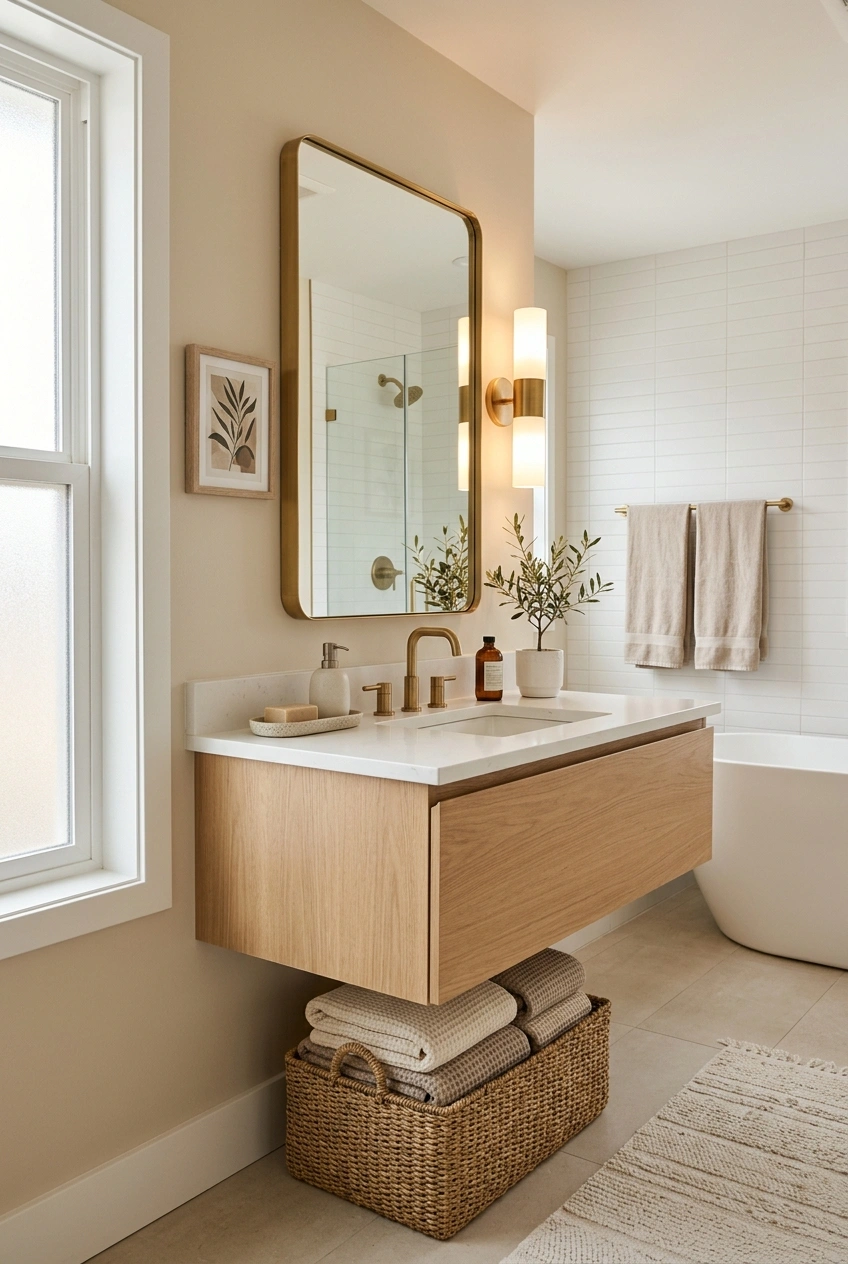
A bathroom can feel dated or unfinished even when the main fixtures are still in good shape. The best bathroom decor ideas focus on simple changes you see and use every day, such as a new mirror, better lighting, fresh towels, a bath mat, updated storage, or a few well-chosen accessories. You do not need to replace the tile or remodel the entire room to make a noticeable difference.
For more home decor inspiration, browse our full collection of ideas.
Start by clearing visual clutter and identifying the biggest problem in the room. Then make one high-impact change, such as updating the mirror, improving the lighting, or adding a fresh color. Finish with two or three textures or personal details that make the space feel more comfortable and cohesive.
Quick Takeaways
- Start with the bathroom you have rather than planning a complete renovation.
- Fix clutter and storage before adding more decoration.
- Use a well-sized mirror and layered lighting to improve the room’s visual balance.
- Add warmth through towels, rugs, wood, baskets, and other natural textures.
- Choose colors and materials that work with your existing fixtures.
- Small bathrooms benefit from open floor space, vertical storage, and fewer accessories.
- Spend more on items you use every day and less on easy-to-replace decorative pieces.
- Keep decorative pieces limited so the room feels finished rather than crowded.
The Best Bathroom Decor Ideas to Try First
If you want the biggest visual improvement without a major renovation, start with the elements that occupy the most visible space. In most bathrooms, the mirror, lighting, textiles, walls, and storage have more impact than small decorative accessories.
1. Update the Mirror
The mirror is often one of the first things you notice when you enter a bathroom.
Replacing a plain builder-grade mirror with a framed, rounded, arched, or otherwise distinctive design can immediately give the room more character.
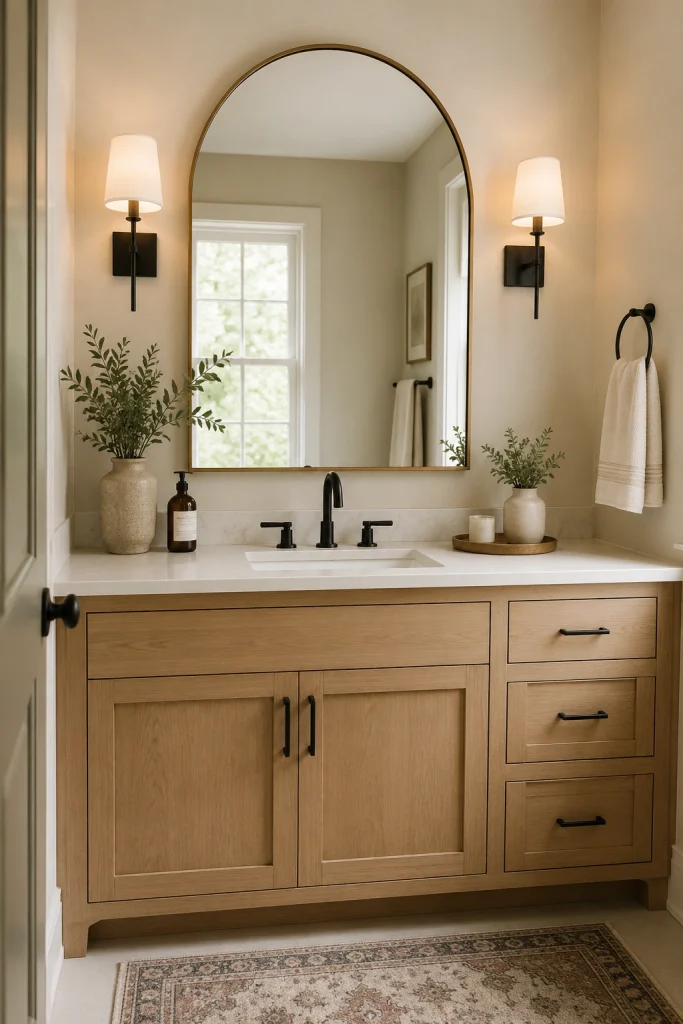
Choose the shape according to the room:
- Round: softens bathrooms with lots of straight lines
- Arched: adds a more decorative feel
- Rectangular: works well with modern and simple interiors
- Large frameless: keeps the look clean and understated
- Wood-framed: adds warmth to white or cool-toned bathrooms
The mirror should also be appropriately sized for the vanity and wall. A very small mirror can look lost above a wide vanity, while an oversized mirror can overwhelm a compact space. For small bathrooms, a larger well-proportioned mirror can also help reflect light and make the room feel more open.
2. Improve the Lighting
Good lighting makes a bathroom easier to use and can change how its colors and materials appear. If the bathroom feels harsh or flat, consider improving the vanity lighting rather than relying only on one ceiling fixture.
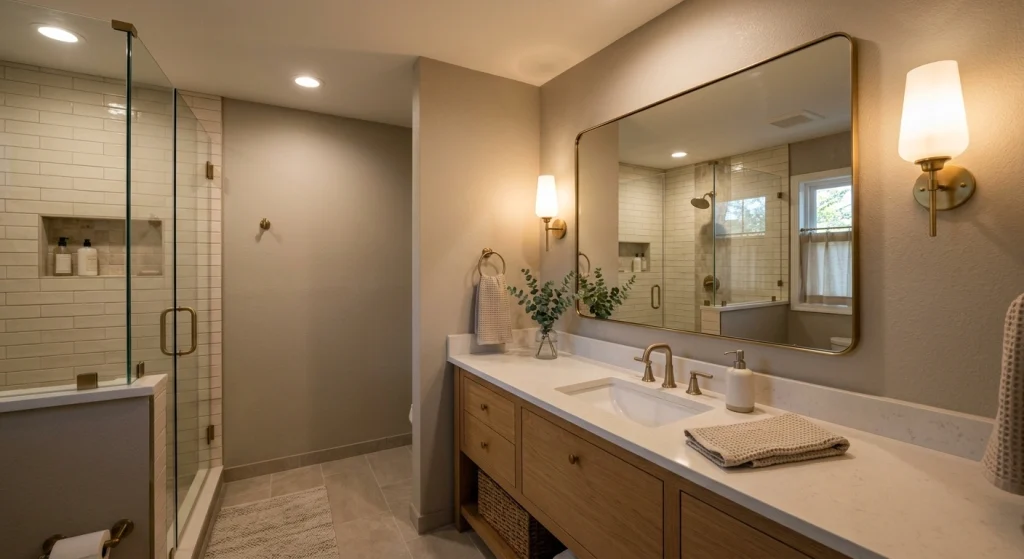
You can use:
- Wall sconces
- Vanity lights
- Ceiling lighting
- Natural light
- Accent lighting where appropriate
For bulbs, a warmer color temperature can create a softer atmosphere. Around 2700K to 3000K can work well for a warm residential feel, although the best choice depends on the fixture, room, and how you use the space.
For makeup or grooming, balanced vanity lighting matters more than simply making the room warmer.
3. Replace Tired Towels
Towels are both functional and decorative, so changing them is one of the easiest ways to refresh a bathroom. Choose towels that work with the room’s existing colors rather than introducing several unrelated shades.
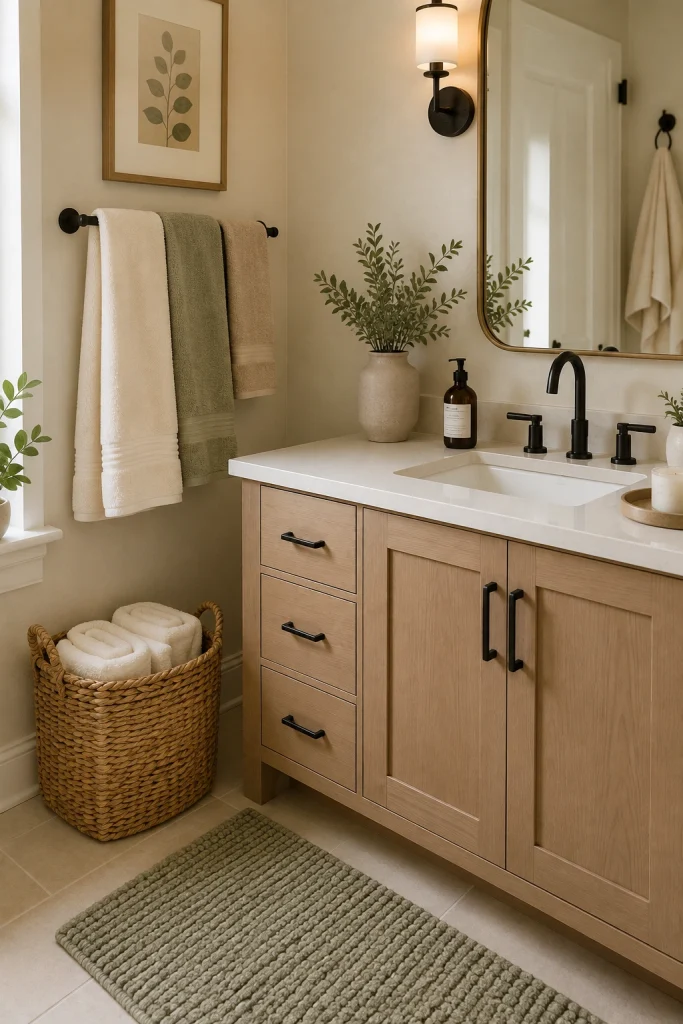
For a calm bathroom, try:
- White and cream
- Beige and taupe
- Soft blue
- Muted green
- Warm gray
For more personality, use one accent color and repeat it in another small detail.
4. Add a Bathroom Rug or Bath Mat
A rug can soften hard tile and introduce color or pattern.
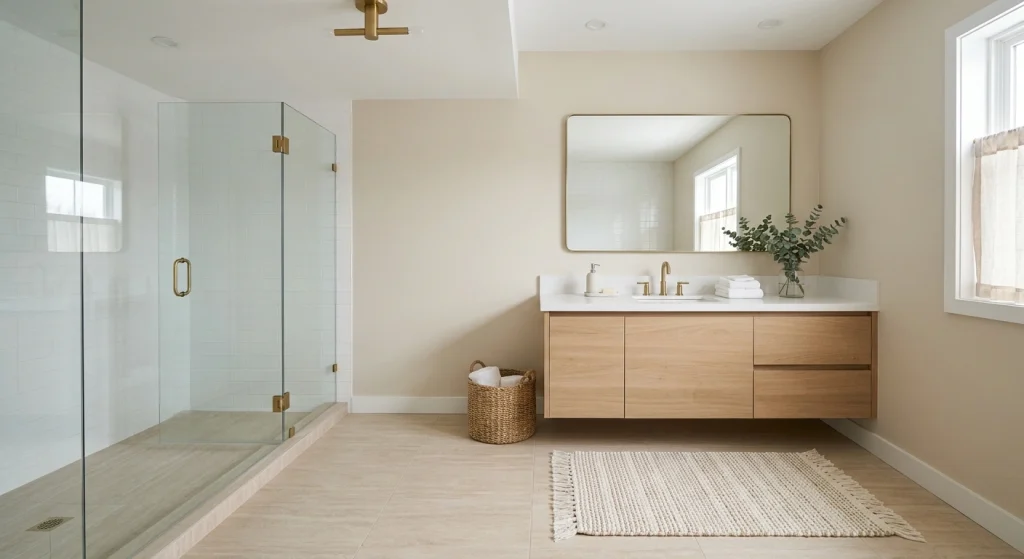
Choose a bath mat designed for bathroom use and make sure it fits the available floor space. In a small bathroom, one appropriately sized mat is usually enough.
For a larger bathroom, a washable runner can create more visual warmth without covering the entire floor.
5. Bring in Natural Texture
Bathrooms often contain hard surfaces such as tile, glass, stone, and metal. Adding softer materials keeps the space from feeling cold.
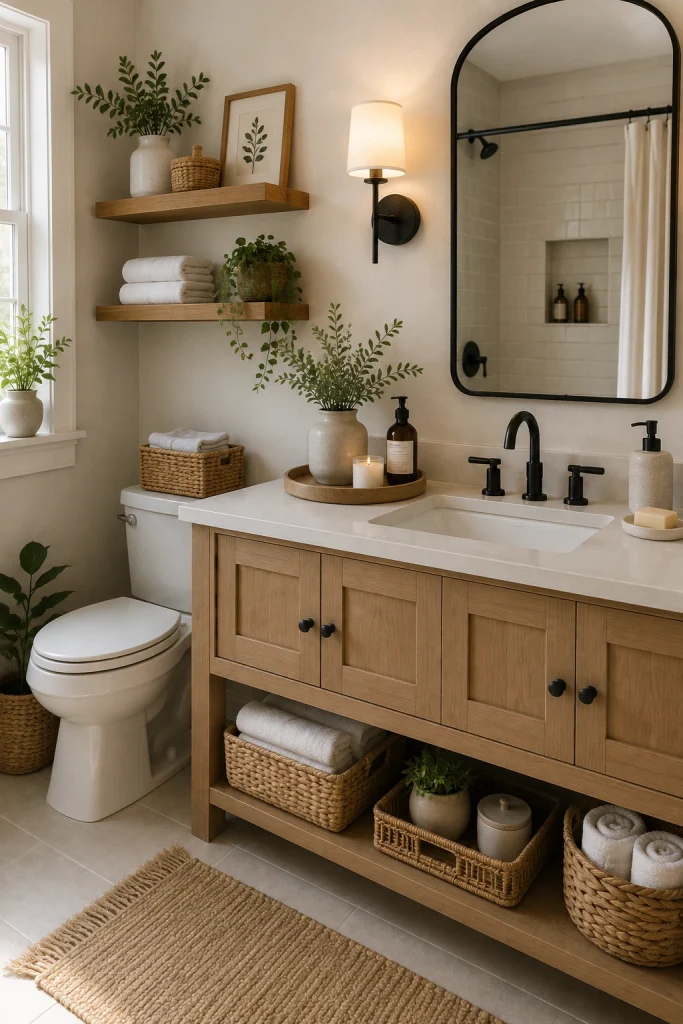
Try:
- Woven baskets
- Wood accessories
- Linen or cotton textiles
- Rattan
- Ceramic pieces
- Natural-looking rugs
You do not need all of these. Two or three complementary textures are usually enough. “You can also DIY your own woven baskets or wood accents see our DIY home decor ideas.”
6. Add One Piece of Wall Art
A bathroom does not have to be completely functional-looking. A framed print, botanical illustration, photograph, or simple abstract piece can make an empty wall feel intentional.
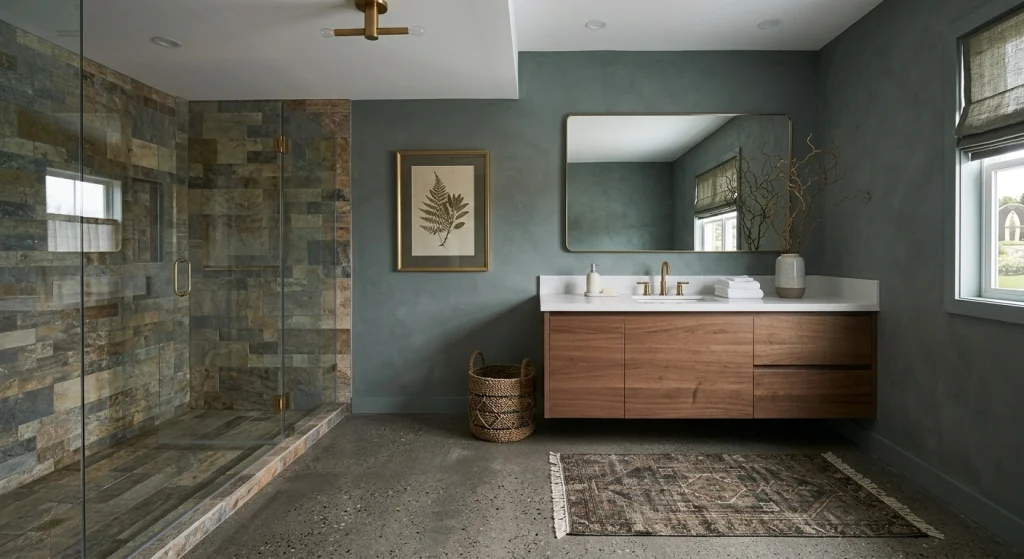
Keep moisture in mind when choosing artwork and its placement. Avoid putting valuable or moisture-sensitive pieces directly where they will receive regular splashes or heavy steam.
7. Style the Counter With a Tray
Instead of spreading toiletries across the vanity, group a few everyday items on one tray.
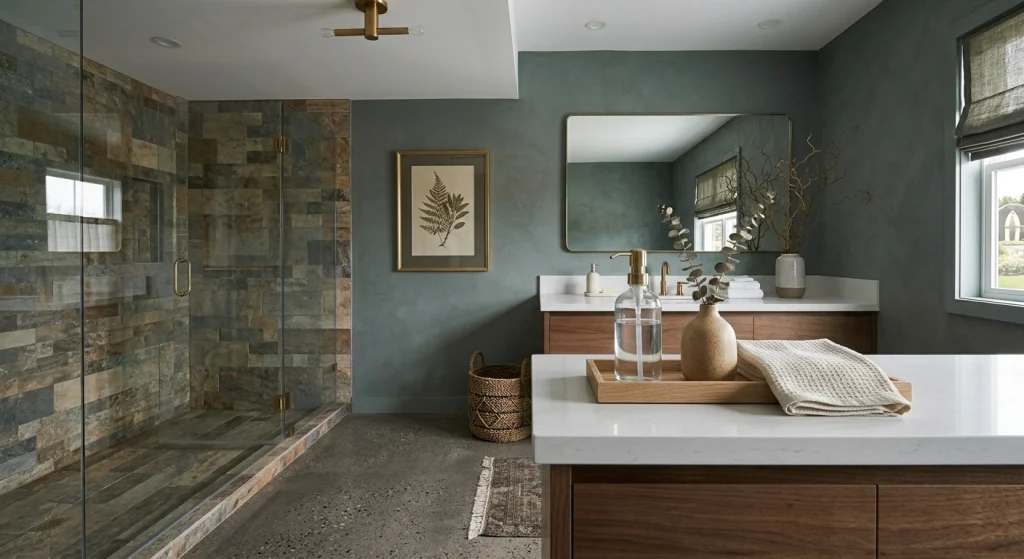
For example:
Tray + soap dispenser + small vase + hand towel
The tray creates a visual boundary and makes the counter easier to reset.
Keep personal products that do not need to be displayed in drawers or cabinets.
How to Plan Your Bathroom Decor
Before buying anything, look at what is already working and what is not.
Ask yourself:
- Does the room feel too dark?
- Is the counter always cluttered?
- Does the bathroom lack storage?
- Are the colors too cold or mismatched?
- Is there an empty wall that needs attention?
- Does the mirror feel too small or dated?
- Is there enough texture?
- Does the room feel too plain?
Your answers will tell you where to spend your time and money.
Start With the Largest Visual Areas
Large elements usually have more impact than small accessories.
Look at:
- Walls
- Mirror
- Vanity
- Lighting
- Shower curtain or enclosure
- Floor textiles
- Storage
- Small accessories
This helps prevent a common mistake: buying lots of decorative objects while the main visual problems remain unchanged.
Choose a Simple Color Palette
A limited palette makes it easier to create a cohesive bathroom.
You can use one main color, one supporting color, and a small accent.
For example:
Warm white + beige + muted green
or
White + light wood + soft blue
The exact colors are less important than repeating them naturally throughout the room.
Use the Three-Layer Approach
A simple way to organize your bathroom decor is to think in three layers:
- Base: Walls, flooring, vanity, tile, and major fixtures.
- Function: Lighting, mirror, storage, hooks, and towels.
- Personality: Art, plants, baskets, rugs, trays, and decorative accessories.
Start with the base you already have. Improve the functional elements next, then add personality. This keeps decorative choices connected to the room instead of adding accessories without solving the bigger visual or practical problems.
Small Bathroom Decor Ideas
A small bathroom does not need to be completely white or almost empty. Good small bathroom decor ideas focus on controlling visual clutter, using vertical space, choosing the right scale, and keeping the floor visually open.
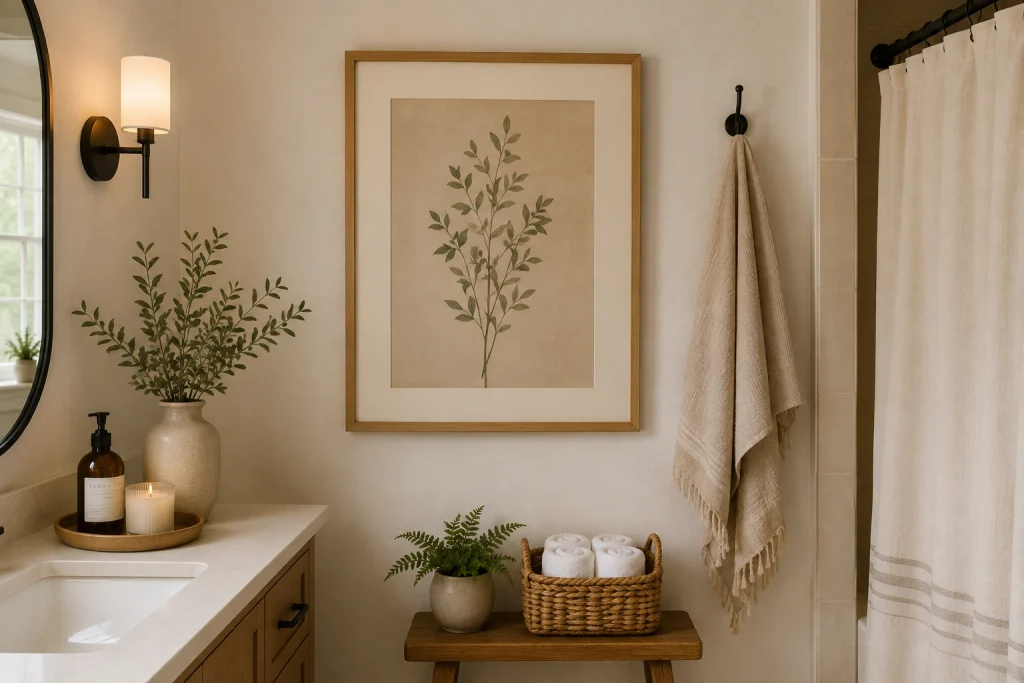
Use a Larger Mirror
A well-sized mirror can reflect light and make the room feel more open.
If the vanity is narrow, choose a mirror that gives the wall enough visual weight without extending awkwardly beyond the surrounding fixtures.
Use Vertical Storage
When floor space is limited, use the walls for storage. Vertical storage keeps everyday items accessible without taking up valuable floor space.
Consider:
- Narrow shelves
- Wall-mounted cabinets
- Hooks
- Over-the-door storage
- Tall storage units
- Shelves above the toilet where appropriate
Keep frequently used items accessible and use baskets or closed storage to hide visual clutter.
Keep the Floor Open
The more floors you can see, the less crowded a small bathroom tends to feel.
Wall-mounted storage and floating furniture can help create this effect.
Avoid filling every available corner with baskets, stools, plants, and accessories.
Choose Fewer, Larger Decorative Pieces
A small bathroom can look busier when it contains many tiny objects.
Instead, try:
Large mirror + one framed print + one basket + simple textiles
The result is usually easier to maintain and visually calmer.
Use Color Strategically
Light colors can help reflect available light, but you do not have to avoid darker shades completely.
A dark accent wall, patterned wallpaper, or deeper vanity color can work in a small bathroom when balanced with suitable lighting and lighter surrounding elements.
Bathroom Decor Ideas for Color and Texture
Color gives the bathroom its overall mood, while texture keeps the space from looking flat.
Warm Neutral Bathroom
Warm white, cream, beige, taupe, and soft brown create a relaxed foundation.
Add:
- Light wood
- Woven baskets
- Cream towels
- Ceramic accessories
- Soft neutral artwork
This works especially well when the existing bathroom has white tile that feels too cold.
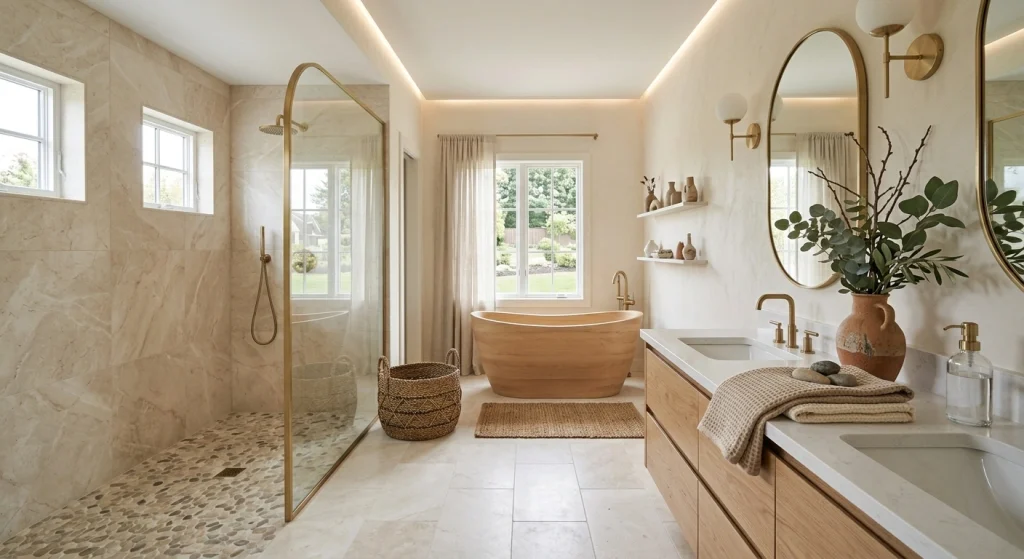
Soft Green Bathroom
Muted green can bring a natural feeling into the room without becoming overwhelming.
Pair it with:
- Warm white
- Natural wood
- Brass or simple metal details
- White or cream textiles
- Greenery
Blue Bathroom
Soft blue can work well for a calm, fresh look.
Combine it with white, cream, light wood, or sandy neutrals rather than introducing several additional colors.
Add Texture Instead of More Color
If the room already has enough color, use texture to create interest.
For example:
Wood tray + woven basket + cotton towels + ceramic vase
adds visual variety without requiring another accent color.
Bathroom Storage and Countertop Ideas
Bathroom decor and organization should work together. A bathroom that looks beautiful but is difficult to keep organized will quickly become frustrating, so solve practical storage problems before adding more decorative items.
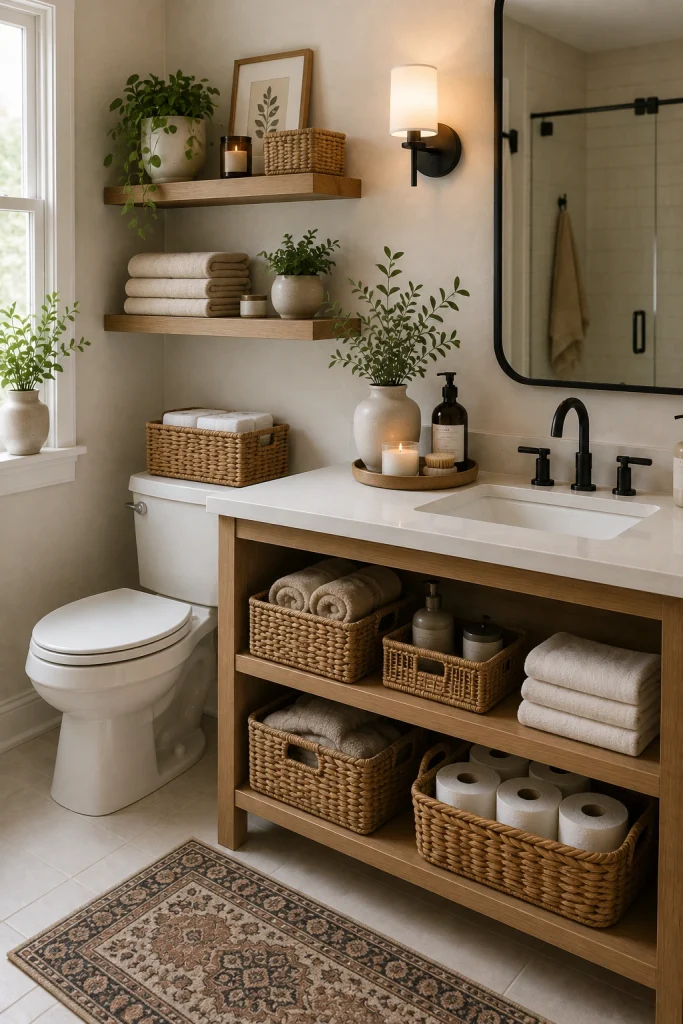
Use Baskets for Flexible Storage
Baskets are useful for:
- Extra towels
- Toilet paper
- Hair tools
- Washcloths
- Everyday supplies
Choose baskets that fit the available space rather than buying them first and trying to find a place for them later.
Combine Open and Closed Storage
Open shelves are useful for things that look attractive when displayed, such as folded towels, baskets, plants, and ceramics.
Closed cabinets and drawers are better for personal products, cleaning supplies, and items you do not want visible.
Keep the Counter Simple
You do not have to keep the entire counter empty.
A practical arrangement might include:
- Soap dispenser
- Small tray
- One decorative object
- Hand towel
Everything else can go into storage.
Add a Small Shelf
An empty wall can become useful storage with a narrow shelf.
Use it for a few carefully selected items rather than filling it completely.
Bathroom Lighting and Mirror Ideas
Lighting and mirrors are particularly important because they combine practical and decorative functions.
Layer the Lighting
If possible, use more than one light source.
For example:
Ceiling light + vanity light
or
Natural light + vanity sconces
This can create more balanced illumination than relying on a single fixture.
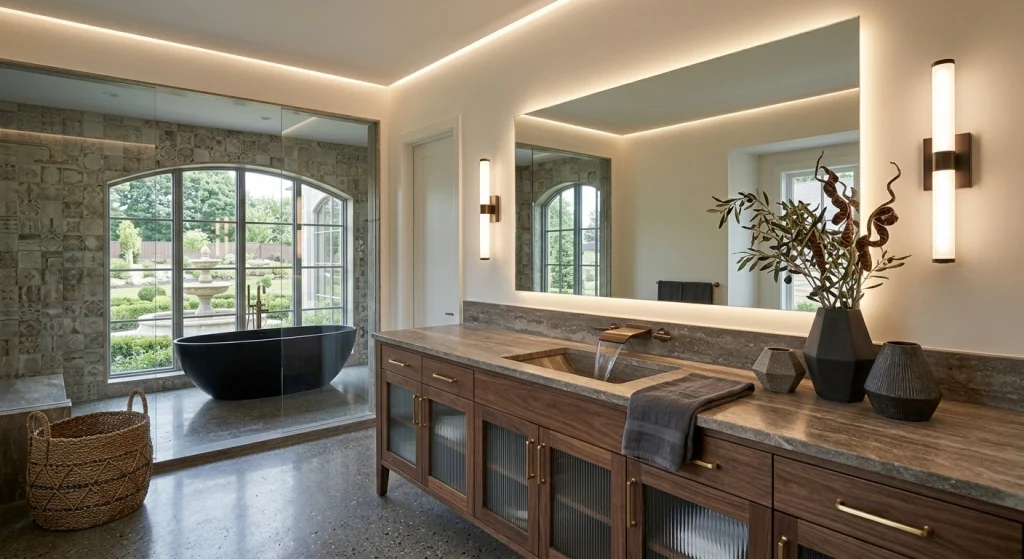
Choose Vanity Lighting Carefully
Place vanity lighting where it provides useful illumination without creating uncomfortable glare or strong shadows.
The exact fixture depends on the mirror, vanity, ceiling height, and electrical layout, so follow the manufacturer’s installation guidance and applicable electrical requirements when making changes.
Match the Mirror to the Room
Your mirror can reinforce the style you want.
- Black frame: modern or industrial
- Wood frame: warm or natural
- Brass frame: traditional or elegant
- Frameless: minimal and clean
- Decorative frame: vintage or classic
You do not need every bathroom element to match exactly. Repeating a finish once or twice is usually enough to create a connection.
Bathroom Decor Ideas by Style
Your bathroom style can guide your choices without forcing you to follow a strict design formula.
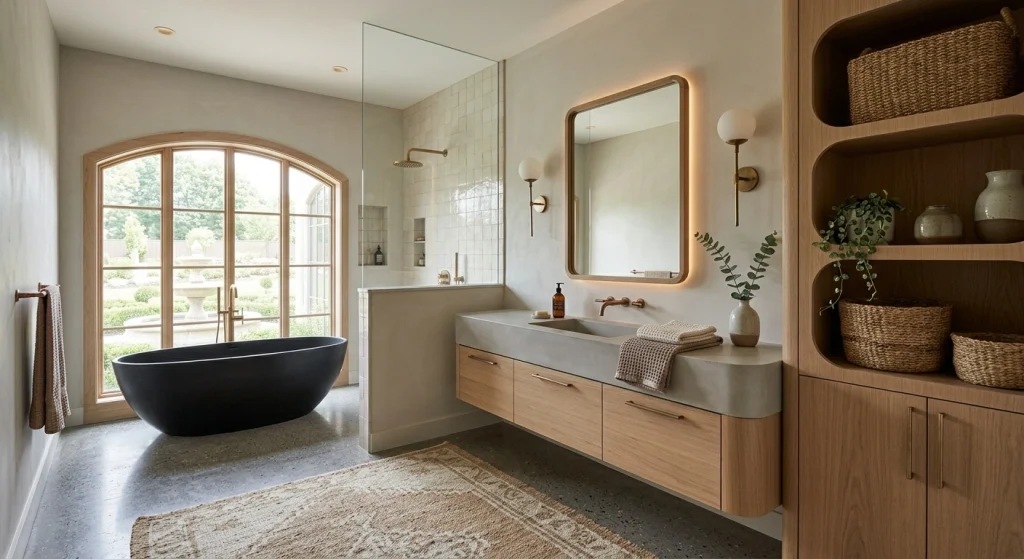
Modern Bathroom
Use:
- Clean lines
- Simple hardware
- Neutral colors
- Minimal accessories
- Large or simple mirrors
Add one warmer material, such as wood, to prevent the room from feeling too clinical.
Minimalist Bathroom
A minimalist bathroom works best when every visible item has a purpose. Use:
- Simple shapes
- Neutral or limited colors
- Clean-lined storage
- A simple mirror
- Minimal countertop decoration
Keep the room functional and avoid filling empty surfaces just because space is available.
Farmhouse Bathroom
Combine:
- Wood accents
- Soft white
- Black or aged metal
- Woven storage
- Simple vintage-inspired artwork
The goal is warmth rather than filling the room with rustic objects.
Coastal Bathroom
Try:
- Soft blue
- White
- Sandy beige
- Rattan
- Light wood
- Linen-like textiles
Keep nautical decorations limited if you want a more sophisticated coastal look.
Boho Bathroom
Boho style works well with:
- Plants
- Warm wood
- Woven baskets
- Patterned textiles
- Handmade-looking ceramics
Mixing several textures can create character without requiring much wall or floor space.
Spa-Inspired Bathroom
For a calmer atmosphere, use:
- Warm neutrals
- Soft lighting
- Plush towels
- Natural textures
- Simple greenery
- Minimal countertop decoration
A spa-inspired bathroom should feel uncluttered rather than filled with spa-themed objects.
Vintage Bathroom
Use a few vintage-inspired details rather than making everything look old.
Try:
- Decorative mirror
- Brass or aged-metal details
- Botanical artwork
- Patterned rug
- Small stool
- Traditional-style accessories
If you like this style, check out matching bedroom decor ideas and living room decor ideas to keep your whole home cohesive.
Budget-Friendly Bathroom Updates
You can refresh a bathroom at several different budget levels.
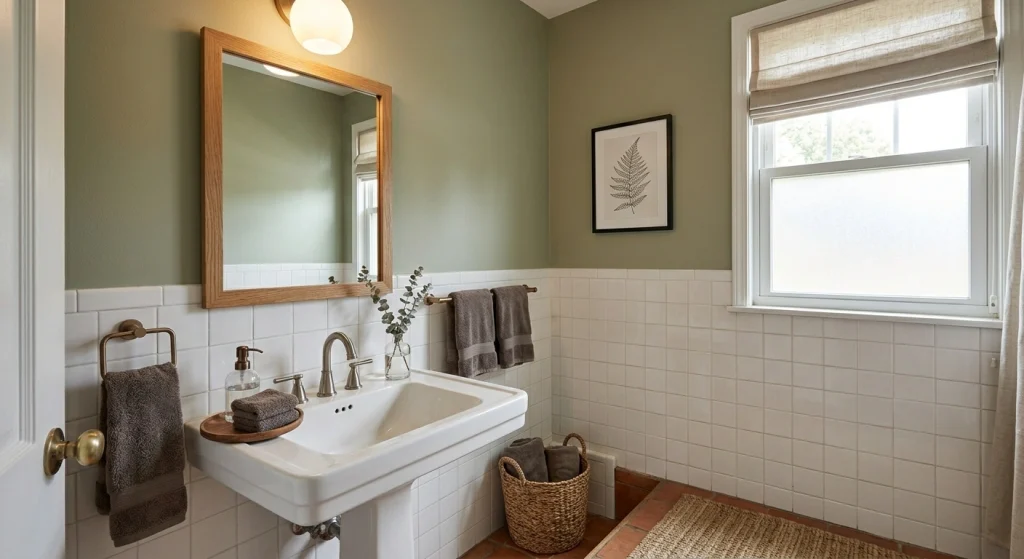
Low-Cost Changes
Start with:
- Towels
- Bath mat
- Shower curtain
- Small basket
- Tray
- Artwork
- Soap dispenser
- Faux or suitable live plant
These are easy to change later if your style evolves.
Mid-Range Changes
If you have more room in your budget, consider:
- New mirror
- Updated lighting
- Cabinet hardware
- Floating shelves
- Better storage
- Removable wallpaper
These changes can have more visual impact while still avoiding a full remodel.
Where to Spend More
If you have a larger budget, prioritize improvements that affect both daily use and long-term durability, such as:
- Quality lighting
- A well-made mirror
- Functional storage
- A durable vanity
- Water-efficient fixtures
The U.S. The Environmental Agency’s WaterSense program provides useful guidance when choosing water-efficient bathroom fixtures. For example, WaterSense-labeled showerheads use no more than 2.0 gallons of water per minute, while the federal maximum for standard showerheads is 2.5 gallons per minute.
If you are replacing a toilet, WaterSense-labeled models can also reduce water use compared with older, less efficient toilets.
How to Refresh a Bathroom Step by Step
If you want to make changes without getting overwhelmed, follow this order. The simplest order is: declutter first, solve the biggest problem, choose your color direction, make one high-impact change, then add texture and personality.
Step 1: Clear the Room
Remove unnecessary products, empty packaging, and decorative items you no longer like.
Do not buy storage until you know what actually needs storing.
Step 2: Identify the Biggest Problem
Choose one:
- Clutter
- Poor lighting
- Dated mirror
- Lack of color
- Lack of texture
- Not enough storage
- Empty walls
Start there.
Step 3: Choose Your Color Direction
Pick a simple palette that works with the permanent elements you are keeping.
If your tile is staying, make your towels, artwork, rug, and accessories work with it.
Step 4: Make One High-Impact Change
Choose a mirror, lighting fixture, wall treatment, vanity hardware, or another major visual element.
One strong change is usually more useful than several unrelated small purchases.
Step 5: Add Texture
Bring in two or three materials that soften the room without making the space feel busy.
For example:
Wood + woven material + soft cotton
Step 6: Organize the Functional Items
Use drawers, cabinets, baskets, hooks, and shelves to give everything a place.
Step 7: Add Personality
Finish with one or two details you genuinely like.
A plant, artwork, ceramic piece, or decorative tray can be enough.
Step 8: Stop Before It Feels Crowded
Step back and look at the room.
If every surface has something on it, remove a few pieces.
Good decorating is often as much about editing as adding.
Common Bathroom Decorating Mistakes
Adding Too Many Accessories
More decoration does not automatically make a bathroom feel more finished.
If the room already has plenty of visual detail, remove a few items before adding anything else.
Using Too Many Colors
A large number of competing colors can make a small bathroom feel busy.
Instead, repeat a few colors across different materials.
Ignoring Scale
Small artwork can disappear on a large wall, while oversized accessories can overwhelm a compact vanity.
Consider the size of the surrounding furniture and wall before choosing decor.
Buying Decor Before Measuring
A mirror, rug, shelf, or storage piece can look completely different once it is in the room. Measure the available wall and floor space before buying larger items, and check the product dimensions rather than relying on photos alone.
Making Everything Match
A bathroom does not need matching towels, baskets, hardware, containers, and accessories.
Use repeated colors or materials to create cohesion while allowing some variation.
Forgetting Moisture
Bathrooms have different moisture levels depending on ventilation and use.
Choose materials that can handle the environment, and avoid placing moisture-sensitive artwork, untreated wood, or unsuitable textiles where they will receive frequent water or steam.
Decorating Before Solving Storage
If toiletries have nowhere to go, decorative styling will not solve the underlying problem.
Create a practical storage system first, then decorate around it.
Small vs. Large Bathroom: What Changes?
The same decorating principles can work in both spaces, but the amount and scale of decor should change.
| Small Bathroom | Large Bathroom |
| Use vertical storage | Use larger storage pieces |
| Keep the floor visually open | Add a larger rug or runner |
| Choose fewer accessories | Use more layers where appropriate |
| Use a well-sized mirror | Consider a larger statement mirror |
| Keep patterns controlled | More room for bolder patterns |
| One main focal point often works best | Multiple related focal areas can work |
The key is scale, not simply size.
A large bathroom does not automatically need more decoration, and a small bathroom does not need to be completely minimalist.
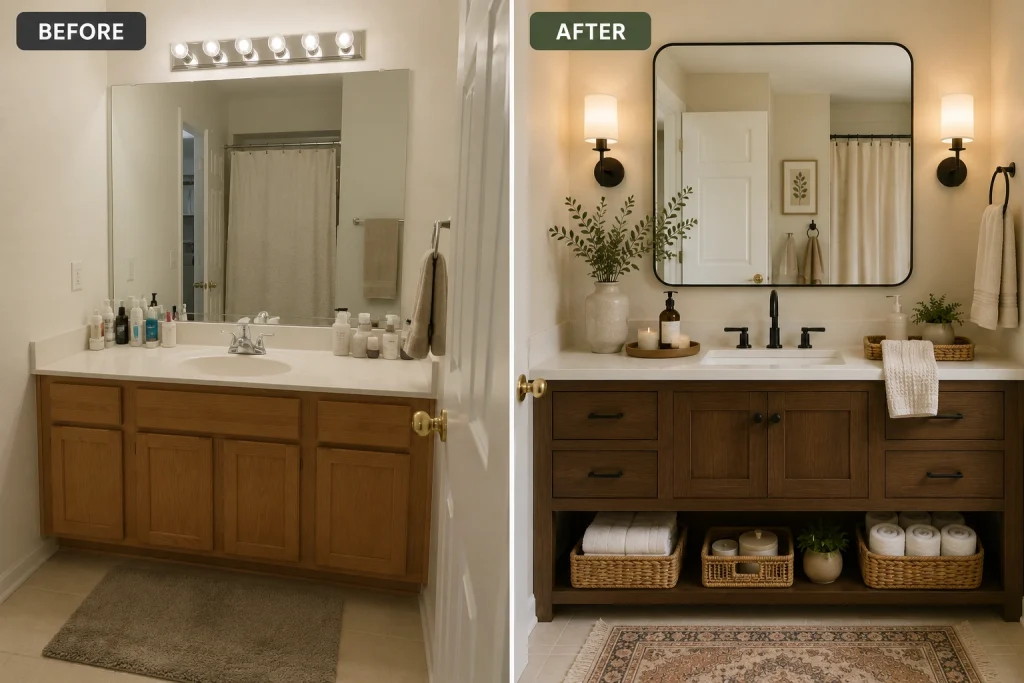
A Simple Before-and-After Example
Imagine a bathroom with white tile, a basic mirror, harsh ceiling lighting, a cluttered vanity, and little storage.
You could keep the tile and main fixtures and change only the supporting elements.
Before
- Plain mirror
- Cluttered counter
- One harsh light source
- Mismatched towels
- Empty wall
- No defined storage
After
- Larger framed mirror
- Improved vanity lighting
- One consistent towel color
- Woven storage basket
- Framed artwork
- Tray for daily essentials
The main structure of the bathroom stays the same, but the room becomes more cohesive, functional, and easier to maintain.
That is the main advantage of decorating instead of remodeling: you can change the atmosphere without changing the entire room.
Bathroom Decor Ideas FAQ
What is the easiest way to update a bathroom?
Start with the details that are easiest to see and replace: towels, a bath mat, mirror, lighting, shower curtain, artwork, and storage accessories. Clear clutter first so you can see which changes the room actually needs.
How can I make a small bathroom look bigger?
Keep the floor visually open, use vertical storage, choose appropriately scaled furniture, and use a well-sized mirror to reflect available light. Light colors can help, but good organization, lighting, and careful use of space are just as important.
How can I make my bathroom feel warmer?
Introduce warm neutrals and natural materials. Wood, woven baskets, soft towels, ceramic accessories, and warm lighting can soften bathrooms dominated by white tile, glass, or metal.
What are good bathroom decor ideas for renters?
Choose changes that can be removed or taken with you, such as towels, rugs, shower curtains, freestanding storage, artwork, plants, trays, and removable hooks. Before using adhesive products or removable wallpaper, check the manufacturer’s instructions and your rental agreement.
How do I decorate a bathroom counter?
Start by removing everything that does not need to stay there. Group a few useful items on a tray and add one decorative element, such as a small plant or ceramic piece. Keep personal products in drawers or cabinets whenever possible.
What colors work well in a bathroom?
Popular options include warm white, cream, beige, soft green, muted blue, taupe, and other subdued neutrals. The right choice depends on your existing tile, flooring, fixtures, natural light, and the atmosphere you want to create.
How can I make a bathroom look more expensive?
Focus on visual consistency rather than adding expensive accessories. A well-sized mirror, good lighting, coordinated textiles, simple hardware, natural textures, and an uncluttered counter can make the room look more polished.
Should bathroom decor match the rest of the house?
It does not have to match exactly. It usually works better when the bathroom shares one or two elements with nearby rooms, such as a color, wood tone, or metal finish.
Explore bedroom, living room, and kitchen decor ideas for more inspiration.
How much does it cost to refresh a bathroom?
There is no single price because the cost depends on what you change. Replacing towels and accessories can be relatively inexpensive, while a new mirror, lighting, vanity, or other larger updates can increase the budget considerably. Decide which change will make the biggest difference before setting your spending priorities.
What is the difference between bathroom decor and bathroom design?
Bathroom decor focuses mainly on styling elements such as color, textiles, artwork, accessories, and finishing details. Bathroom design covers broader decisions such as layout, fixtures, storage planning, lighting placement, materials, and how the room functions.
Are plants good bathroom decor?
They can be, provided the plant suits the bathroom’s available light and moisture conditions. Bathrooms with little natural light may not support many live plants, so a suitable faux plant can be a practical alternative.
Quick Summary
- Clear clutter first: Decoration works better when the room has a simple visual foundation.
- Start with high-impact changes: The mirror, lighting, textiles, and wall treatment can make a noticeable difference.
- Use texture: Wood, woven materials, cotton, linen, and ceramic can add warmth.
- Match your existing room: Let permanent fixtures guide your colors and materials.
- Adapt to the space: Small bathrooms need careful scale and storage; larger bathrooms can handle more visual layers.
- Keep function in mind: Storage, lighting, ventilation, and suitable materials matter just as much as appearance.
- Edit before adding: A few intentional pieces usually work better than a crowded collection of accessories.
Conclusion
You do not need a full bathroom renovation to refresh your space. The most effective bathroom decor ideas usually start with clutter, lighting, the mirror, storage, textiles, and a few well-chosen decorative details.
Start with what is bothering you most, then make one meaningful change before adding smaller details.
A new mirror can change the focal point. Better lighting can improve the atmosphere. Fresh textiles can introduce color and softness. Storage can remove clutter. Natural materials and a few personal touches can make the room feel finished.
The best bathroom decor is not about filling every empty space. It is about choosing details that make the room more functional, cohesive, comfortable, and personal. Ready to refresh more rooms? Browse our full room-by-room decor guide.
Join the Conversation
What Do You Think?