
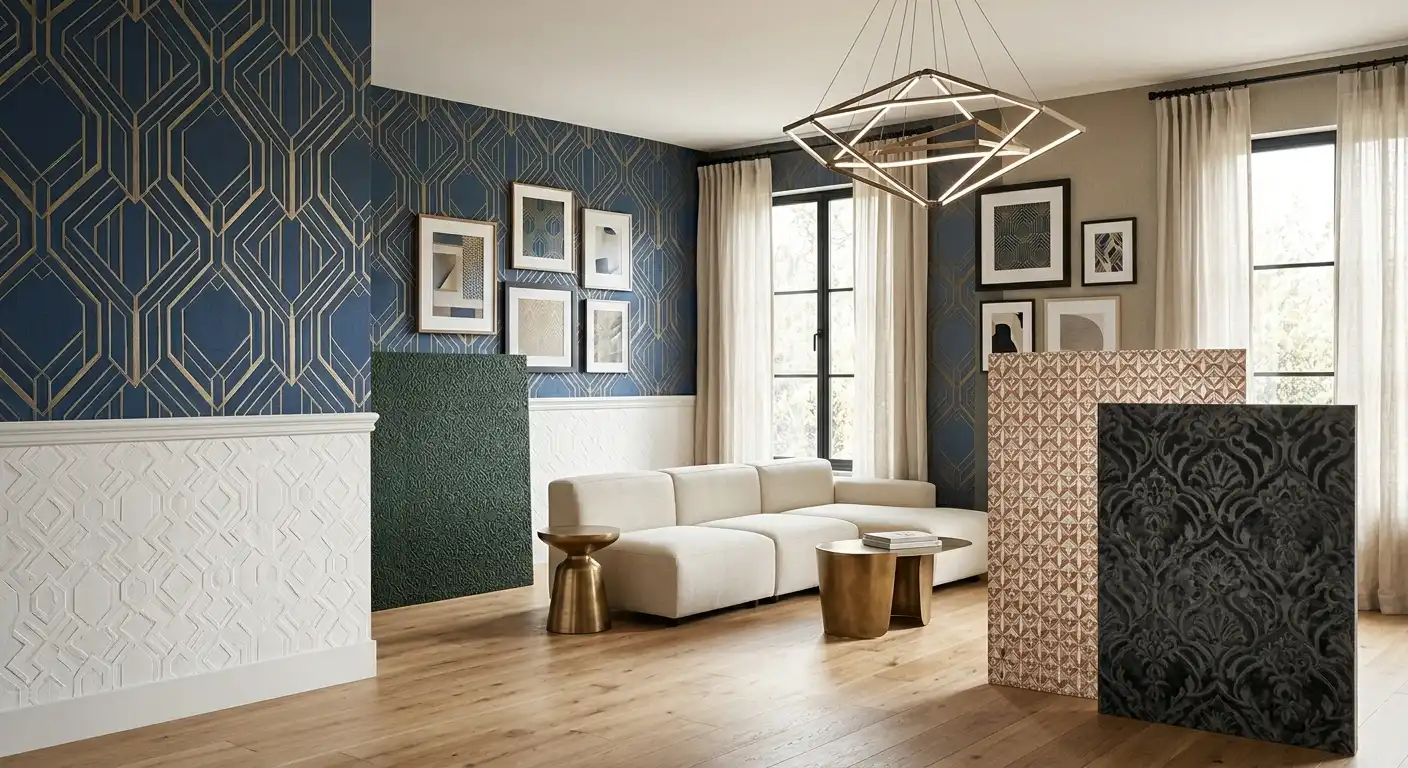
Wallpaper can change a living room faster than almost anything else you can do to it. One wall, and the whole room can read differently: warmer, calmer, more finished, more like you.
But the right wallpaper isn’t simply the prettiest pattern you find online. The wrong scale, contrast, color, or placement can make a room feel smaller or busier than it did with plain paint.
The best living room wallpaper depends on your room size, natural light, existing furniture, focal points, and how much visual impact you want. This guide covers six versatile wallpaper styles, where to put them, how to choose the right pattern and material, and the practical mistakes that can make an otherwise beautiful design feel wrong.
For furniture layout and styling ideas to pair with your new wall, our Living Room Decor hub is a good next stop.
Will Wallpaper Work in Your Living Room?
Yes. Wallpaper can work in almost any living room; the key is choosing the right pattern, scale, color, material, and placement.
A small, dim living room needs a different approach from a large, sunlit space. A rental has different practical limits from a home you’re planning to keep for years. And a room with a patterned rug and colorful furniture needs a different wallpaper from one with a simple neutral sofa.
The easiest way to think about wallpaper is not simply “What pattern do I like?” but:
“What does this wall need to do for the room?”
If the room feels flat, texture or depth may help. If it feels visually empty, a larger-scale pattern can give it structure. If the furniture already carries a lot of visual weight, a quieter wallpaper may create better balance.
That approach helps you choose wallpaper around your actual space rather than around a trend you happened to like online.
6 Living Room Wallpaper Ideas by Style
1. Botanical and Mural Wallpaper
Large-scale leaves, trees, garden scenes, and scenic murals can add depth to a flat wall while creating a strong focal point. A soft, blurred forest or garden scene can sometimes feel more like a view than a repeated pattern, which is why murals can work particularly well when a room needs visual depth.
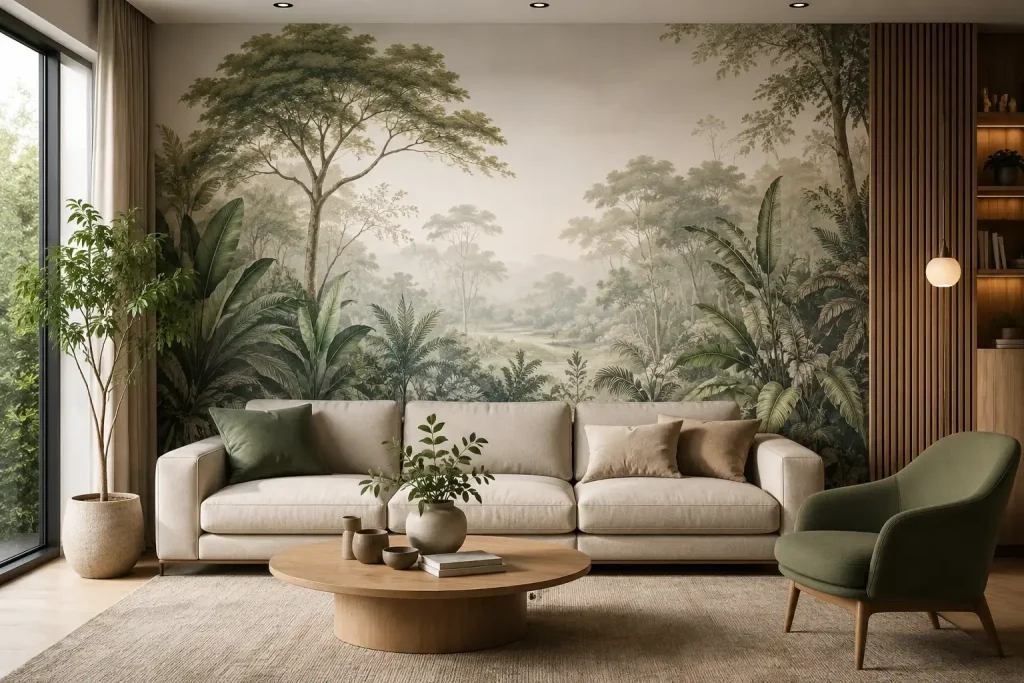
Best for: rooms with one clear focal wall, such as behind the sofa or TV, and enough natural or artificial light to show the detail.
A mural doesn’t automatically make a small room feel larger. The effect depends on the contrast, visual density, and amount of open space in the design. A softly layered scene can create depth, while a highly detailed, high-contrast mural may make the same room feel busier.
2. Textured and Grasscloth Wallpaper
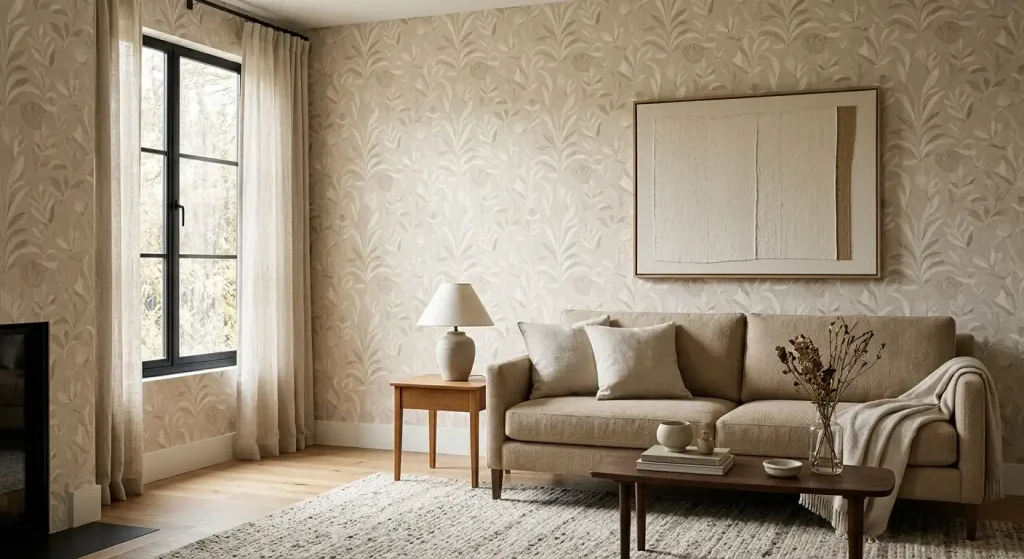
Grasscloth, linen-weave, and plaster-effect wallpapers add dimension without relying on a strong printed pattern. They are a useful middle ground when you want the warmth of wallpaper but don’t want the wall to become the main feature.
Texture can also help balance rooms containing many hard surfaces, such as leather seating, glass tables, metal accents, or glossy finishes.
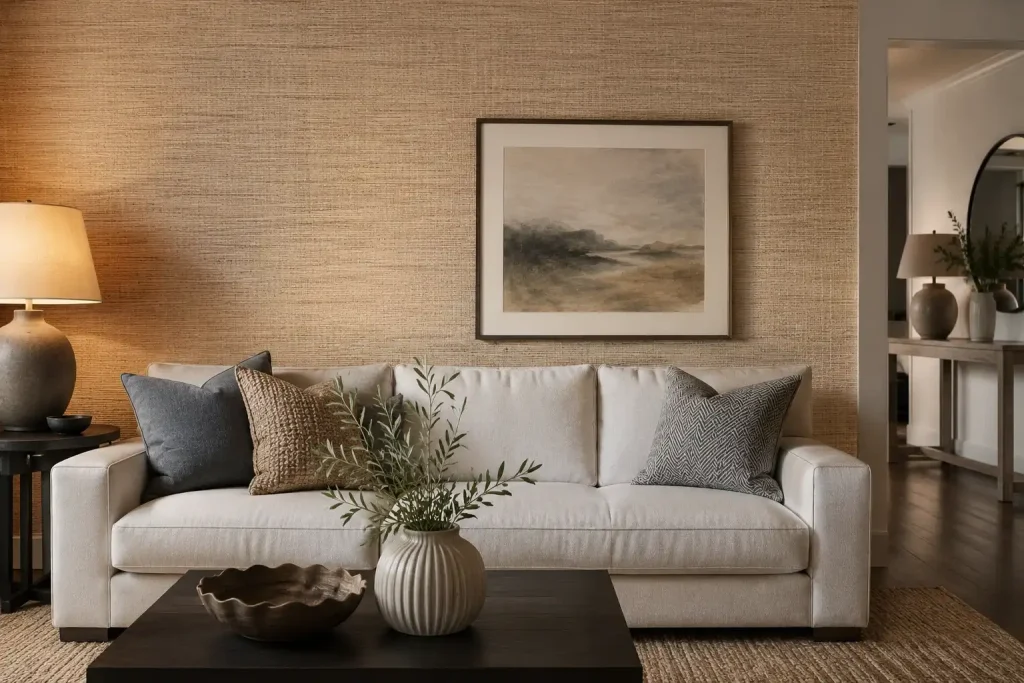
Best for: living rooms that need warmth and visual softness, especially when the furniture or artwork already provides enough pattern.
Natural-fiber wallpapers such as grasscloth can be more delicate than washable vinyl products, so think about where people, pets, or furniture are likely to come into contact with the wall before choosing one.
This Old House’s wallpaper materials guide is a helpful reference for comparing how vinyl and natural-fiber options hold up over time.
3. Warm Neutral and Earth-Tone Wallpaper
Clay, terracotta, warm beige, sand, and soft sage are popular choices for living rooms because they create a warm, grounded backdrop.
These colors can work particularly well when you’re keeping existing furniture. Instead of competing with the sofa, rug, or artwork, a restrained earth-tone wallpaper can connect those pieces through a shared color family.
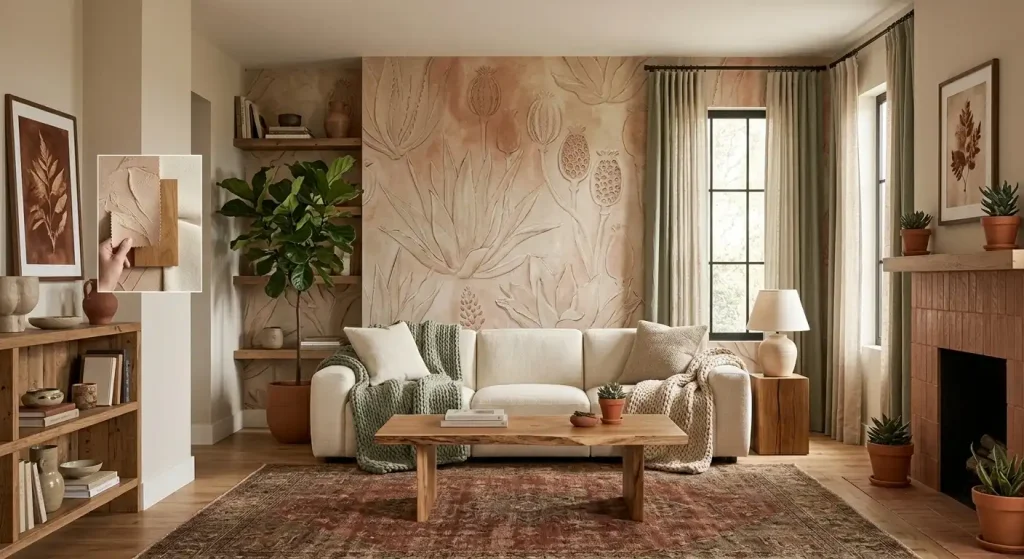
Best for: rooms with existing furniture, natural wood finishes, neutral upholstery, or anyone who wants wallpaper that feels distinctive without becoming the only thing you notice.
When choosing a neutral wallpaper, don’t match colors by name alone. A beige with a warm undertone can sit comfortably beside warm oak and cream, while a cooler beige may look disconnected from the same furniture.
4. Geometric and Abstract Wallpaper
Clean lines, soft arches, organic shapes, and watercolor-style abstract patterns can bring structure to a living room without making it feel overly themed.
Abstract wallpaper can be especially flexible because it can read more like artwork than a literal decorative motif. That makes it easier to pair with modern, transitional, or minimalist furniture — see Home Decor Styles if you’re still narrowing down which direction fits your room.
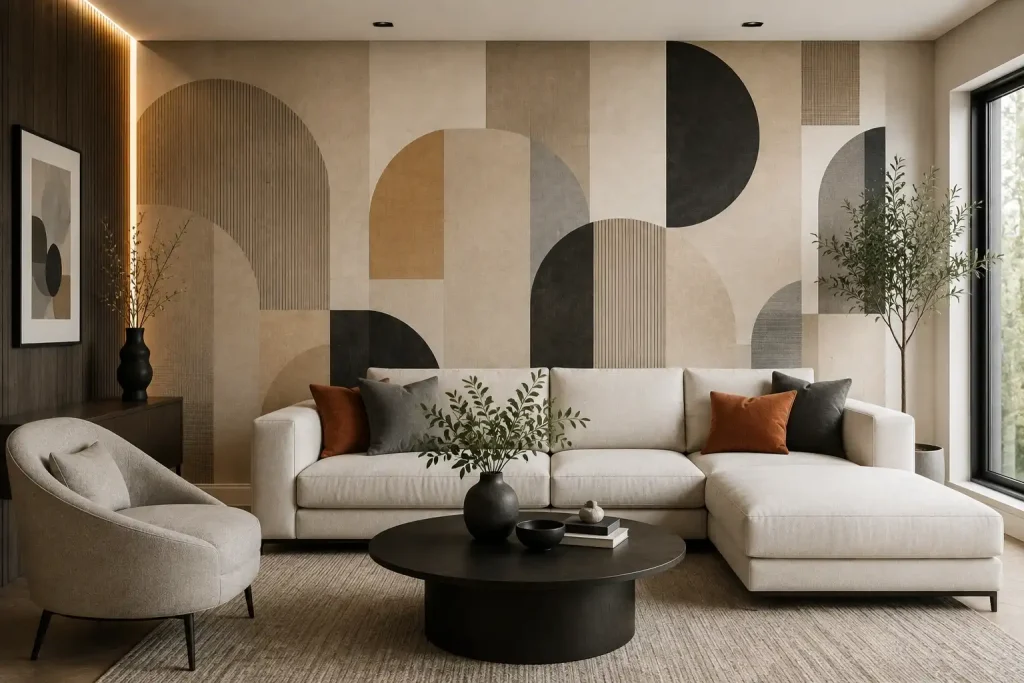
Best for: modern and transitional living rooms, particularly when you want a stronger feature wall without relying on florals or traditional motifs.
Pay attention to pattern density, not just pattern size. A large abstract design with plenty of negative space can feel calm, while a small, tightly repeated geometric pattern can feel much busier even if its colors are subtle.
5. Chinoiserie and Heritage Florals
Hand-painted-style florals featuring birds, branches, leaves, and detailed botanical elements can give a living room a traditional, layered character.
This style works naturally with classic furniture shapes, brass or wood details, framed artwork, and warmer lighting.
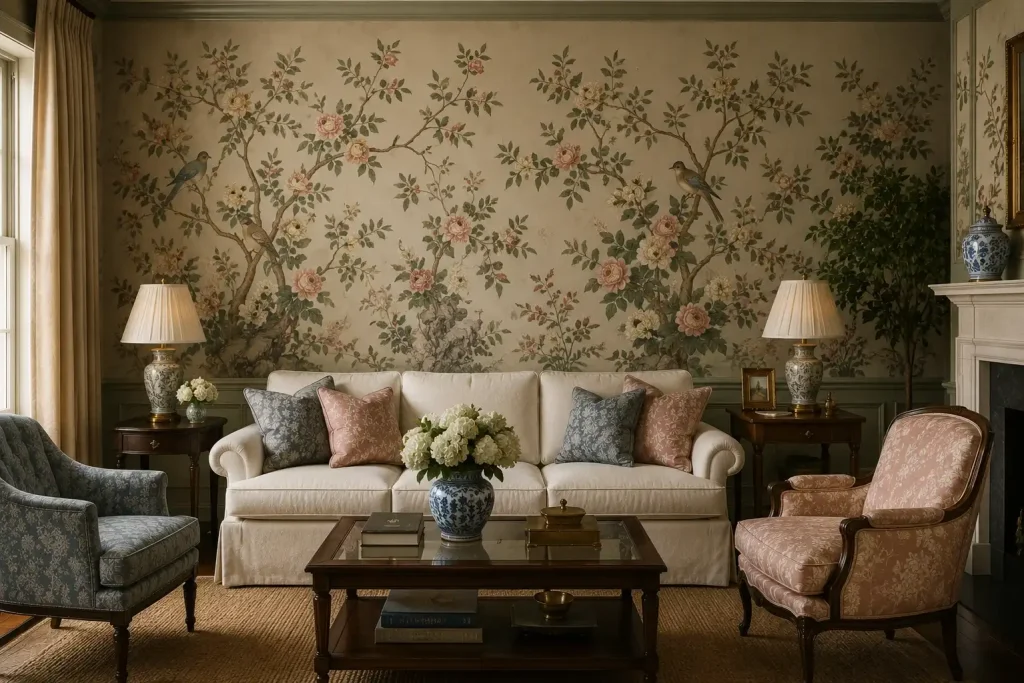
Best for: traditional or formal living rooms, especially when the wallpaper is intended to become the design centerpiece.
Because these patterns can contain a lot of detail, let the rest of the room support rather than compete with the wallpaper. Solid upholstery, restrained accessories, and repeated colors from the wallpaper can help the overall room feel intentional.
6. Stripes and Mixed Patterns
Vertical stripes can be both decorative and practical because their direction draws the eye upward. That makes them useful when you want to emphasize ceiling height.
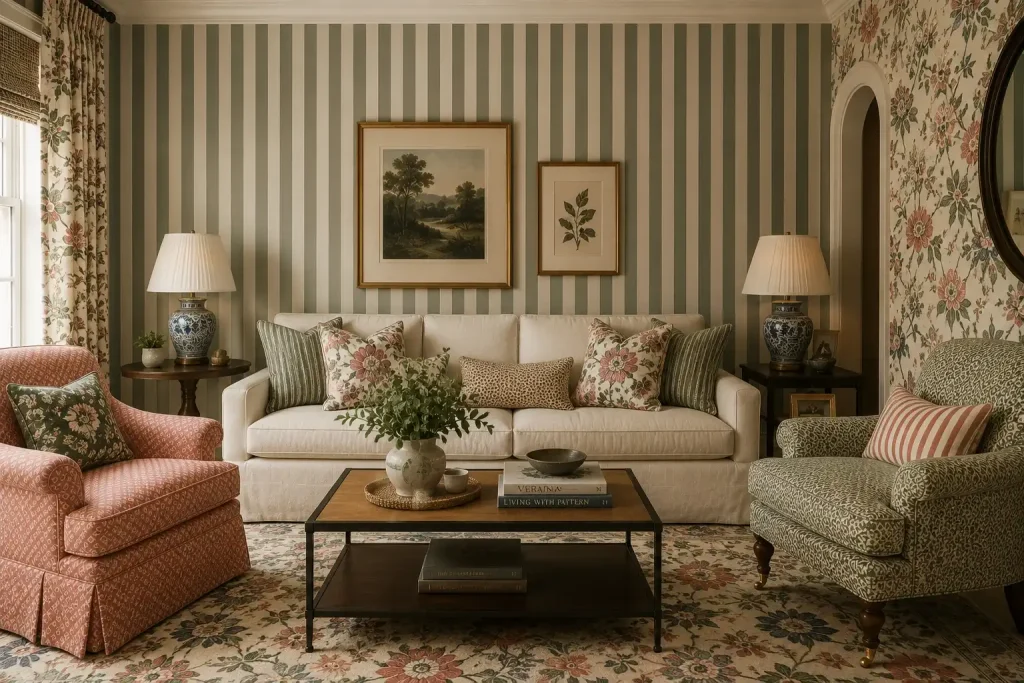
Mixed patterns can also work, but coordination matters more than simply choosing patterns you like individually. A stripe and floral, for example, are easier to combine when they share a color family or similar visual intensity.
Best for: rooms with lower ceilings and decorators who want to introduce patterns without making every wall equally dramatic.
The key is to give each pattern a role. If both the wallpaper and nearby furniture are bold, keep the remaining elements quieter so the room has places for the eye to rest.
Wallpaper Ideas by Room Condition
The best wallpaper isn’t determined by style alone. Your room’s physical characteristics should influence the choice too.
| If your living room is… | Consider… | Be careful with… |
| Small and dim | Light backgrounds, low contrast, subtle texture | Dark, high-contrast patterns across every wall |
| Small and bright | Soft murals, restrained geometrics, lighter patterns | Very dense repeats that make the room feel busy |
| Large and bright | Large murals, botanical designs, bold repeats | Tiny motifs that disappear at viewing distance |
| Narrow | Vertical patterns or vertically oriented motifs | Strong horizontal bands if you don’t want to emphasize width |
| Furniture-heavy | Textured or quieter wallpaper | Multiple competing bold patterns |
| Minimal | Geometric, abstract, botanical, or mural designs | Adding so many accessories that the wall loses its purpose |
| Open-plan | One wallpapered wall to define the living zone | Different bold patterns in every zone |
| Rental | Removable or peel-and-stick products where appropriate | Products without clear removal instructions |
This is why two rooms of the same size can need completely different wallpaper. Room conditions change how a pattern is perceived.
Where to Put Wallpaper in a Living Room
You don’t have to wallpaper the whole room. For many homeowners, one feature wall is an easier starting point, while full-room wallpaper can create a more immersive look when the pattern and room scale support it.
| Placement | Best For | What It Does |
| Accent wall behind the sofa | Most living rooms | Creates a focal point without overwhelming the room |
| Fireplace wall | Rooms where the fireplace is already the focal point | Reinforces an existing architectural feature |
| Behind built-in shelving | Bookcases, media units, and display walls | Adds depth without taking up additional floor space |
| TV wall | Media-focused living rooms | Gives the screen a designed backdrop and can reduce the feeling of an empty wall |
| Ceiling (“fifth wall”) | Plain, low-detail ceilings | Adds unexpected visual interest |
| Full room | Larger rooms or quieter patterns | Creates an immersive and cohesive effect |
If you’re unsure, start with the wall that already attracts attention.
A fireplace, large window arrangement, built-in shelving, or sofa wall can often provide a natural focal point. Wallpaper usually works better when it reinforces the room’s visual hierarchy rather than creating a completely unrelated focal point.
How to Choose the Right Wallpaper for Your Room
1. Match the Pattern Scale to the Room Size
Room size and pattern scale are connected, but bigger doesn’t automatically mean better.
A large-scale mural in a small room can either create a sense of depth or overwhelm the space. The difference often comes down to contrast, density, and how much visual breathing room the pattern has.
A useful starting point is:
- Small room, low light: pale backgrounds, subtle patterns, soft texture, or controlled vertical movement.
- Medium room: mid-scale patterns usually provide enough detail without dominating the space.
- Large room with good natural light: larger motifs, murals, and bolder repeats have more room to breathe.
Also consider viewing distance. A pattern that looks beautiful from six inches away on a sample may look completely different when viewed from across the room.
2. Understand Pattern Scale vs. Pattern Density
These two things are easy to confuse.
Pattern scale refers to how large the individual motif is.
Pattern density refers to how much of the wall is visually occupied by the pattern.
For example:
- Large motif + low contrast + plenty of negative space = can feel calm.
- Small motif + high contrast + tight repetition = can feel busy.
- Large motif + high contrast + multiple colors = strong visual statement.
- Small motif + low contrast = often more understated.
This matters because simply choosing a “large pattern for a small room” or a “small pattern for a large room” is too simplistic. The amount of visual activity matters just as much as the size of the motif.
3. Think About Your Light Before Your Color
Natural light changes how wallpaper actually looks on your wall.
A warm beige that looks soft in a bright showroom can appear flatter or cooler in a room with limited natural light. The same wallpaper may also look different in morning daylight compared with evening lamp light.
Before buying, place a real sample on the wall and view it at different times of day.
If the room is dim, consider how the wallpaper works with your artificial lighting as well as daylight. Warm lamps can change the appearance of colors and textures after sunset.
4. Match Undertones, Not Just Colors
Wallpaper doesn’t exist in isolation. It needs to work with the undertones already present in your living room.
Look at:
- sofa upholstery
- flooring
- wood finishes
- curtains
- rugs
- artwork
- metal accents
For example, warm beige wallpaper can work naturally with warm oak and cream upholstery. A cooler gray-beige may create a different relationship with the same furniture.
The goal isn’t necessarily to find an identical color. Repeating or complementing an existing undertone is often enough to make different materials feel connected.
5. Decide Whether You’re Designing Around the Wallpaper or Around Existing Furniture
There are two very different ways to approach a wallpaper project.
If the wallpaper comes first:
You can use its colors to guide the sofa, rug, cushions, curtains, and artwork.
If your furniture already exists:
The wallpaper needs to join an established visual system.
In an existing room, look for one or two colors, tones, or materials that the wallpaper can relate to.
A useful DecorHubs rule is:
Wallpaper should either repeat something already in the room or intentionally become the room’s dominant visual element.
The awkward middle ground is when both the furniture and wallpaper are trying to be the main attraction.
6. Factor In Real-Life Wear
Living rooms can experience daily traffic, pets, children, furniture movement, and frequent cleaning, so durability matters.
Vinyl and vinyl-coated wallpapers are often more practical for areas that need regular cleaning or experience more contact. Delicate natural-fiber wallpapers such as grasscloth can mark or fray more easily and are better suited to lower-contact walls.
If your living room has pets, young children, or a high-traffic layout, consider where people are most likely to touch or bump the wall before choosing a delicate finish.
The DecorHubs Wallpaper Match Test
Before choosing a wallpaper, check these five things:
| Room Factor | Ask Yourself | It Influences |
| Light | Is the room bright, balanced, or dim? | Color and contrast |
| Scale | Is the room compact, average, or spacious? | Pattern size and density |
| Focal Point | Where does the eye naturally go? | Wallpaper placement |
| Furniture Load | Are the sofa, rug, and artwork visually busy? | Pattern complexity |
| Commitment | Is this a temporary update or a long-term choice? | Material and design |
If several elements are already visually strong, quieter wallpaper will usually create better balance.
If the room is simple and lacks a clear focal point, wallpaper can carry more of the design.
The goal isn’t to follow a rigid formula. It’s to understand why a wallpaper works in one room but not another.
Using Wallpaper to Define an Open-Plan Living Room
In an open-plan home, wallpaper can help visually define the living area without adding a physical wall.
Applying wallpaper to the main living-room focal wall can create a clear zone while allowing the kitchen and dining areas to remain visually lighter.
The important part is connection.
The living room doesn’t need to use the same wallpaper elsewhere, but its colors, materials, or undertones should relate to the surrounding spaces.
For example, a sage-and-cream wallpaper can connect naturally with warm wood, neutral upholstery, and simple greenery throughout an open-plan space.
Should You Wallpaper Behind the TV?
Yes, but choose the pattern with the screen in mind.
A TV is already a strong visual rectangle, especially when it is switched off. A wallpaper with moderate texture or visual variation can help integrate the screen into the wall rather than leaving it floating against a completely empty background.
Before installing, consider:
- Is the TV already the room’s dominant focal point?
- Will the pattern create distracting lines behind the screen?
- Does the wallpaper have enough visual variation to balance the dark screen?
- Are power and cable routes already planned?
- Is the TV wall also being used for shelves or artwork?
If the TV is large and centered on the wall, extremely high-contrast wallpaper can sometimes compete with the screen rather than complement it.
Step-by-Step: Planning and Applying Living Room Wallpaper
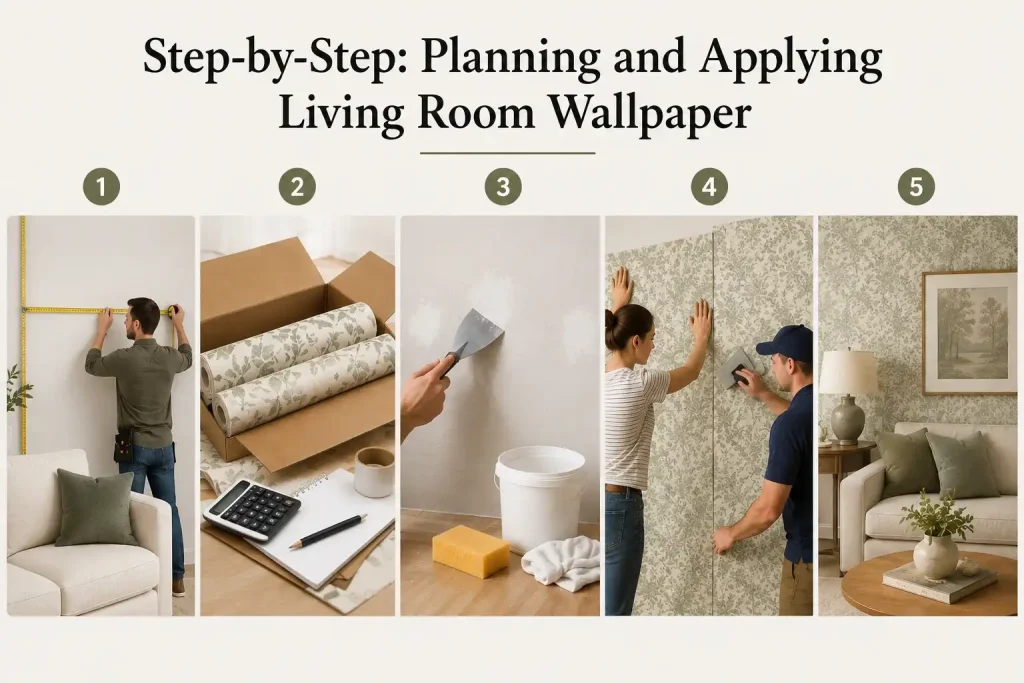
1. Measure the Full Wall
Measure the full height and width of each wall. For most wallpaper projects, it is safer to calculate material from the full wall dimensions rather than subtracting every window, door, or outlet.
Follow the manufacturer’s measurement guidance for the specific product.
2. Order Enough Extra Material
Allow for pattern matching, trimming, installation waste, and future repairs.
The amount of extra material depends on the wallpaper’s pattern repeat, panel or roll format, wall dimensions, and installation method. Follow the manufacturer’s coverage recommendation or ask your installer rather than relying on one universal percentage.
3. Prep the Wall Properly
Fill holes, smooth uneven areas, clean the surface, and use the appropriate primer where required.
Surface preparation matters because wallpaper can highlight imperfections that were barely noticeable on a painted wall. Poor preparation can also contribute to adhesion problems.
4. Decide: DIY or Professional?
Peel-and-stick wallpaper and straightforward accent walls can be reasonable DIY projects for people comfortable with careful measuring and alignment.
Large murals, full-room installations, complicated pattern matching, and delicate natural-fiber papers are often worth professional installation because mistakes can be difficult to correct without replacing material.
5. Live With a Sample First
Tape or temporarily position a sample on the wall and leave it there for several days.
Look at it:
- in morning daylight
- in afternoon light
- under evening lamps
- beside your sofa
- beside your flooring
- next to your existing artwork
A wallpaper sample tells you much more when it is viewed in the actual room rather than on a screen.
Common Living Room Wallpaper Mistakes
- Choosing a pattern without considering density. A large motif isn’t automatically overwhelming, and a small repeat isn’t automatically subtle.
- Wallpapering every wall in a small, dark room. Full-room wallpaper can work, but a dark, high-contrast pattern may make a dim space feel more enclosed.
- Skipping the light test. Wallpaper colors can change noticeably under different daylight and artificial lighting conditions.
- Matching colors without checking undertones. Two colors can look similar on a screen but feel disconnected when their undertones clash.
- Mixing multiple bold patterns without a shared visual connection. Pattern mixing works better when colors, scale, or visual intensity have some relationship.
- Using delicate natural-fiber wallpaper in high-touch areas. Grasscloth and similar materials need more careful placement and maintenance.
- Ignoring the existing focal point. Wallpaper is usually more effective when it supports the room’s natural visual hierarchy rather than competing with it.
- Not ordering enough material for pattern matching. Running short during installation can create unnecessary delays and mismatched replacement panels or rolls.
Wallpaper Types Compared
| Type | Feel | Durability | Renter-Friendly | Best Use |
| Vinyl / vinyl-coated | Smooth, printed pattern | Often high; many versions are washable | Usually no for traditional paste products | High-traffic feature walls |
| Grasscloth / natural fiber | Woven, textured | Moderate; can mark or fray | Usually no | Low-contact feature walls |
| Mural panels | Scenic, large-scale image | Varies by material | Sometimes | Single focal wall |
| Peel-and-stick | Smooth or textured | Moderate; product-dependent | Often yes | Rentals and low-commitment updates |
Always check the manufacturer’s cleaning, installation, removal, and durability instructions because products within the same category can behave differently.
Quick Wallpaper Decision Guide
If you’re still unsure, start here:
Want the room to feel warmer?
→ Consider textured wallpaper or warm neutral tones.
Want more visual depth?
→ Consider a softly layered mural or botanical design.
Want the ceiling to feel taller?
→ Consider vertical stripes or vertically oriented motifs.
Already have a patterned rug and furniture?
→ Consider a quieter texture or lower-contrast wallpaper.
Have simple furniture and an empty focal wall?
→ A stronger geometric, botanical, or mural design can carry more visual weight.
Have an open-plan living area?
→ Use one wallpapered wall to visually define the living zone.
Renting?
→ Look for a removable product with clear installation and removal guidance.
Not sure you can commit?
→ Start with one feature wall and test a real sample first.
Frequently Asked Questions
Does wallpaper make a small living room look smaller?
Not necessarily. Light colors, subtle patterns, and low contrast can make a small room feel more open, while dark, busy patterns can make it feel enclosed.
What wallpaper is best for a small living room?
Choose light backgrounds, subtle textures, low contrast, or patterns with enough negative space. Soft murals can also add depth.
What color wallpaper makes a living room look bigger?
Lighter colors and low-contrast patterns generally create a more open feel. Natural light, pattern density, and placement also matter.
Should I match the wallpaper to my sofa?
Not exactly. Match compatible undertones or connect the wallpaper with colors from your sofa, rug, flooring, or artwork.
Is one accent wall enough, or should I wallpaper the whole room?
One accent wall is a simple starting point. Full-room wallpaper can work when the pattern and room size support it.
Is peel-and-stick wallpaper good for a living room?
Yes, especially for renters or temporary updates. Check the product’s adhesion and removal instructions before installation.
How long does living room wallpaper typically last?
It can last for many years, depending on the material, installation, room conditions, and maintenance.
Can I put wallpaper behind a TV?
Yes. Choose a pattern that complements the screen without creating too much visual distraction, and plan cable management before installation.
Key Takeaways
- Choose wallpaper based on room size, light, furniture, focal points, and visual density, not just the pattern you like in a photograph.
- Start with the question “What does this wall need to do for the room?” before choosing a style.
- Pattern scale and pattern density are different; a large pattern can be calm, while a small repeat can be visually busy.
- Match wallpaper with your room’s undertones, not just its obvious colors.
- If your furniture already exists, choose wallpaper that supports the room’s established visual system rather than competing with it.
- Use wallpaper to reinforce a natural focal point or define an open-plan zone.
- Match the material to real-life use: more durable products for higher-contact areas and delicate textures for lower-contact walls.
- Always test a real sample in your room and check it under different lighting before committing.
Related Next Steps
- Explore Living Room Decor for furniture layout, styling, and color-pairing ideas that work with your new wallpaper.
- Planning a complete room refresh? See Home Decor Styles to make sure your wallpaper fits the overall design direction.
- Working with a small space? Pair your wallpaper choice with small-space decorating ideas to keep scale and proportion balanced.
- Planning around a budget? Use decorating-on-a-budget ideas to decide where wallpaper fits into the rest of your room update.
Sources and References
- This Old House, “All About Wallpaper and How You Can Use It to Liven a Home” — used for material and durability comparisons between vinyl and natural-fiber wallpaper.
- This Old House, “How to Hang Wallpaper in 8 Steps” — used for wall prep and installation guidance.
- SFGate Home Guides, “How to Choose the Scale of Wallpaper for a Small Room” — used for pattern scale guidance in small rooms.

Join the Conversation
What Do You Think?